
Quick answer
- Weak at every tank-fed tap, normal at the direct-supply tap: the tank or its outlet. Sludge, a choked strainer or a low water level are the usual causes.
- Weak at one tap only: a blocked aerator, a scaled-up mixer or a half-closed valve on that line. Not the tank.
- Spitting and bursts of air: an airlock. Bleed it from the highest tap.
- Tank keeps running low: a stuck float valve, a weak pump or a blocked foot valve in the sump.
- Weak everywhere, including the direct line: supply pressure, the pump or the main pipe. A plumber’s job.
Do the 10-minute check below before buying a booster pump. A bigger pump will not push water through a blocked outlet.
Weak flow from a tank-fed line? Clear the outlet
Pressure restored at the outlet: an overhead tank from a fixed ₹699, a sump from ₹1,499. Sludge cleared from around the outlet, and you pay once the before and after photos are in.
Most Gurgaon homes do not get their tap pressure from the city line. Water is stored in an overhead tank and falls to the taps by gravity, so the pressure you feel depends on two things: how high the water sits above the tap, and how freely it can leave the tank and travel down the pipe. A dirty tank attacks the second of those quietly, over months. Gurgaon’s hard groundwater and tanker silt make it happen faster here than in many cities. In newer tanker-fed sectors such as Sector 84, our crews often find the outlet socket half buried in fine tanker silt. We wrote about how sediment lowers pressure in Delhi homes earlier; this guide is built around a floor-by-floor test you can run yourself, and around the pump-and-pipe faults that look like tank problems. For a weak-flow check on site, our Gurgaon water tank cleaning crew will show you where the restriction is.
How a tank chokes your water pressure
The outlet of a rooftop tank is usually a pipe fitted a few centimetres above the floor, sometimes with a small strainer on it. Everything that settles in the tank settles around that opening. These are five common tank-side causes:
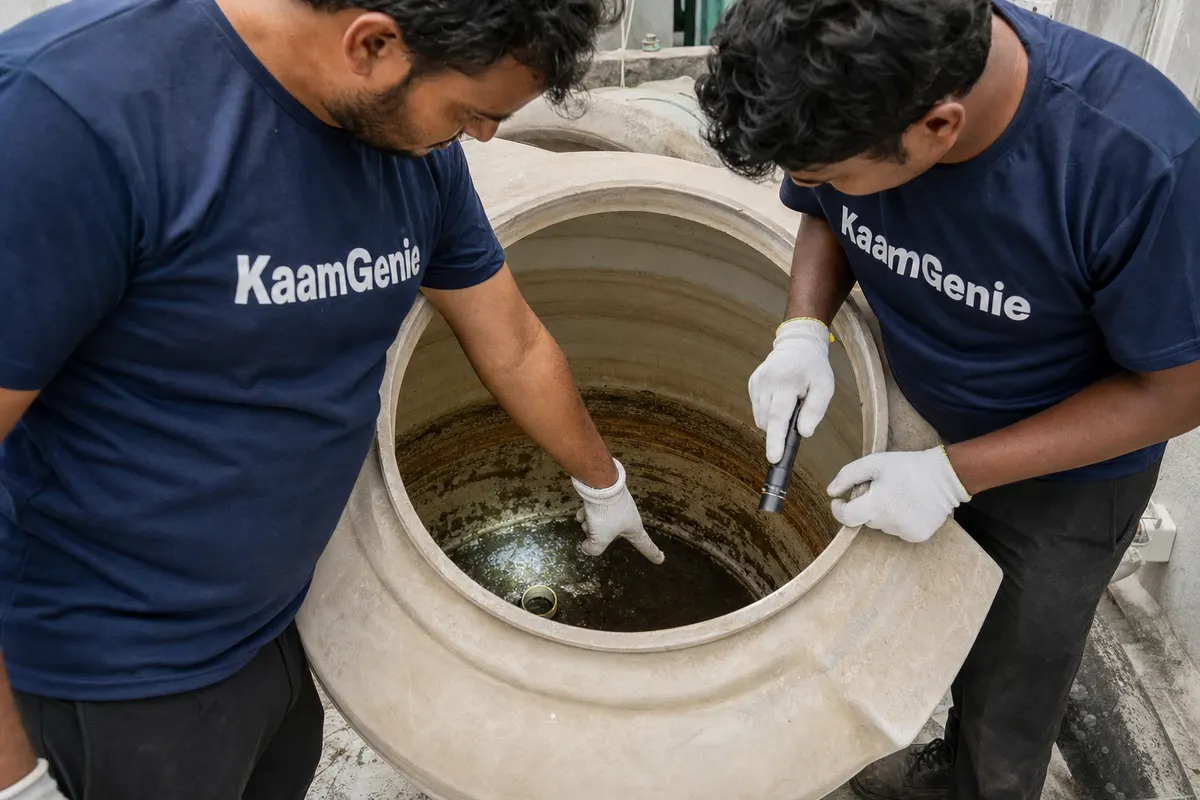
- Sludge over the outlet. Silt from tankers and supply restarts (see the muddy-water post above for keeping restart silt out), rust flakes and organic matter build a soft layer on the floor. Once it reaches the outlet, the pipe draws a thick mix of water and silt, and flow falls off.
- A clogged outlet strainer. Many plastic tanks have a mesh or slotted strainer on the outlet. It does its job, catching debris, until it is coated and water can only seep through.
- Scale inside the outlet fitting. Hard water leaves white or grey mineral crust on every surface, including the inside of the outlet socket and the first bend of the pipe. Our guide to hard-water scale in Gurgaon tanks explains why it builds so quickly here.
- A tank that never fills. If the float valve is stuck, or the inlet is partly blocked with scale, the tank stays half full. Less water above the tap means less pressure, and the top floor suffers first.
- An airlock in the outlet line. When a tank runs dry, a trapped air bubble at a high bend can block the flow almost entirely. How to bleed it, top floor down, is in our post on muddy water after supply is restored, since airlocks usually follow an outage.
In homes with an underground sump, there is one more: the foot valve at the end of the pump’s suction pipe. It sits near the sump floor with a strainer around it, and when sludge builds up, the strainer clogs, the pump struggles, and the overhead tank fills slowly or not at all.
The 10-minute floor-by-floor pressure check
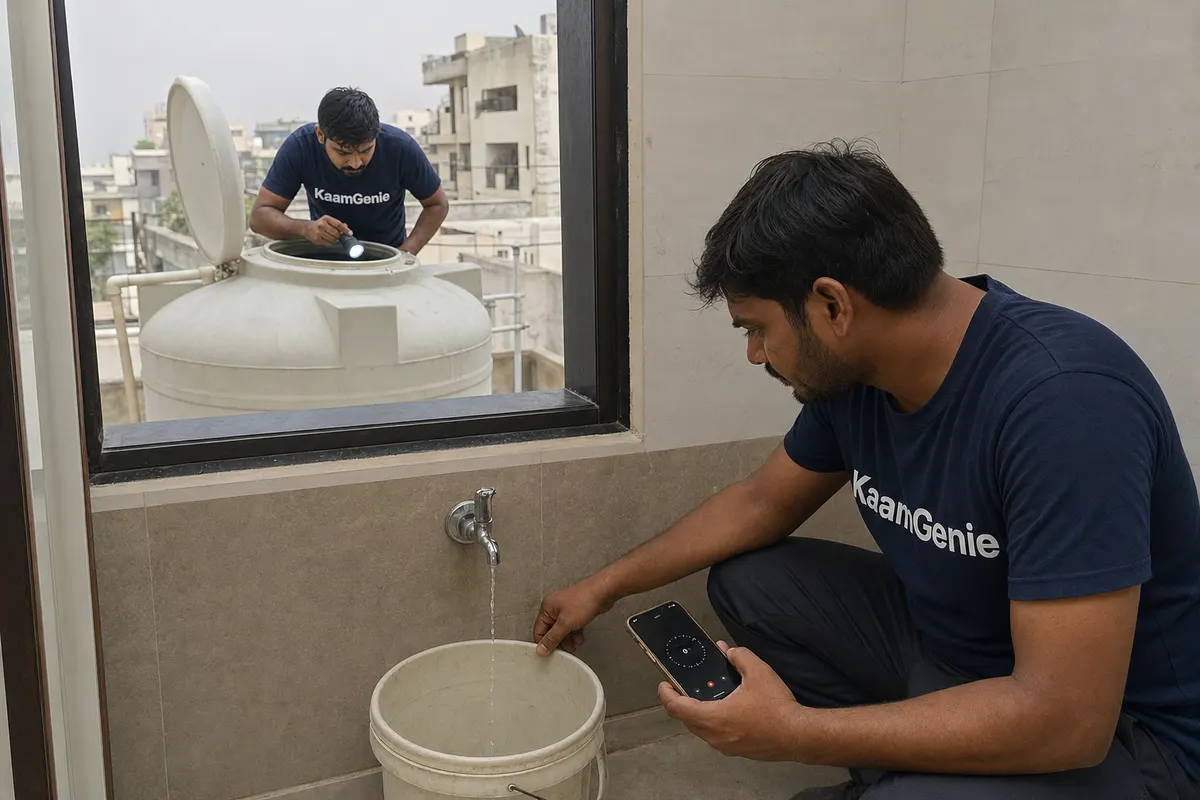
You need a 10-litre bucket, a phone stopwatch, a torch and someone to help. Do it at a quiet time when nobody else is using water and the pump is off. Write every number down.
- Look in the tank first (2 minutes). Open the lid and shine a torch inside. Note roughly how full it is and whether you can see a brown or grey layer on the floor, especially around the outlet. If the tank is less than half full, top it up before testing.
- Time a bucket at the direct-supply tap (1 minute). Most builder floors and kothis have one tap, usually outside or in the ground-floor kitchen, that runs straight off the GMDA line or the pump. Open it fully and time how long the bucket takes to fill. This is your baseline for the supply itself.
- Time a bucket on each floor (4 minutes). Use a tank-fed tap on each floor, ideally the same kind of tap, opened fully. Start with the top floor and work down. Note each time.
- Compare two taps on the same floor (1 minute). If the bathroom tap is slow but the kitchen tap next to it is fine, the problem is in that branch or that tap, not the tank.
- Unscrew the aerator of the slowest tap (1 minute). Run it without the mesh tip. If the flow jumps, the aerator was blocked with grit or scale.
- Listen and watch (1 minute). Spitting, gurgling or bursts of air point to an airlock. Cloudy water at the start of the slowest tap points to sludge being drawn from the tank floor.
You are not looking for a “correct” fill time; every house is different. You are looking for the pattern. Gravity means lower floors should fill a little faster than upper floors. What should worry you is a sharp drop that affects every tank-fed tap at once, or water that arrives cloudy.
Reading your results
| Pattern | Most likely cause | Tank job or plumber job |
|---|---|---|
| All tank-fed taps slow, direct tap fine, sludge visible near the outlet | Sludge or a clogged strainer at the tank outlet | Tank job: clean the tank and the outlet area |
| All tank-fed taps slow, tank only half full | Stuck float valve, slow pump or blocked foot valve | Both: clean the sump, then a plumber for the valve or pump |
| Taps spit air, then flow improves | Airlock after the tank ran dry | Bleed it yourself; plumber if it keeps coming back |
| One tap slow, others on the same floor fine | Blocked aerator, scaled mixer cartridge or half-closed valve | DIY clean, or a plumber for the cartridge |
| Top floor much weaker than lower floors, tank full and clean | Not enough height between tank and top-floor taps | Plumber: a small pressure pump on that floor’s line |
| Direct tap slow too | Low supply pressure, failing pump or a choked main pipe | Plumber, or the society maintenance team |
Pump and pipe causes that look like a tank problem
Not every pressure problem starts in the tank, and it is worth knowing the common ones so you do not pay for a cleaning that will not help. If your direct tap is also slow, or the tank is clean and full, look at these:
- Scaled-up GI pipes. Many houses in the older sectors still have galvanised iron pipes. Over decades, rust and mineral scale narrow their bore from the inside until a pipe carries a fraction of its original flow. No cleaning of the tank changes that; the pipe needs replacing with CPVC or PPR. In older plotted sectors such as Sector 4, our crews regularly see rusty GI outlet fittings still in service on rooftop tanks.
- A worn pump. A motor that takes far longer than it used to to fill the tank may have a worn impeller, or it may be sucking air through a leaking joint on the suction side.
- A half-closed gate valve. Someone closed the valve on the outlet or a branch line during a repair and never opened it fully. Check every valve between the tank and the taps.
- A failing pressure pump or its switch. Booster pumps in flats and duplexes switch on and off with a pressure switch. If it cycles constantly or does not start, the fault is in the pump set.
- Society pressure settings. In some towers, pressure-reducing valves on each floor limit the flow. That is a matter for the maintenance team.
- A hidden leak. A leak inside a wall or under the floor can steal both water and pressure. Damp patches, a water bill that does not add up, or a tank that empties overnight with no one using it are clues.
A good test before calling anyone: if the tank is clean, full and its outlet is clear, but the taps are still weak, the problem lies downstream of the tank.
Send us your bucket times
WhatsApp us the fill times from each floor and a photo inside the tank. We will tell you honestly whether it is the tank or a plumber job.
Shared roofs: when only your floor is weak
In a builder floor, each floor often has its own tank on a shared roof, fed by one supply. It is common for one floor’s tank to be choked while the next floor’s is fine, so a neighbour’s good pressure proves nothing about yours. Check which tank actually feeds your flat before anyone opens a lid; pipes on old roofs are often rerouted during repairs. Our guide to builder floor tank cleaning in Gurgaon covers shared roofs and separate tanks, and the complete guide to water tank cleaning in Gurgaon covers other building types.
How KaamGenie restores flow from a dirty tank
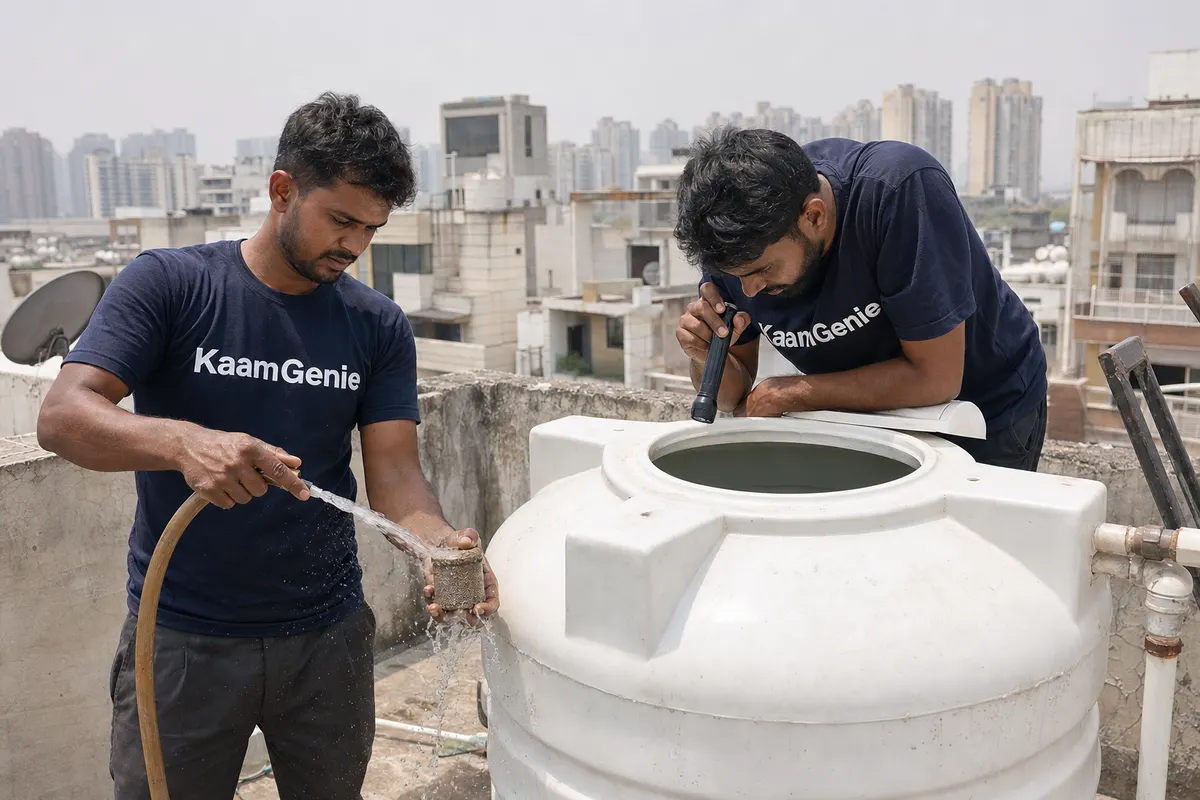
The full cleaning sequence is in the Gurgaon cleaning process guide. When the problem is pressure, the visit is focused on the outlet end of the tank:
- Outlet closed before draining. With the inlet shut and the outlet valve to the house closed, loosened sludge cannot be pushed down into your pipes, which would only move the blockage somewhere harder to reach.
- The outlet corner de-sludged first. The silt bank around the outlet socket is scooped and wet-vacuumed out and carried away, never flushed into the drains, then the socket and first few centimetres of fitting are scrubbed of loose scale.
- The strainer rinsed, where one is fitted. Silt is washed off it with the jet wash. A strainer crusted hard with scale, or cracked, needs replacing by a plumber, and we will point it out.
After the fresh-water rinse and refill, run your bucket test again on the same taps; the before and after times tell you more than any description. Restoring flow is a physical job, so no chemicals go in by default; disinfection is added only if you ask.
We are a cleaning crew, not plumbers. If we notice a stuck float valve, a rusted outlet fitting or a scaled pipe, we point it out in the before and after photos on WhatsApp, so your plumber knows what to look at. Rust in the fittings often shows up in the water too; our post on rust in tank water in Gurgaon explains which parts to check. For a sump, see underground sump cleaning in Gurgaon: a cleaned sump lets your plumber clear the foot-valve strainer properly.
What not to do
- Do not buy a bigger booster pump first. It will not pull water through a blocked outlet, and it can draw sludge harder from the tank floor.
- Do not poke the outlet with a stick or rod from above. You will push the sludge into the pipe, where it is far harder to remove.
- Do not pour acid or descaler into the tank yourself to dissolve scale. It is dangerous to handle on a rooftop and leaves residues in your drinking water.
- Do not run the tank dry to “flush” it. That is how airlocks start, and the last water out is the dirtiest.
Bucket times point to the tank? Here is the next step
Send us your numbers, or just book. Pressure-related cleaning starts at ₹699 for an overhead tank and ₹1,499 for an underground sump, fixed before work begins; you pay after the job, once the photos are in and you have timed the same taps again. Low-flow visits reach DLF Phase 3, Sohna Road and Sector 82; see the rest on our Gurgaon water tank cleaning page, check the other signs your Gurgaon tank needs cleaning, or call +91 95603 66362. For timing, see how often to clean a water tank in Gurgaon.
Frequently asked questions
Can a dirty water tank really cause low water pressure?
Yes. In a gravity-fed system the outlet pipe sits just above the tank floor, which is exactly where silt, rust flakes and scale collect. Once that layer reaches the outlet, or coats the strainer on it, the pipe can only draw a thin mix of water and silt, and every tap fed by the tank slows down together. Removing the sludge and clearing the outlet area usually brings the flow straight back.
How do I tell if low pressure is the tank or the pump?
Compare a tap that runs straight off the supply or pump with the taps fed by the overhead tank. If the direct tap is strong and every tank-fed tap is weak, look at the tank and its outlet. If the tank fills slowly or never fills completely, the pump, its foot valve or the float valve is the likely cause. If even the direct tap is weak, it is supply pressure or the main pipe.
Why is the top floor of my builder floor getting the least water?
Gravity pressure depends on how high the water sits above the tap, and the top floor has the smallest drop from the rooftop tank. A full, clean tank still gives the top floor less pressure than the floors below. If it has become much worse recently, the tank may be running half full because of a stuck float valve, or the outlet may be partly blocked with sludge, both of which hit the top floor first.
How do I clear an airlock in my house pipes?
With the tank full, open the highest tank-fed tap fully until the spitting stops, then work down floor by floor. Our muddy-water post has the full routine, because airlocks usually follow a supply outage. What matters for pressure is the repeat case: if airlocks keep coming back, the tank is probably running dry regularly, or a leaking joint is letting air in, and a plumber should look at it.
Will a pressure booster pump fix my low pressure?
A booster pump helps when the problem is simply not enough height between the tank and the taps, as on top floors. It does not help when the outlet is blocked with sludge or scale, and it can make things worse by pulling harder on the silt layer. Run the floor-by-floor check first, clean the tank if the outlet is choked, and only then decide whether a pump is needed.
What is a foot valve and why does it matter for pressure?
A foot valve is the one-way valve with a strainer at the bottom end of the suction pipe that lifts water from an underground sump. It keeps the pump primed and stops debris entering it. When sludge builds up on the sump floor, the strainer clogs, the pump struggles, and the overhead tank fills slowly. Our crew cleans the sump, not the valve, but a cleaned sump lets your plumber clear the foot-valve strainer, which often solves a slow-filling tank without any pump repair.
My old house has GI pipes. Will tank cleaning fix the pressure?
It will fix any part of the problem that comes from the tank, and that is worth doing first because it is quick and inexpensive. But galvanised iron pipes that are decades old often have scale and rust narrowing them from the inside, and no tank cleaning changes that. If pressure is still weak after the tank is clean, a plumber should assess the pipes and replace the worst runs with CPVC or PPR.
How much does it cost to clean a tank for low pressure in Gurgaon?
A low-pressure clean is priced from ₹699 for an overhead tank and from ₹1,499 for an underground sump. That quote holds even if the outlet corner is badly silted, with no surprise extras for the cleaning itself, and you pay only after the work, once you have the before and after photos and can re-time your taps. If we notice a fault that needs a plumber, such as a stuck float valve or a corroded fitting, we point it out so your plumber can quote for it.
Sources & references
- CPHEEO Manual on Water Supply and Treatment: the Government of India engineering manual covering storage tanks, service pipes and distribution pressure.
- Bureau of Indian Standards (BIS): IS 10500:2012 sets the drinking-water limit for total hardness at 200 mg/l acceptable and 600 mg/l permissible.
- Central Ground Water Board (CGWB): groundwater quality information for Haryana, including the hard, mineral-rich groundwater of Gurugram district.
- Gurugram Metropolitan Development Authority (GMDA): the agency responsible for bulk water supply in Gurugram.
Last verified: 22 November 2026. If you find any of these links broken, please let us know.