
Quick answer
- The usual rusting parts: old galvanised iron (GI) inlet and outlet pipes, the metal arm and rod of the float valve, iron ladders or brackets inside the tank, the lid frame and hinges, and whole tanks made of iron or mild steel.
- Quick check: a fridge magnet sticks to iron and steel, not to brass, copper, CPVC or plastic. Any part that holds a magnet is iron or steel and may rust.
- Fix: replace rusting parts with CPVC or PPR pipe, brass or plastic valves and fittings, and a plastic float valve. Painting over rust inside a tank is not a fix.
- Order: replace first, then clean. Cutting and threading pipe drops fresh rust and swarf into the tank.
Not sure the colour is rust at all? Our yellow water guide has a 3-glass test to tell pipes, tank and source apart.
Replacing rusty fittings? Book the clean for after
Rust sediment out of an overhead tank from a fixed ₹699, out of a sump from ₹1,499, and you pay once the before and after photos of your tank arrive.
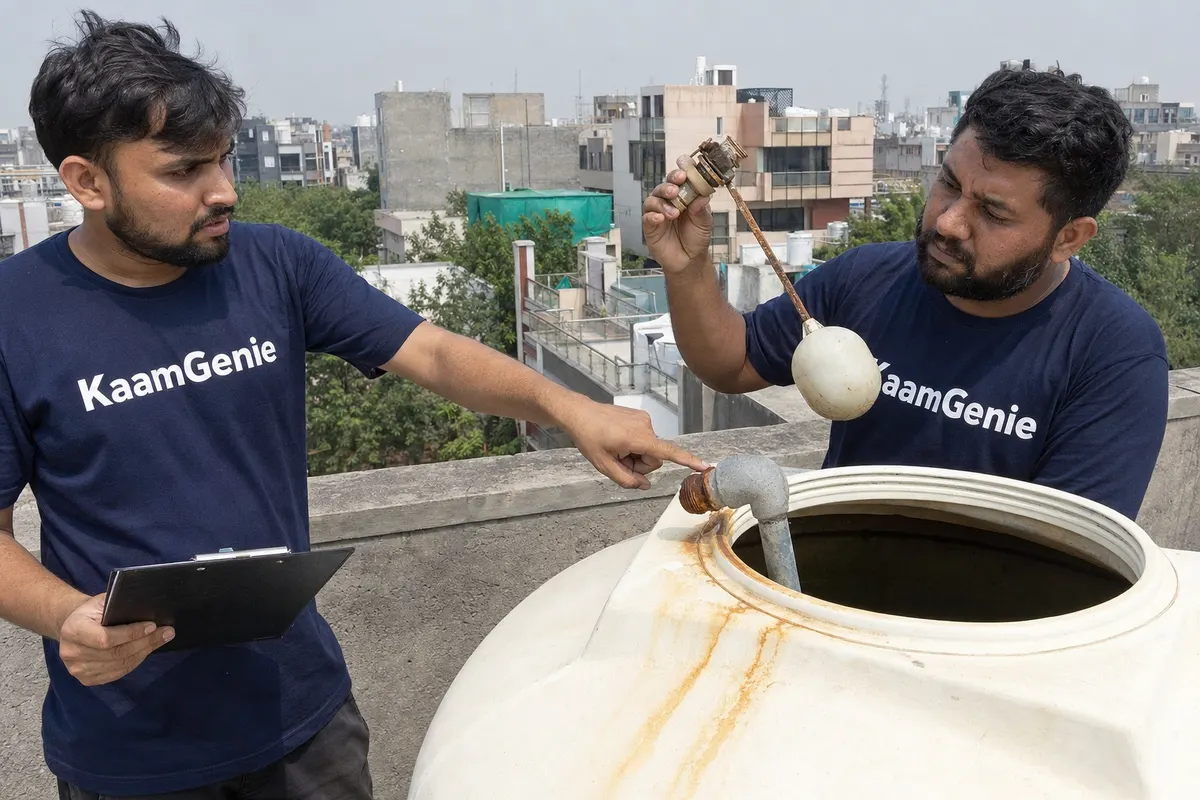
Rust in tank water is not a mystery substance. It is iron oxide, and it can only come from iron or steel that is touching your water, or hanging over it. In Gurgaon, common sources are older galvanised iron plumbing, still in service in many older houses, and the small metal parts that even modern plastic tanks are fitted with. Our guide to yellow and brown water covers reading the colour. This post covers which part is shedding rust and what should replace it. In older plotted sectors such as Sector 14, our crews regularly find GI inlet pipes and steel lid frames rusting on rooftop tanks, a result of decades in hot, wet air. Our Gurgaon water tank cleaning crew can point out corroded fittings on site.
Why metal fittings rust faster in Gurgaon
Galvanised pipe is steel with a thin zinc coating. The zinc protects the steel for years, but it wears away, and once the steel underneath is exposed, it rusts steadily from the inside. Several local conditions speed this up. Much of Gurgaon’s groundwater is hard and mineral-rich, which leaves scale on the inner walls that traps moisture against the metal. Rooftop fittings go through long, very hot summers and then damp monsoons, so joints expand, contract and crack their protective coatings. Tanks that are often run low or empty, which happens in tanker-dependent homes, expose metal parts to air and water in turn, and that wet-dry cycle is ideal for rust. Our article on hard water in Gurgaon tanks explains the scale side of this.
A part-by-part map of what rusts
Use this table as a checklist when you go up to the roof. It covers parts that commonly rust on and around tanks, and what the rust looks like on each.
| Part | Where the rust shows | What it does to your water |
|---|---|---|
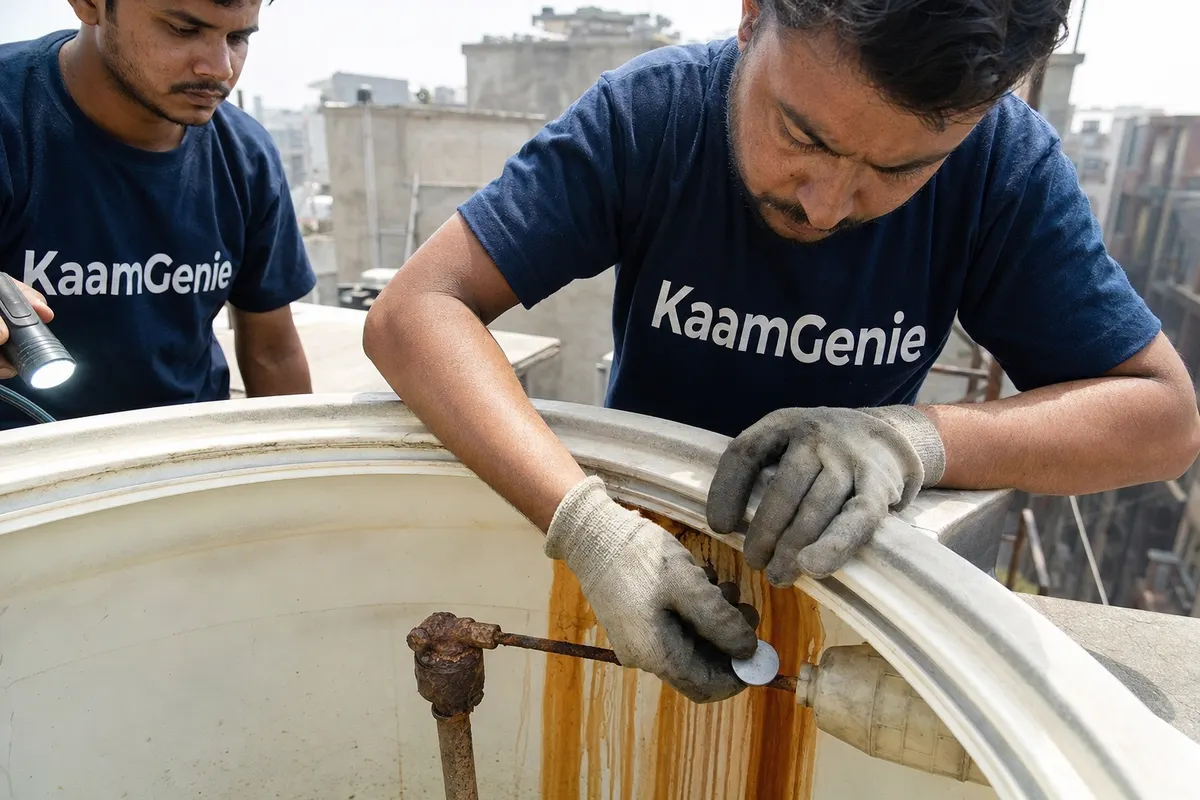
| GI inlet pipe and its bend into the tank | Orange streaks on the tank wall below the inlet; flaking at the threaded joint | Drops flakes straight into the tank on every fill |
| Float valve (ball cock) arm and rod | Brown crust on the metal arm; pivot pin seized or wobbly | Sheds rust into the water and can stick open or shut |
| GI outlet and the first metre of the down pipe | Rust ring around the outlet socket; pitted pipe surface | Rust travels directly to your taps |
| Metal ladder, rungs or brackets inside the tank | Bubbled paint and orange patches below the waterline | Constant slow rust release, plus sharp edges for the crew |
| Lid frame, hinges and lock hasp | Rust falling onto the tank rim; lid no longer closing flush | Flakes fall in when the lid is opened; gaps let dust and insects in |
| Old iron or mild steel tank | Rust patches on the floor and seams; weeping joints outside | Heavy, ongoing rust sediment; leaks as the metal thins |
How to inspect each part yourself
Take a torch, a fridge magnet, a white tissue and an old screwdriver. Switch the pump off first, and do not climb into the tank; everything below can be checked from the opening and around the tank. If your tank sits on a high stand without a safe ladder, leave this to a professional.
1. The magnet test
Touch the magnet to every metal part you can see: the inlet pipe, the valve bodies, the float arm, the outlet, the lid frame. A magnet sticks to iron and steel, which may rust. It does not stick to brass, copper, gunmetal, stainless steel of the common non-magnetic grades, CPVC or plastic. This instantly tells you which parts are worth worrying about. A shiny fitting that holds a magnet is probably chrome-plated or galvanised steel and will rust once the coating goes.
2. The inlet pipe and bend
Follow the inlet from where it comes over the parapet to where it enters the tank. Look for orange bloom at threaded joints, swelling under old paint, and damp spots. Wipe the inside of the inlet mouth with a white tissue if you can reach it: a rusty-orange smear means the inside of the pipe is corroding too.
3. The float valve
Look at the arm that connects the float ball to the valve. Older Gurgaon tanks often have a brass valve with a steel or iron arm and pin, and the arm rusts long before the valve body. Lift the float gently: it should move smoothly and shut off the flow firmly. A rough, stiff or loose arm is shedding rust and is likely to fail soon. Float valves deserve a careful choice, which is covered below.
4. The outlet and down pipe
Shine the torch at the outlet socket near the tank floor. A rust-coloured ring around it, or a crust of orange sediment banked up beside it, means the outlet fitting or the pipe just beyond it is corroding. Outside the tank, run your hand along the first stretch of the down pipe and look for pitting or a damp, rusty stain on the wall behind it.
5. Ladders, brackets and the lid
Concrete and some larger tanks have an internal iron ladder or rungs set into the wall. Look for bubbled paint and orange patches at and below the waterline. Then check the lid: rust on the frame and hinges falls into the water each time the lid is lifted. Press a screwdriver tip gently against rusty spots. Surface rust only marks the screwdriver; flaking that lifts in layers or a tip that sinks into soft metal means the part is past repair.
Replace or repair: what each part should become
Rust in contact with drinking water is something to remove, not to cover. Most of these parts are inexpensive to replace, and replacing them stops the rust at the source.
| Part | Repair is enough when | Replace with |
|---|---|---|
| GI inlet or outlet pipe | Only light surface rust outside, clean inside | CPVC or PPR pipe, with brass or CPVC unions at the tank |
| Float valve with a metal arm | Rarely; a rusty arm usually means the whole valve is old | A plastic float valve, or a brass valve with a plastic arm and float |
| Gate valve or ball valve near the tank | Body is brass and only the handle has rusted | A brass or good-quality plastic ball valve |
| Internal ladder or brackets | Never inside a drinking-water tank, if rust is active | Removal by a mason in a concrete tank, with the holes patched in a material safe for drinking water; a portable ladder for access |
| Lid frame and hinges | Light rust outside the tank, well away from the opening | A plastic or stainless steel lid with a proper seal |
| Iron or mild steel tank | Not for long; patching only buys time | A new plastic, stainless steel or properly built concrete tank |
If you are weighing up tank materials, our comparison of plastic and concrete tanks in Gurgaon covers how each behaves over the years.
What to ask your plumber
This is routine work for a plumber, but it helps to go in with clear questions so you get a lasting fix rather than a patch.
- “Which material are you using, and is it rated for hot rooftop conditions?” CPVC and PPR both handle the heat well. Ask for pipe and fittings from the same system rather than mixed brands.
- “Will you replace up to the first joint inside the house, or only the visible part?” Replacing only the rooftop stretch leaves rusting GI further down.
- “What will connect the new pipe to any old GI that stays?” A brass union or adapter at the change-over avoids a weak, leaky joint.
- “Will you use a plastic float valve or a brass one with a plastic arm?” Either avoids a rusting arm.
- “Can you close the tank inlet and outlet while you work, and keep cuttings out of the tank?” Swarf and thread-cutting debris dropped into the water are the most common mess after plumbing work.
- “Will you take away the old pipes and fittings?” Old rusty pipe left on the roof keeps staining the surface and the tank rim.
Replace first, then clean
The order makes a real difference. Plumbing work on a tank shakes loose rust from the old pipes, drops pipe cuttings and thread sealant into the water, and stirs up whatever was already lying on the floor. If the tank is cleaned first and the plumber comes later, you end up with a freshly cleaned tank full of new debris.
- Inspect and list every rusting part using the checks above, and take your own photos for the plumber.
- Have the plumber replace the parts, ideally with the tank drained low and the outlet closed.
- Book the tank cleaning straight after, so the rust sediment from years of corrosion and the debris from the repair come out together.
- Watch the taps for a few days. Some old rust can still flush through the house pipes. If the tank stays clean but taps still run rusty, the rust is in the pipes further down.
If budgets mean the fittings must wait, a cleaning still helps, because it removes the accumulated rust layer that keeps recolouring the water. Just expect the flakes to return until the metal is replaced.
Want a second opinion on your fittings?
Send us photos of your tank inlet, float valve and lid on WhatsApp. We will tell you which parts look like a likely rust source before you call a plumber.
When the rust is not coming from the tank
The magnet and tissue checks sometimes clear the tank completely: every fitting is plastic or brass, the walls are clean, and the water still runs orange. Then the rust is joining the water somewhere else, and a tank clean will not change it. Three places to look next:
- The house pipes below the tank. If a fresh bucket from the tank itself is clear but the taps run rusty, old GI pipes inside the walls are the source. That is a re-piping job, and a plumber can tell you how far the old pipe runs.
- The first flow after an outage. Rust that appears only when supply returns after a shutdown, then fades, is usually scale knocked loose in the mains and your service line. Our post on muddy water after supply is restored has the routine for keeping that slug out of your tank.
- The borewell. Iron dissolved in groundwater comes out clear and turns orange in the tank as it meets air. A lab test for iron against the IS 10500 limit of 0.3 mg/l tells you whether you need an iron filter on that line.
Corroded fittings and old pipes also narrow over the years, so rust often arrives together with weak taps. If you have both, our floor-by-floor pressure check helps you separate a choked tank outlet from a scaled pipe. For the bigger picture across building types, see the complete guide to water tank cleaning in Gurgaon.
How KaamGenie handles a rusty tank
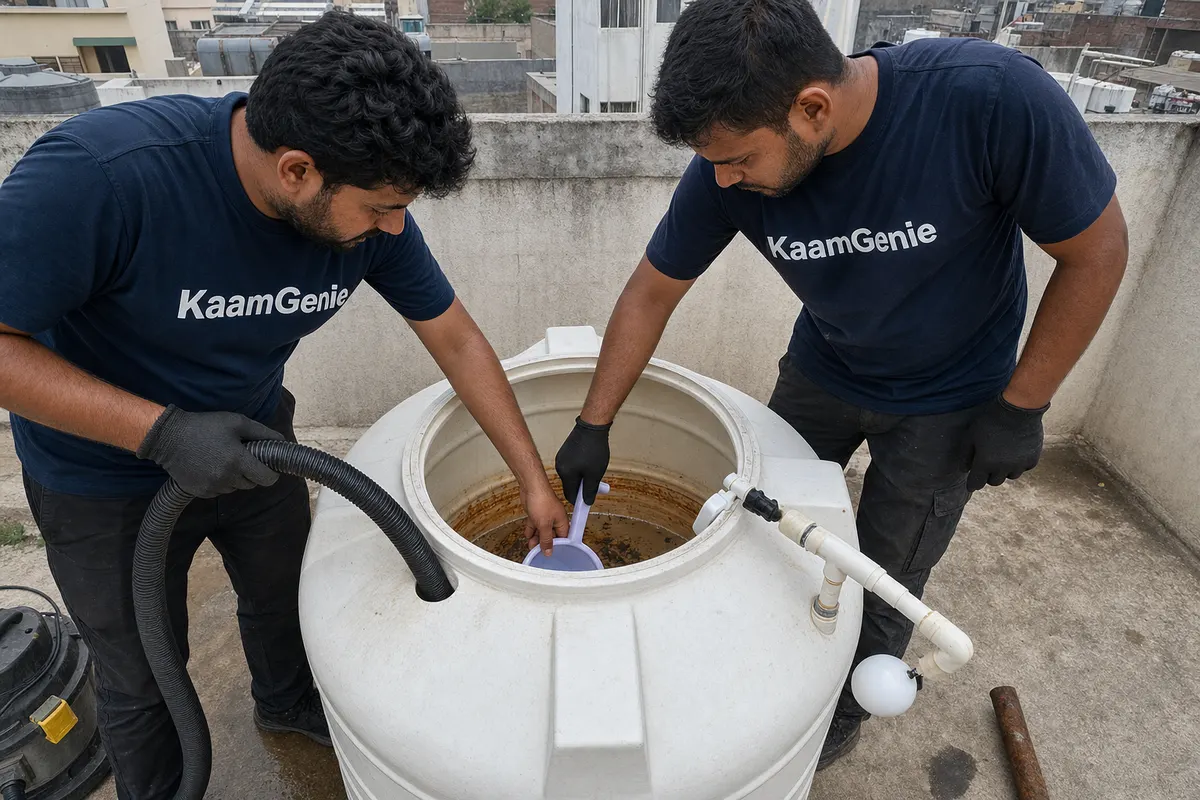
We are a cleaning crew, not plumbers, and we do not sell fittings. Our job is to get the rust that has already collected out of the tank. The full sequence is in the Gurgaon cleaning process guide; on a rusty tank, the parts that matter are:
- The outlet stays closed while the tank drains. Rust flakes are heavy and lie on the floor near the outlet, so the outlet valve to the house is shut before draining begins and the rust layer is not sent down your pipes.
- Rust and repair debris come out by hand. Flakes, silt, pipe cuttings and bits of thread sealant left by the plumber are scooped and wet-vacuumed out and carried away, not flushed into drains.
- The stain line under the inlet gets extra scrubbing. Orange streaks below an old inlet hold loose rust in their texture. The scrub removes loose rust and scale; a deep stain on old plastic may stay visible even when it is clean to the touch.
You get before and after photos on WhatsApp, and you can ask the crew to point out any corroded fittings still in place. Rust comes out by scooping and scrubbing, so no chemicals go in by default; some owners request disinfection after major plumbing work. If you are unsure whether the whole tank should go, see signs your Gurgaon tank needs attention.
What not to do
- Do not paint the inside of the tank with ordinary or rust-proof paint. Most paints are not made for drinking-water contact, and they flake off into the water.
- Do not use rust removers or converters inside the tank. They are acids made for metalwork, not for water you will drink.
- Do not wrap a rusty pipe in tape or putty and forget it. It hides the leak while the pipe keeps corroding inside.
- Do not clean the tank the day before the plumber. You will pay for a second clean.
- Do not ignore a stiff float valve. A rusted arm that sticks open can overflow the tank and flood the roof.
New fittings in? Now book the clean
Line up the plumber first, then us. Rust removal from an overhead tank starts at ₹699 and from an underground sump at ₹1,499, fixed before work starts, and you pay after the job, once the photos are with you. Post-repair visits reach Sector 4, Sector 17 and DLF Phase 2; see the full list on our Gurgaon water tank cleaning page, or call +91 95603 66362. For timing your next clean, read how often to clean a water tank in Gurgaon, and if the rust shows up in borewell water too, see borewell water tank cleaning in Gurgaon.
Frequently asked questions
Where do rust flakes in my tank water come from?
They come from iron or steel that touches your water or hangs above it. In Gurgaon the usual sources are old galvanised iron inlet and outlet pipes, the metal arm of the float valve, iron ladders or brackets fixed inside the tank, the lid frame and hinges, and tanks that are themselves made of iron or mild steel. A fridge magnet quickly shows which of your fittings are iron or steel and therefore able to rust.
Is it safe to drink water with rust flakes in it?
Rust itself is mainly a taste, staining and appearance problem, and IS 10500:2012 sets an iron limit of 0.3 mg/l with no relaxation. The bigger concern is that rust sediment on the tank floor shelters bacteria and other dirt. Avoid drinking or cooking with water that shows flakes, use bottled or separately stored water for now, and see a doctor if anyone in the family feels unwell.
Should I replace my GI pipes with CPVC or PPR?
Both are good choices for drinking water in Gurgaon and both cope with hot rooftop conditions. CPVC is joined with solvent cement and is widely available; PPR is joined by heat fusion, which gives very strong joints. The more important point is to use one system with matching fittings and to have a brass union where new pipe meets any old GI that stays. Your plumber can advise on which suits your layout.
Can a rusty float valve be repaired?
Sometimes a seized pivot pin can be freed or replaced, but a float valve with a heavily rusted arm is usually old enough that the seal inside is also worn. Replacing it costs little compared to the trouble it causes, which includes rust in the water and a tank that overflows or does not fill. A plastic float valve, or a brass valve with a plastic arm and float, avoids the problem.
Can I paint the inside of my tank to stop rust?
Not with ordinary paint, enamel or rust-proof metal paint. Most paints are not designed for constant contact with drinking water, and once they blister they release flakes into the tank. For an iron or mild steel tank that has started rusting through, the honest answer is replacement. For internal ladders or brackets in a concrete tank, have a mason remove them and patch the wall with a material safe for drinking water, then use a portable ladder for access.
Should I clean the tank before or after replacing fittings?
After. Plumbing work drops cuttings, thread sealant and old rust into the tank and disturbs the sludge already lying there. If you clean first, the plumber undoes the cleaning. Ask the plumber to close the inlet and outlet while working, then book the tank cleaning straight after, so years of rust sediment and the debris from the repair come out in one visit.
Why does rust keep coming back after cleaning?
Because the cleaning removes the rust that has collected, but not the metal that is producing it. If the inlet pipe, float arm or tank itself is still corroding, fresh flakes start settling again from the first fill. If the tank stays clean but the taps run rusty, the rust is coming from the house pipes below the tank. In both cases the lasting fix is replacing the corroding metal.
How much does a tank cleaning cost after replacing rusty fittings in Gurgaon?
A rust clean-up after new fittings costs from ₹699 for an overhead tank and from ₹1,499 for an underground sump. The quote stays fixed even under a thick rust layer, and you pay only after the job, once the before and after photos of your tank reach WhatsApp. If any corroded parts are still in place, ask the crew to point them out so you know what is left to replace. A rusty tank gets no chemicals unless you request disinfection.
Sources & references
- Bureau of Indian Standards (BIS): IS 10500:2012 sets the drinking-water iron limit at 0.3 mg/l with no relaxation, and publishes standards for pipes and fittings.
- CPHEEO Manual on Water Supply and Treatment: the Government of India engineering manual covering pipe materials, corrosion and service connections.
- WHO Guidelines for Drinking-water Quality, 4th edition: guidance on iron, corrosion of plumbing materials and stored water.
- Central Ground Water Board (CGWB): groundwater quality information for Haryana, including hardness and iron in Gurugram district.
Last verified: 22 November 2026. If you find any of these links broken, please let us know.