
Quick answer
- Why it happens: sunlight is reaching the water, through thin or faded plastic walls, a translucent or cracked lid, or a lid left open. Warm rooftop water speeds it up.
- Green film that wipes off the wall: algae growing where light hits the tank. The tank needs scrubbing, and the light leak needs fixing.
- Slippery, dull green-brown coating: bio-film, a mix of algae and bacteria. It needs scrubbing too; rinsing alone leaves it behind.
- Green tint in a glass of water: algae floating in the water itself, a sign of heavy growth. Do not drink it.
- The lasting fix: a full scrub clean, then keep light out with an opaque, clamped lid, shade, or a multi-layer tank with an opaque inner layer.
Bleach poured into a green tank does not remove the algae; it just leaves it dead on the walls to grow back.
Tank turned green? Get it scrubbed clean
Algae scrubbing on an overhead tank is a fixed ₹699: walls, floor and lid cleaned, the green carried away, and payment only after the before and after photos arrive. No chemicals unless you ask.
Green growth is one of the most common tank problems on Gurgaon rooftops in the hot months. The city’s summers are long and harsh, rooftop tanks sit in full sun for most of the day, and the water inside warms up well beyond what you would expect from a tap. Add a lid that lets light through and you have a small greenhouse sitting on your roof. This guide covers green growth only. If your water is yellow or brown, read our guide to yellow or brown tank water in Gurgaon instead. To have the green scrubbed off on site, book our Gurgaon water tank cleaning team. Our crews often find heavy green walls in older plotted sectors such as Sector 31, where many rooftop tanks are ageing single-layer plastic that years of sun have thinned and faded.
Three kinds of green: what are you looking at?
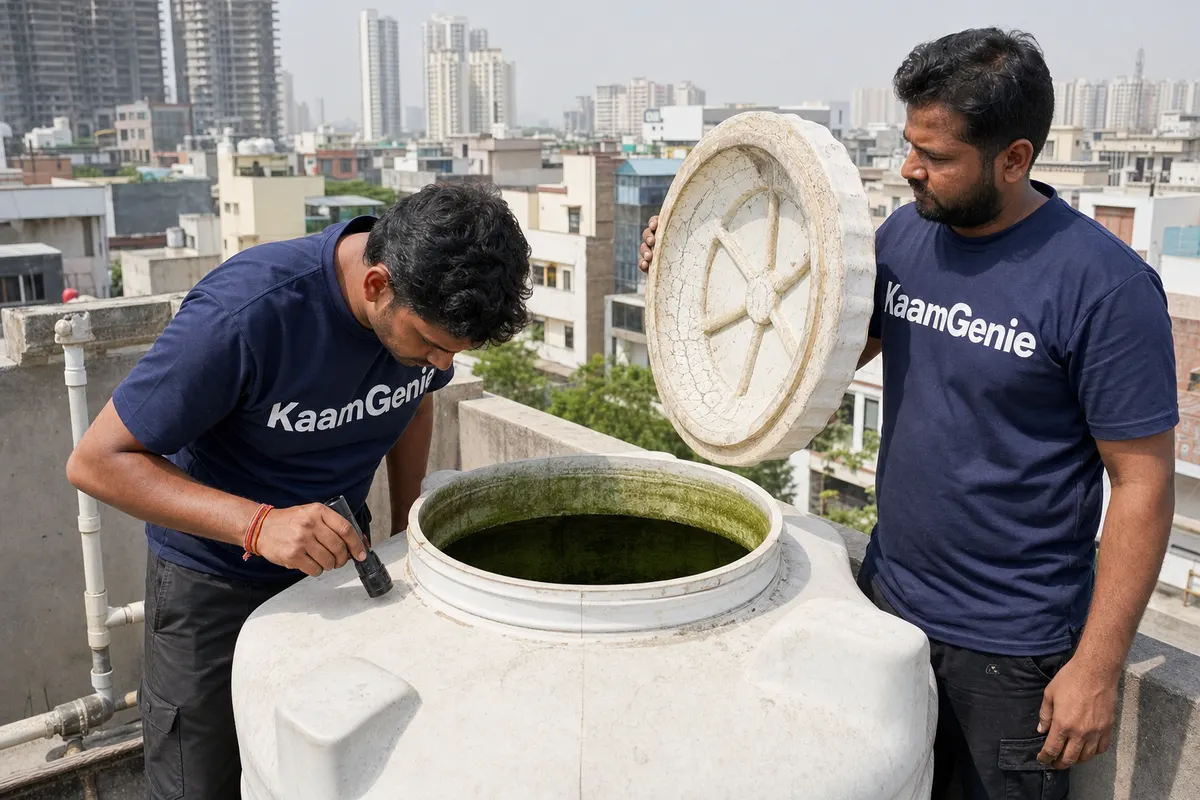
“Green tank” can mean three different things, and they need slightly different attention. Look through the open lid with a torch, then run a finger along the inside wall if you can reach it safely.
| What you see | Where it is | What it is | What it needs |
|---|---|---|---|
| Bright or grass-green layer, wipes off on a finger | Upper walls and the side facing the sun; under a translucent lid | Algae attached to the wall | Scrub clean and block the light |
| Dull green-brown, slippery, sometimes in streaks | Around the waterline and corners | Bio-film: algae, bacteria and dirt bound in slime | Scrub clean; check for musty smell |
| Water itself looks pale green in a white mug | Throughout the water | Free-floating algae, usually heavy growth | Stop drinking; drain and clean soon |
| Dark green or black patches on the floor | Tank floor, mixed with silt | Algae that has died and settled with the sludge | Full de-sludge, not just a rinse |
| Green moss on the outside of the tank | Outer wall, near leaks or under a dripping pipe | Moss feeding on a leak, not inside the water | Fix the leak; check the inside anyway |
If your tank has a slippery film but also a strong earthy or musty smell, the film is the likely source of that smell. Scrubbing deals with both.
The torch test: find where the light gets in
Algae only grows where light reaches it, so finding the light leak is the real diagnosis. This test takes two people and about ten minutes, and it works best after dark.
- Close the lid and switch off nearby lights. Stand on the roof at dusk or after dark with a strong phone torch.
- Press the torch flat against the outside wall. Have the second person lift the lid a few centimetres and look inside. If they can see the torch glowing through the wall, the wall is letting light in. Repeat at the top, middle and sun-facing side.
- Shine the torch down onto the closed lid. The person looking through a gap at the rim should see whether the lid glows. Faded, thin or translucent lids are a common leak.
- Run the torch around the rim and pipe holes. Light through a crack, a warped lid edge or an oversized pipe hole shows up as a bright line or spot from inside.
- Note what glowed. Wall glow means the tank material is the problem. Lid glow or rim glow means a cheaper fix: a new lid or sealing the gaps.
Compare your result with where the algae was thickest. They almost always match: algae on the sun-facing wall, under the lid, or in a fan shape below a crack.
Why Gurgaon tanks turn green so readily
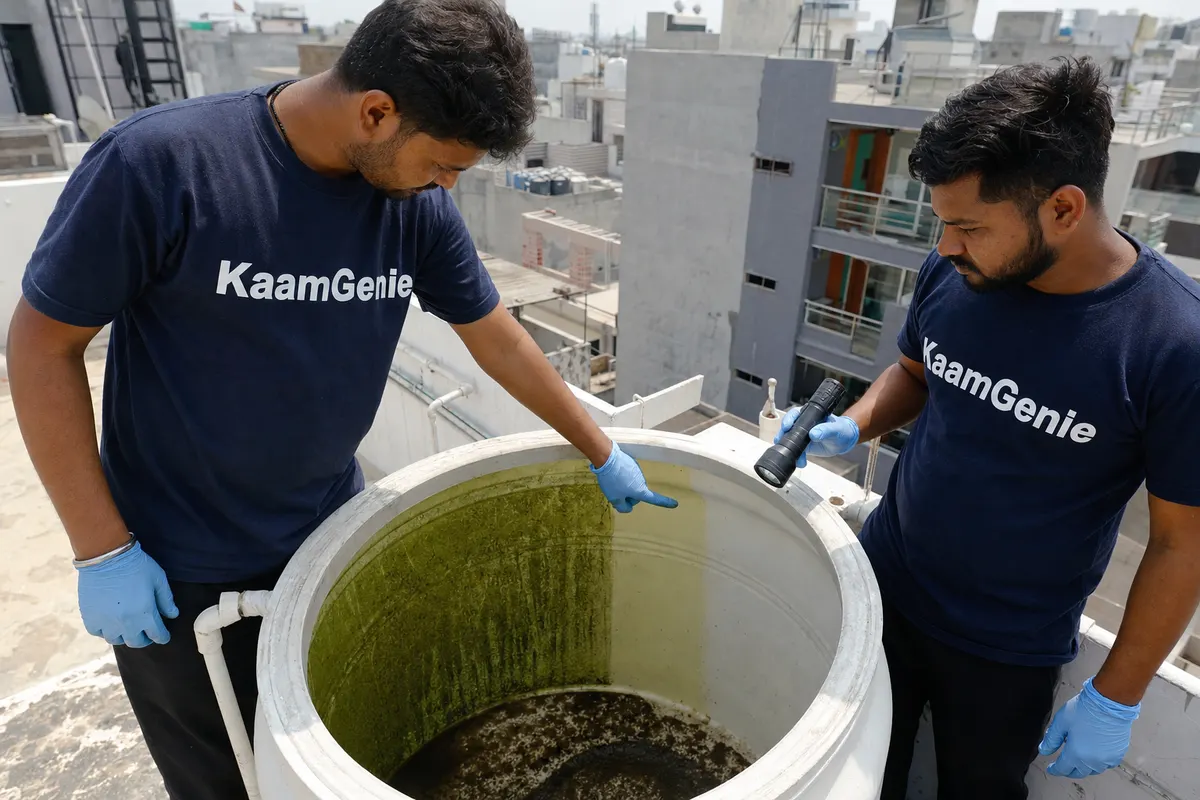
Sun and heat. Rooftop tanks in Gurgaon face strong direct sun for months, with long hot spells before the monsoon that the India Meteorological Department tracks as heatwave conditions. Warm water allows algae to multiply faster.
Thin and ageing plastic. Single-layer and older plastic tanks let a surprising amount of light through, and years of sun exposure fade and thin the plastic further. Multi-layer tanks are built differently, as the section on tank build below explains.
Lids. The lid is the most common culprit. Original lids crack in the heat, get lost during rooftop work and are replaced with whatever is lying around: a plastic sheet, a basin, a piece of tin with gaps at the edges.
Still water. A tank serving a rarely used floor, a guest room or an empty flat keeps the same water for days. Algae has time to build up before the water is replaced, and the same still water can also start to smell; our post on why tank water smells in Gurgaon helps you tell an algae smell from the more serious ones.
Dust and nutrients. Summer dust, bird droppings and leaves that slip in add nutrients that algae feeds on, and the dead algae then joins the sludge on the floor. A gap big enough for leaves is big enough for a bird or a rat, which is a far more urgent problem; see what to do about a dead bird or rat in your tank.
Is green water harmful?
Most green algae in tanks are a hygiene and taste problem rather than a poison, but there are two reasons not to drink from a green tank. First, the slimy film that comes with algae shelters bacteria, and you cannot see which ones are present. Second, some blue-green types, which are actually bacteria called cyanobacteria, can produce toxins, and the WHO drinking-water guidelines treat them as a concern. You cannot tell the types apart by eye. A green tint is a colour problem rather than cloudiness: the water can look clear and still be tinted, and green-tinted water is not clear water. IS 10500:2012 sets separate limits for colour and for turbidity, and a lab report will show both. If anyone at home has a stomach upset or skin irritation that worries you, see a doctor or dermatologist.
Why scrubbing works and bleach does not
Algae does not float loosely on the walls. It anchors itself into a film that sticks to the plastic or concrete, especially on the rough surface of older tanks. Pouring bleach into a full tank may kill the cells near the surface and turn the green paler for a while, but the dead layer stays stuck to the walls and the floor. That dead material becomes food for bacteria, the light leak is still there, and new algae grows on top of the old within weeks. Worse, a DIY dose is hard to judge in a tank of unknown volume, and the water you are drinking and bathing in carries whatever was added.
Physical removal is what clears it: drain the tank, scrub the film off every surface, wash it out and vacuum away the residue. Then close the light leak so it cannot regrow. Our post on chemicals in tank cleaning explains why we avoid DIY dosing.
Which tank build keeps algae out
Colour on its own does not decide this, construction does. The tank that resists algae best is a multi-layer one with an opaque, light-blocking inner layer and a lighter outer layer: the inner layer stops light reaching the water, and the lighter outside reflects heat so the water stays cooler. The tank to avoid is a thin, single-layer, translucent one, which lets light straight through whatever its colour. Two tanks on the same roof can behave completely differently for this reason, and the torch test above tells you which kind you have. In leafy colonies such as DLF Phase 4, our crews also see leaves slipping under loose lids, which feeds the green layer from inside. Our comparison of plastic and concrete tanks in Gurgaon covers how each material fouls; concrete blocks light well but its rough walls hold film once a loose slab lets light in.
If you are replacing a tank anyway, ask the seller how many layers it has and whether the inner one is opaque. If you are not, the lid and a shade do most of the work, as below. For the building-level picture, including society reservoirs, see the complete guide to water tank cleaning in Gurgaon.
Send us a photo of the inside of your tank
A clear phone photo through the open lid is enough for us to tell you whether it is algae, bio-film or something else, and quote a fixed price.
How KaamGenie removes algae
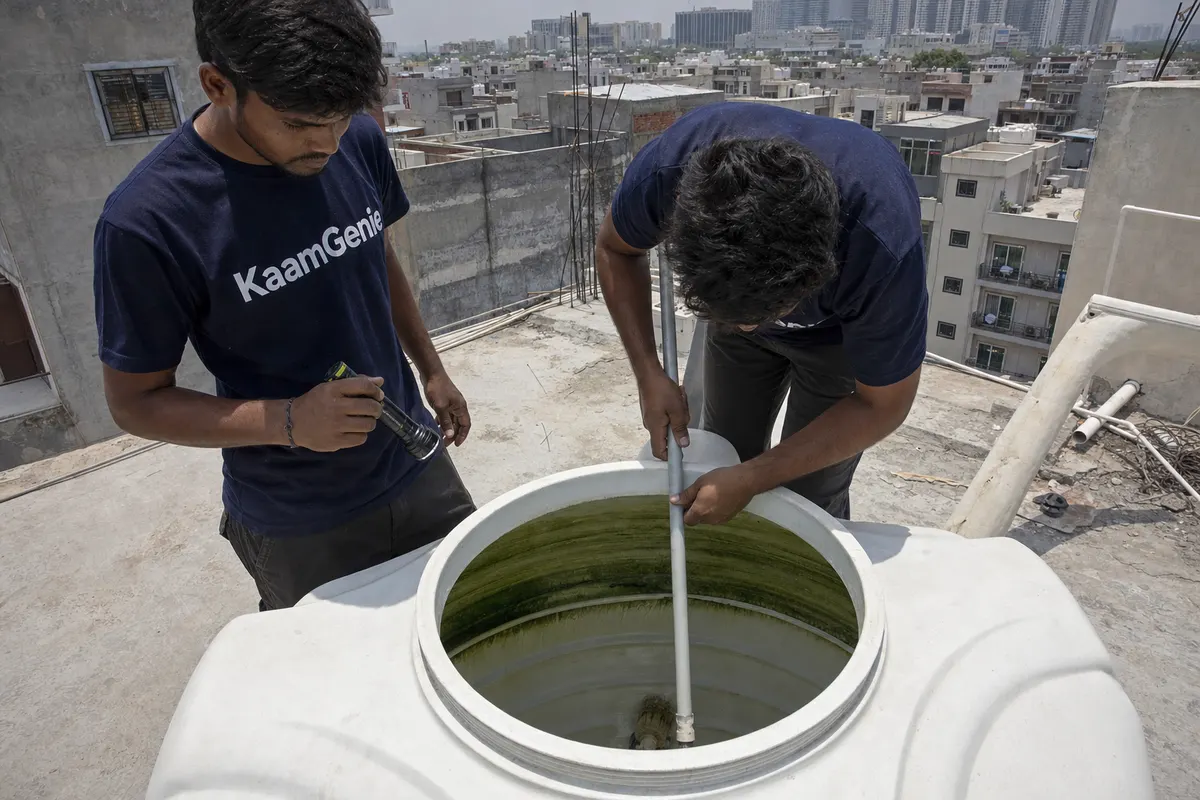
Our full sequence, from shutting the inlet to the before and after photos, is in the Gurgaon cleaning process guide. On a green tank, the work is concentrated in three places:
- The light-exposed band. The upper walls, the sun-facing side and the strip around the old waterline carry the thickest growth. These are scrubbed until the wall surface is bare to the touch, not just until it looks paler, because a thin film left behind regrows first.
- The lid underside and the rim. Under a translucent or cracked lid, algae grows on the lid itself and drips back into the water. It gets the same scrub as the walls, with a soft brush on plastic so the surface is not scratched.
- The floor. Dead algae sinks and mixes with silt into a dark layer. That is scooped and wet-vacuumed out and carried away, not flushed into drains, before the jet wash and fresh-water rinse.
Algae comes off with brushes and water, so no chemicals go in by default. If you would also like the scrubbed green tank disinfected, that is added on request. Ask the crew to show you where the growth was thickest in the photos; it usually lines up with your torch-test result.
Keeping the light out afterwards
- Fix the lid first. A solid, opaque lid that sits flat and is clamped, strapped or locked down is the cheapest and most effective change. Never rely on a brick or a weight on top; it shifts and leaves a gap.
- Shade the tank. A simple shade over the tank, or a thick opaque cover fitted around it, cuts both light and heat. Make sure the lid and overflow stay accessible.
- Seal cracks and pipe holes. Even small gaps let in a beam of light.
- Replace a tank that glows. If the torch test shows light through the walls of an old single-layer tank, a multi-layer tank with an opaque inner layer is a better long-term answer than repeated cleaning.
- Keep water moving. In a rarely used flat, run the taps on visits so the tank turns over.
For when to schedule a clean around the summer and monsoon, see the best time to clean your tank in Gurgaon and how often to clean your water tank.
What not to do
- Do not pour bleach or other chemicals into a green tank yourself. The algae stays on the walls, regrows, and the dose ends up in your water.
- Do not paint the inside of the tank. Paint not made for drinking-water contact can leach into the water, and it peels.
- Do not just rinse with a hose from the top. The film stays anchored to the walls.
- Do not use wire brushes or scrapers on plastic tanks. Scratches roughen the wall and give algae more to grip next time.
- Do not ignore a green tint because the water looks clear in the glass. Check it in a white mug; pale green is easy to miss in a steel glass.
Get the green out, then keep the lid shut
Do the torch test tonight and send us a photo of what you found. We will scrub the tank and tell you plainly whether a new lid, a shade or a new tank is the better next step. Clearing algae from an overhead tank starts at ₹699 and from an underground sump at ₹1,499, a price fixed before work begins, and you pay once the scrub is done and the photos show clean walls. Green-tank visits reach Golf Course Extension Road, DLF Phase 4 and Sector 31; the full list is on our Gurgaon water tank cleaning page. For the other warning signs, read signs your Gurgaon tank needs cleaning, or call +91 95603 66362.
Frequently asked questions
Why does my water tank keep turning green in Gurgaon?
Because light is still reaching the water. Algae grows wherever sunlight gets in, through faded or thin plastic walls, a translucent or cracked lid, or gaps around pipes, and Gurgaon’s hot rooftops make it grow faster. Cleaning removes the algae, but if the light leak stays, it regrows. Use a torch test at night to find where the light comes in, then fix the lid, shade the tank or replace it.
Is it safe to drink water from a tank with algae?
It is best not to. Most tank algae is a taste and hygiene problem, but the slimy film around it shelters bacteria, and some blue-green types can produce toxins. You cannot tell which kind you have by looking. Use bottled or separately stored water until the tank has been drained and scrubbed. If someone at home feels unwell, see a doctor.
Can I remove algae by adding bleach to the tank?
Bleach may make the green fade for a while, but it does not lift the algae off the walls. The dead layer stays stuck there, feeds bacteria and gives new algae a base to grow on. A DIY dose in a full tank is also hard to judge. Draining and scrubbing removes it properly. Disinfection of an algae tank can be added on request at booking.
Do black or dark tanks prevent algae?
Outer colour is not the real answer. What helps is a multi-layer tank with an opaque, light-blocking inner layer and a lighter outer layer, which blocks light and reflects heat so the water stays cooler. A thin, single-layer, translucent tank lets light through whatever its colour. Even a good multi-layer tank grows algae under a cracked or translucent lid, or a lid left open, so the lid matters as much as the walls.
Does a tank cover or shade really help?
Yes, if it blocks light properly. A thick opaque cover around the tank, or a simple shade structure above it, cuts the light and also keeps the water cooler in summer, both of which slow algae. Make sure the cover does not trap rainwater against the lid or block the overflow, and that the lid can still be opened for cleaning.
Why is only one side of my tank green?
That side is getting the most sun. On Gurgaon rooftops the south and west faces usually take the strongest afternoon light, so algae grows thickest on those inside walls, or in a patch directly under a crack. The pattern is useful: it tells you exactly where to shade or seal. Run the torch test on that side first.
Will algae damage my plumbing or purifier?
Algae and bio-film flakes break off and travel through the pipes, where they can clog tap aerators, shower heads and the pre-filters of RO purifiers, so filters need changing sooner. Heavy growth can also leave a musty smell and taste in the water. Removing it from the tank and stopping the light leak protects the rest of the system.
How much does it cost to clean an algae-covered tank in Gurgaon?
Algae removal costs from ₹699 for an overhead tank and from ₹1,499 for an underground sump, settled before the brushes come out. A thick green coat takes longer to scrub but the quote does not change, and you pay after the job, once the before and after photos are with you. Ask the crew where the light seems to be getting in. A green tank gets no chemicals unless you request disinfection.
Sources & references
- WHO Guidelines for Drinking-water Quality, 4th edition: covers algae and cyanobacteria in water supplies and storage, including toxin concerns.
- Bureau of Indian Standards (BIS): IS 10500:2012 sets limits for turbidity, colour and odour in drinking water.
- India Meteorological Department (IMD): temperature records and heatwave warnings for the Delhi NCR region, including Gurugram.
- CPHEEO Manual on Water Supply and Treatment: engineering guidance on covered storage tanks and preventing contamination.
Last verified: 22 November 2026. If you find any of these links broken, please let us know.