
Water Tank Cleaning Rules & Norms
Raj Babbar · 9 min read
Home › Water Tank Cleaning › Society / RWA Tank Cleaning › Laxmi Nagar Extension
Behind the Laxmi Nagar market, the Extension lanes are stacked with rental floors where one landlord owns four storeys and four families share the tank on top. Getting that shared tank cleaned and the visit recorded is what this service covers. From ₹1,500 per tank.
Laxmi Nagar Extension is the packed residential belt just behind the main market, its narrow lanes lined with builder floors let out family by family. Almost every building keeps a single plastic rooftop tank that several tenanted flats draw from, so the storage is shared even though no formal society exists. The water leans heavily on private borewell, iron-tinged and hard, with DJB reaching only the wider lanes. Because the flats are rented and the owner rarely lives on site, the rooftop tank has no clear custodian and simply keeps running. Between the hardness and the constant multi-family draw, sediment and an orange iron stain settle in without anyone watching.
For these multi-family buildings KaamGenie organises the clean with whoever holds the keys, the resident landlord or a senior tenant, and does the shared tank in one pass. We draw the tank down, scrape the iron-heavy deposit off the base, brush the walls clean, finish with a food-safe sanitiser and leave timestamped photos so every family can see the result. A tenant wanting only their own connection checked can read water tank cleaning in Laxmi Nagar Extension. Here we focus on the whole shared building tank.
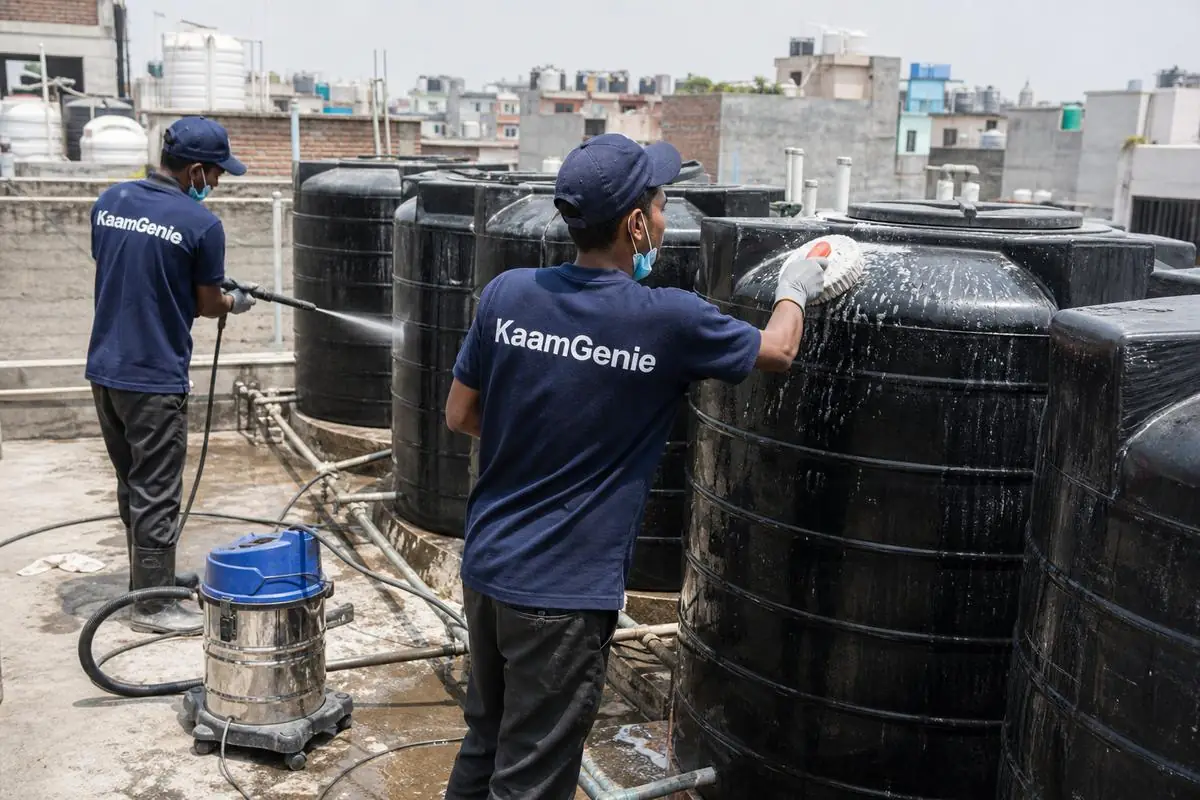
The borewell that most Extension buildings run on is not just hard, it carries iron, and iron water does two things to a shared tank: it lays down a rust-coloured film and it feeds the load that settles at the bottom. Split four ways between rented flats, the tank fills and empties all day, so fresh iron and grit arrive faster than they would in a single-family home. The result is a base deposit that thickens month on month. On a building nobody owns full-time, that goes unnoticed until the water itself changes colour.
That settled iron and silt is where biofilm takes hold, and the tenants feel it first as a metallic taste and a faint yellow tint in the first bucket of the day. The same particles clog tap aerators and stain washing across every flat the tank feeds. When four families share one supply, the complaints pile onto a landlord who cannot see the cause from the street. Opening and clearing the shared tank twice a year is the only thing that resets it.
No travel charge anywhere in Laxmi Nagar Extension. The final price is confirmed on the call before we come — it depends only on tank size and access.
See it done in 45 seconds
Watch our web story on how a tank is really cleaned — drain, de-sludge, jet-wash, disinfect.
We reach every pocket of Laxmi Nagar Extension — and there’s no travel charge to any of them:
Every locality in Delhi stores different water, and that decides how fast a tank fouls. This is Laxmi Nagar Extension’s profile from The Delhi Water Index, built from our field observations across 250+ localities.
Indicative field characterisation, not a certified lab test. BIS IS 10500: TDS 500 mg/L acceptable, 2,000 permissible. Check any Delhi area →
“In a rented building, who is responsible for cleaning the shared tank?” The building owner holds that responsibility since the tank is common to all the flats, but in practice tenants often have to push for it. Any resident can call us in, we survey and quote for the shared tank, and the dated record we leave usually settles who arranged it.
“Our tap water has an orange tint. Will cleaning the tank fix it?” An orange tint on this iron-tinged borewell is partly the water and partly the rust film and settled iron inside a long-uncleaned tank. Draining, scraping and disinfecting the tank clears the tank's share of the problem, and the first-draw colour usually improves noticeably afterwards.
“What does it cost for a four-family shared tank in the Extension?” Each shared tank of that size is ₹1,500 to ₹2,000. Where a building carries more than one, we price the set as a whole with a bulk cut of around 15 to 20 percent for doing them in a single trip.
“The landlord lives elsewhere and will not arrange it. Can the tenants do this ourselves?” Yes. The families sharing the tank can arrange and split the clean between themselves without the owner present, as long as someone can open the roof access. We still leave the full dated photo record for everyone's reference.
“How often should a four-family building tank be done on this iron borewell?” Twice a year suits most Extension buildings on this water. The iron load and the shared multi-family draw rebuild the stain and sediment within about six months, so a half-yearly clean keeps the first-draw water clear rather than letting it turn.
See our complete water tank cleaning services in Delhi NCR — pricing, process, tank types and full city coverage.
Beyond water tank cleaning, KaamGenie is rolling out a full lineup of home services across Delhi NCR — see our complete list of 12 home services we offer or will be launching through 2026. New to tank cleaning? Read our guide on how to pick the right water tank cleaning service in Delhi — what to look for, what to avoid, and the questions that separate trustworthy crews from quick-job operators.
Rooftop plastic tanks
₹699+ →Kothi sumps & underground tanks
₹1,499+ →Apartments & RWAs
Bulk pricing →FSSAI-compliant cleaning
₹2,500+ →टंकी साफ़ करने वाले
हिन्दी पढ़ें →View all water tank cleaning guides →
All pockets and lanes of Laxmi Nagar Extension covered. If your specific block or society isn’t named in the sub-areas above, just call — we almost certainly cover it.
Same crew, same 6-step process, same-day where possible. Pick any locality below for local pricing and the tanks we typically find there.
Book a slot — we can usually fit you in today or tomorrow.