
Tank Cleaning Near Me: Checklist
Raj Babbar · 8 min read
Home › Water Tank Cleaning › Society / RWA Tank Cleaning › Jhilmil Tahirpur
Where the Jhilmil industrial area meets its DDA flats and worker housing, rooftop tanks sit under a steady fall of factory dust and feed whole blocks of families below. Society and shared-building cleaning here means clearing that grit-loaded storage and recording the job. From ₹1,500 per tank.
Jhilmil Tahirpur is a working belt where DDA flats, labour housing and small factories share the same few lanes around the Jhilmil colony and industrial area. Buildings here commonly run both an underground store and a rooftop tank, and in the flat blocks one such set serves many families at a time. The supply is DJB backed by borewell, but the defining local factor is the air: fine industrial dust drifts off the units and settles heavily onto open roofs and into tank vents. That airborne grit sits on top of whatever the water itself carries, so the sediment load in a Jhilmil tank climbs faster than the supply alone would explain. Shared storage plus a dusty sky makes for tanks that need attention more often than most.
KaamGenie cleans the shared building storage in these blocks, sump and rooftop together where both exist, in one visit set with the block's caretaker or resident group. We de-water each tank, clear the grit-heavy sludge from the base, brush the walls down, apply a potable-grade disinfection and hand across before-and-after photographs for the record. A single household needing only its own tank can see water tank cleaning in Jhilmil Tahirpur. This service is for the shared tanks that supply a whole Jhilmil block.
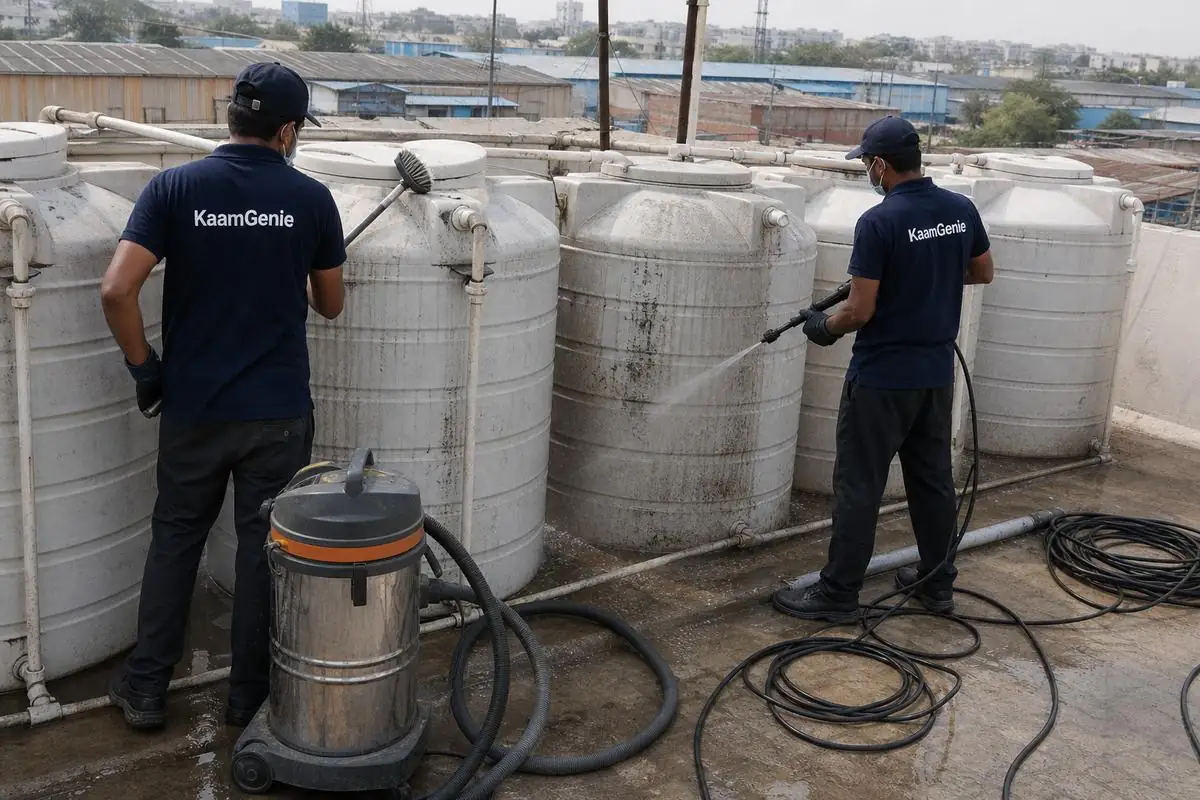
Two loads reach a Jhilmil tank, not one. The water brings its usual silt and hardness, and the industrial air drops a constant film of fine dust through every vent and lid gap onto the surface. Because a block tank refills many times a day for all the families on it, both loads keep arriving with little settling time. The floor deposit that forms is a mix of waterborne silt and industrial grit, and it packs down denser than ordinary sediment. On this kind of roof, an annual rinse never keeps up.
That combined deposit feeds biofilm and holds the fine particulate that clouds the first draw across a whole block of flats. Industrial grit is also abrasive, so it wears pump seals and tap fittings harder than plain silt would, adding to a block's repair load. In mixed-use buildings where nobody treats the shared tank as their own, the problem grows unseen until the water looks visibly off. A more frequent clean, three or four times a year, is what a dusty Jhilmil block actually needs.
No travel charge anywhere in Jhilmil Tahirpur. The final price is confirmed on the call before we come — it depends only on tank size and access.
See it done in 45 seconds
Watch our web story on how a tank is really cleaned — drain, de-sludge, jet-wash, disinfect.
We reach every pocket of Jhilmil Tahirpur — and there’s no travel charge to any of them:
Every locality in Delhi stores different water, and that decides how fast a tank fouls. This is Jhilmil Tahirpur’s profile from The Delhi Water Index, built from our field observations across 250+ localities.
Indicative field characterisation, not a certified lab test. BIS IS 10500: TDS 500 mg/L acceptable, 2,000 permissible. Check any Delhi area →
“The factories nearby leave dust everywhere. Does cleaning the tank help if it just settles again?” It helps, but the answer is a tight lid plus a more frequent cycle. We remove the grit already inside and check the lid seals so less new dust gets in, then recommend three or four cleans a year rather than one so the load never builds to where it clouds the water.
“Our block has flats and a small unit in the same building. Do you clean the shared tank for all of it?” Yes. We clean the storage that serves the whole building, both the sump below and the rooftop tank, in one visit arranged with the caretaker. It does not matter that the building mixes homes and a unit; the shared tank is treated as one job.
“What does it cost for a shared block tank here?” A shared block tank is ₹1,500 to ₹2,000. With a sump and rooftop both to do, we price them as one job and apply a bulk discount rather than charging each separately.
“How often should a tank near the industrial area be cleaned?” Three to four times a year suits a Jhilmil block. The steady dust fall means sediment rebuilds faster here than in a cleaner-air colony, so a quarterly rhythm keeps the shared water usable where a yearly clean would fall behind.
“Can you fit a cover or check the lid so less dust gets in?” We check the lid and vents on every visit and reseat or advise a proper cover where the fit is loose. A well-sealed lid noticeably slows how fast the industrial dust gets back into a cleaned tank.
See our complete water tank cleaning services in Delhi NCR — pricing, process, tank types and full city coverage.
Beyond water tank cleaning, KaamGenie is rolling out a full lineup of home services across Delhi NCR — see our complete list of 12 home services we offer or will be launching through 2026. New to tank cleaning? Read our guide on how to pick the right water tank cleaning service in Delhi — what to look for, what to avoid, and the questions that separate trustworthy crews from quick-job operators.
Rooftop plastic tanks
₹699+ →Kothi sumps & underground tanks
₹1,499+ →Apartments & RWAs
Bulk pricing →FSSAI-compliant cleaning
₹2,500+ →टंकी साफ़ करने वाले
हिन्दी पढ़ें →View all water tank cleaning guides →
All pockets and lanes of Jhilmil Tahirpur covered. If your specific block or society isn’t named in the sub-areas above, just call — we almost certainly cover it.
Same crew, same 6-step process, same-day where possible. Pick any locality below for local pricing and the tanks we typically find there.
Book a slot — we can usually fit you in today or tomorrow.