
PG & Hostel Tank Cleaning
Raj Babbar · 9 min read
Home › Water Tank Cleaning › Society / RWA Tank Cleaning › Shahdara
Shahdara grew up around its railway junction, and many houses ringing the old station have been vertical so long that their shared rooftop tanks predate half the families now drawing on them. Cleaning those long-sealed tanks and logging the visit is what we do here. From ₹1,500 per tank.
Shahdara is among the oldest towns across the Yamuna, a dense knot of markets, railway colonies and rebuilt houses spread around the Shahdara junction and the line running through it. Generations of subdivision have turned single homes into stacked floors, and the rooftop or plastic tank feeding them is usually shared and often as old as the last rebuild. The supply mixes DJB with a widespread borewell backup, and soot and grit from the railway and the crowded bazaar settle onto every open roof. Many of these tanks have not been unsealed in years, some not since the building was last done up. On a roof this exposed and a tank this old, what has collected inside is measured in layers.
KaamGenie opens and cleans these ageing shared tanks for the household or the group of families using them, working one building at a time. We bail out the standing water, clear the caked sediment off the floor, work the walls over by hand, treat everything with a anti-bacterial disinfectant and show the before-and-after in dated photographs. A resident who wants a single tank looked at can start at water tank cleaning in Shahdara. What follows is about the shared tanks that serve a whole old-Shahdara building.
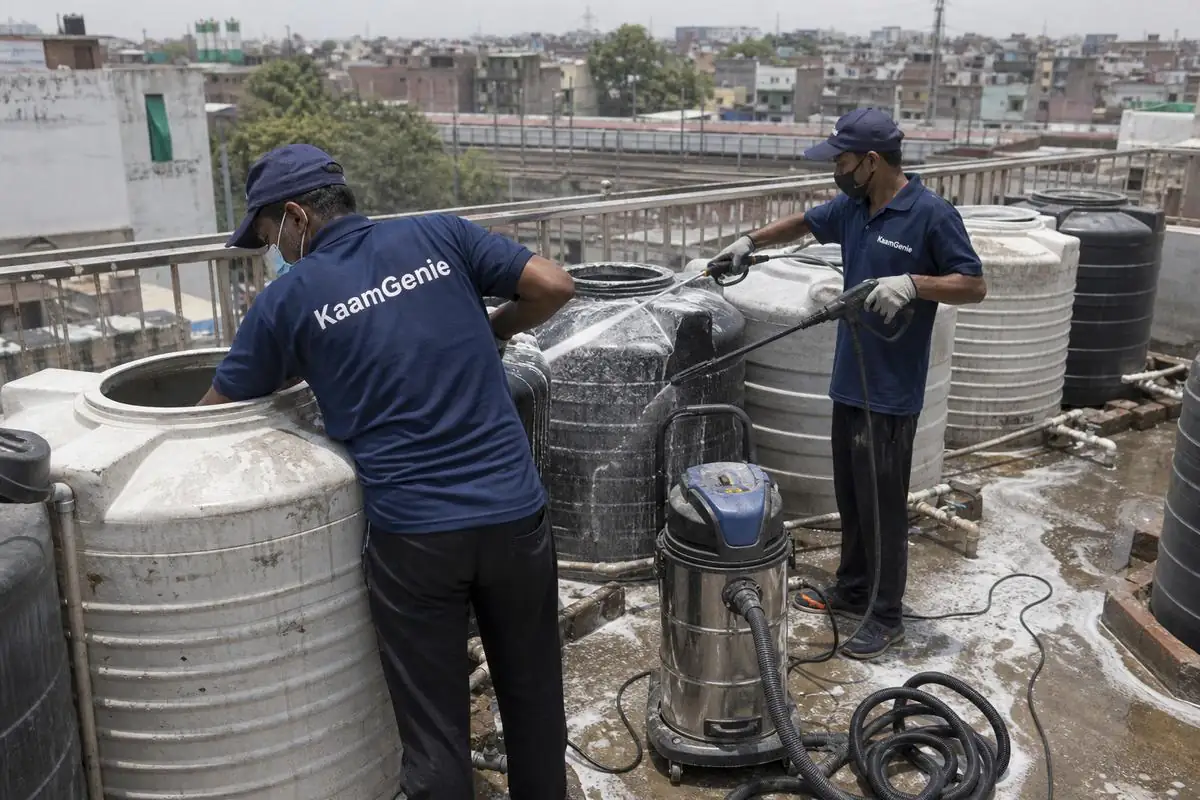
The age of the tank is the whole story in Shahdara. A shared tank that has sat on a roof by the railway line for a decade or more has taken in soot, dust and the sediment of both DJB and borewell water the entire time, and none of it leaves on its own. Because the tank serves several floors, it also refills more often than a single home's would, bringing in fresh grit with every cycle. The floor deposit in these tanks is frequently a solid, compacted layer rather than loose silt. Nothing short of opening and physically clearing it makes a difference.
That old sediment bed is a reservoir for bacteria and the earthy smell residents put up with as normal, and in a shared building it reaches every kitchen the tank feeds. Loosened grit also travels down into motors and taps across the floors, a running repair bill nobody links to the roof. For families in a building this old, the tank is simply the part of the house maintenance forgot. One thorough clean, then a regular cycle, finally breaks a years-long backlog.
No travel charge anywhere in Shahdara. The final price is confirmed on the call before we come — it depends only on tank size and access.
See it done in 45 seconds
Watch our web story on how a tank is really cleaned — drain, de-sludge, jet-wash, disinfect.
We reach every pocket of Shahdara — and there’s no travel charge to any of them:
Every locality in Delhi stores different water, and that decides how fast a tank fouls. This is Shahdara’s profile from The Delhi Water Index, built from our field observations across 250+ localities.
Indicative field characterisation, not a certified lab test. BIS IS 10500: TDS 500 mg/L acceptable, 2,000 permissible. Check any Delhi area →
“The tank has not been opened since we rebuilt the house years ago. Is one clean enough?” One thorough clean clears the compacted backlog: we lift the caked floor layer, scrub the walls and disinfect hygienic. After that a regular cycle keeps it from returning. On a tank sealed for years the first visit does the heavy work, and photos show how much came out.
“We are near the railway line and the roof is always sooty. Does that get into the tank?” It does. Soot and grit from the line and the bazaar settle onto the roof and work in through vents and lid gaps, adding to the water's own sediment. A tight lid helps, but the material already inside only comes out with a proper drain and scrub.
“How much does a shared tank in old Shahdara cost to clean?” The shared tank runs ₹1,500 to ₹2,000 by capacity. Older tanks needing extra de-sludging are still quoted at the survey with no surprise on the day, and several tanks in one building get a bulk rate for the single visit.
“The lanes here are very narrow. Can your crew reach a rooftop tank in old Shahdara?” Yes. Our teams work these old lanes regularly and carry the equipment in on foot where a vehicle cannot follow. We check the roof access during the survey so the visit itself runs without hold-ups.
“Several families share the one tank. How do you make sure nobody is without water during the clean?” We schedule the visit for a low-demand hour and work quickly on the single tank so it is back in service the same session. If the building relies on it heavily, we can advise storing a little ahead so no floor is caught short.
See our complete water tank cleaning services in Delhi NCR — pricing, process, tank types and full city coverage.
Beyond water tank cleaning, KaamGenie is rolling out a full lineup of home services across Delhi NCR — see our complete list of 12 home services we offer or will be launching through 2026. New to tank cleaning? Read our guide on how to pick the right water tank cleaning service in Delhi — what to look for, what to avoid, and the questions that separate trustworthy crews from quick-job operators.
Rooftop plastic tanks
₹699+ →Kothi sumps & underground tanks
₹1,499+ →Apartments & RWAs
Bulk pricing →FSSAI-compliant cleaning
₹2,500+ →टंकी साफ़ करने वाले
हिन्दी पढ़ें →View all water tank cleaning guides →
All pockets and lanes of Shahdara covered. If your specific block or society isn’t named in the sub-areas above, just call — we almost certainly cover it.
Same crew, same 6-step process, same-day where possible. Pick any locality below for local pricing and the tanks we typically find there.
Book a slot — we can usually fit you in today or tomorrow.