
Water Tank Cleaning Cost in Delhi (2026)
Raj Babbar · 8 min read
Home › Water Tank Cleaning › Society / RWA Tank Cleaning › Seelampur
Seelampur runs on its scrap and e-waste trade, and the same tight lanes that keep the recycling market humming are stacked with self-built floors sharing a single small tank at the top. Cleaning that overworked shared tank and logging it is the job here. From ₹1,500 per tank.
Few places in Delhi are as tightly packed as Seelampur, an old Trans-Yamuna quarter famous for its scrap and electronics-recycling market and its tall, narrow self-built houses. On lanes this dense a single rooftop tank often feeds four or five floors of families, so storage is shared by default even without any society structure. The water is mostly private borewell, hard and frequently discoloured, with DJB stretched too thin to reach far inside. Between the recycling dust in the air and the discoloured supply, a Seelampur tank takes in more than its share of solids. Serving so many people off so little storage, it is refilled constantly and rarely still long enough to be noticed.
KaamGenie cleans these shared, multi-floor tanks for the building's owner or the families using them together, working in the tight access these lanes allow. We empty the tank, lift out the discoloured sediment, hand-brush the walls, finish with a food-safe sanitiser and provide dated photos so every floor can see it was done. A household after only its own tank can look at water tank cleaning in Seelampur. Here the focus is the shared building tank that serves a whole Seelampur house.
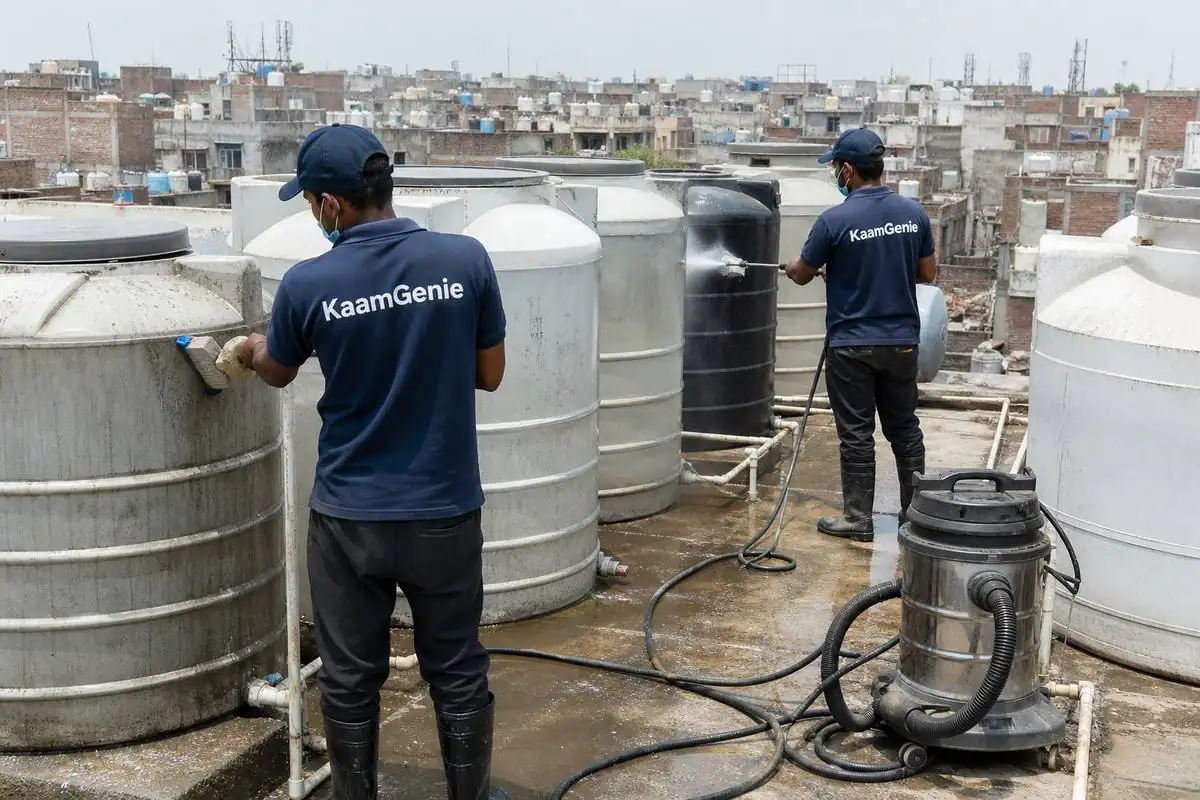
Storage in Seelampur is undersized for the density it feeds. A small rooftop tank meant for a family instead supplies four or five stacked floors, so it empties and refills all day and the hard, discoloured borewell brings fresh solids each time. There is no quiet spell for sediment to be caught early; it simply accumulates. Add the fine dust of a recycling neighbourhood settling from above and the load doubles. The bottom of a Seelampur tank builds up faster than almost anywhere in the city.
That heavy sediment bed shelters bacteria and pushes the discolouration residents already see in the borewell further, so the first bucket of the day comes cloudy across every floor. The grit rides into the shared motor and the taps, wearing them and clouding the flow. When one tank serves this many people, a single dirty tank affects a whole extended household at once. Cleaning it several times a year is not excessive here, it is what the density demands.
No travel charge anywhere in Seelampur. The final price is confirmed on the call before we come — it depends only on tank size and access.
See it done in 45 seconds
Watch our web story on how a tank is really cleaned — drain, de-sludge, jet-wash, disinfect.
We reach every pocket of Seelampur — and there’s no travel charge to any of them:
Every locality in Delhi stores different water, and that decides how fast a tank fouls. This is Seelampur’s profile from The Delhi Water Index, built from our field observations across 250+ localities.
Indicative field characterisation, not a certified lab test. BIS IS 10500: TDS 500 mg/L acceptable, 2,000 permissible. Check any Delhi area →
“Our borewell water comes out discoloured. Is the tank the problem or the borewell?” It is usually both. The borewell here runs discoloured to start with, and a long-uncleaned shared tank adds its own settled sediment and biofilm on top. Cleaning the tank removes the part you can control, and the first-draw water comes out noticeably clearer afterwards.
“The lane is too narrow for a vehicle. Can your team still reach the roof?” Yes. Our crews are used to Seelampur's lanes and carry the pumps, brushes and disinfectant up on foot. We confirm the stair and roof access at the survey so there are no surprises, and the work is done entirely on the roof.
“Five floors share our tank. How do we split the cost?” The shared tank is a single quote of ₹1,500 to ₹2,000 by size, and the families split it however they agree, often evenly by floor. We do the tank once for everyone and leave one dated record the building can keep.
“A tank this heavily used, how often should it be cleaned?” For a tank feeding four or five floors on this water, three cleans a year is realistic. The constant refills and the discoloured supply rebuild the sediment quickly, so a longer gap lets it thicken to where the whole building tastes it.
“Does the recycling-market dust really reach a covered tank?” Fine dust works in through vent holes and any gap at the lid, so even a covered tank collects it over time. We clear what has gathered and check the lid fit, which slows how fast it comes back between cleans.
See our complete water tank cleaning services in Delhi NCR — pricing, process, tank types and full city coverage.
Beyond water tank cleaning, KaamGenie is rolling out a full lineup of home services across Delhi NCR — see our complete list of 12 home services we offer or will be launching through 2026. New to tank cleaning? Read our guide on how to pick the right water tank cleaning service in Delhi — what to look for, what to avoid, and the questions that separate trustworthy crews from quick-job operators.
Rooftop plastic tanks
₹699+ →Kothi sumps & underground tanks
₹1,499+ →Apartments & RWAs
Bulk pricing →FSSAI-compliant cleaning
₹2,500+ →टंकी साफ़ करने वाले
हिन्दी पढ़ें →View all water tank cleaning guides →
All pockets and lanes of Seelampur covered. If your specific block or society isn’t named in the sub-areas above, just call — we almost certainly cover it.
Same crew, same 6-step process, same-day where possible. Pick any locality below for local pricing and the tanks we typically find there.
Book a slot — we can usually fit you in today or tomorrow.