
Quick answer
- Popping, crackling or rumbling while it heats: a layer of scale and silt on the geyser floor. Water trapped under it boils in small bursts.
- Slower heating and a bigger winter bill: scale coating the heating element, so it stays on longer for the same bucket.
- Gritty or muddy water from both the hot and the cold tap: the silt is coming from your tank, sump or supply. Fix the tank first.
- Brown or rusty water from the hot tap only: more likely the geyser itself (a worn anode rod or a corroding inner tank) or old hot-water pipes.
- No heat, a tripping MCB, steam or a spitting valve: an electrical or thermostat fault. Switch it off at the mains and call a technician.
Cleaning the storage tank stops new silt reaching the geyser. Descaling and servicing the geyser is a job for a geyser technician or plumber; KaamGenie does not service geysers, and nobody should open one at home.
Grit in the hot water? Start with the tank
Overhead tanks from ₹699, sumps from ₹1,499, a fixed price agreed before the crew starts. Silt and loose scale come out, and you get before and after photos.
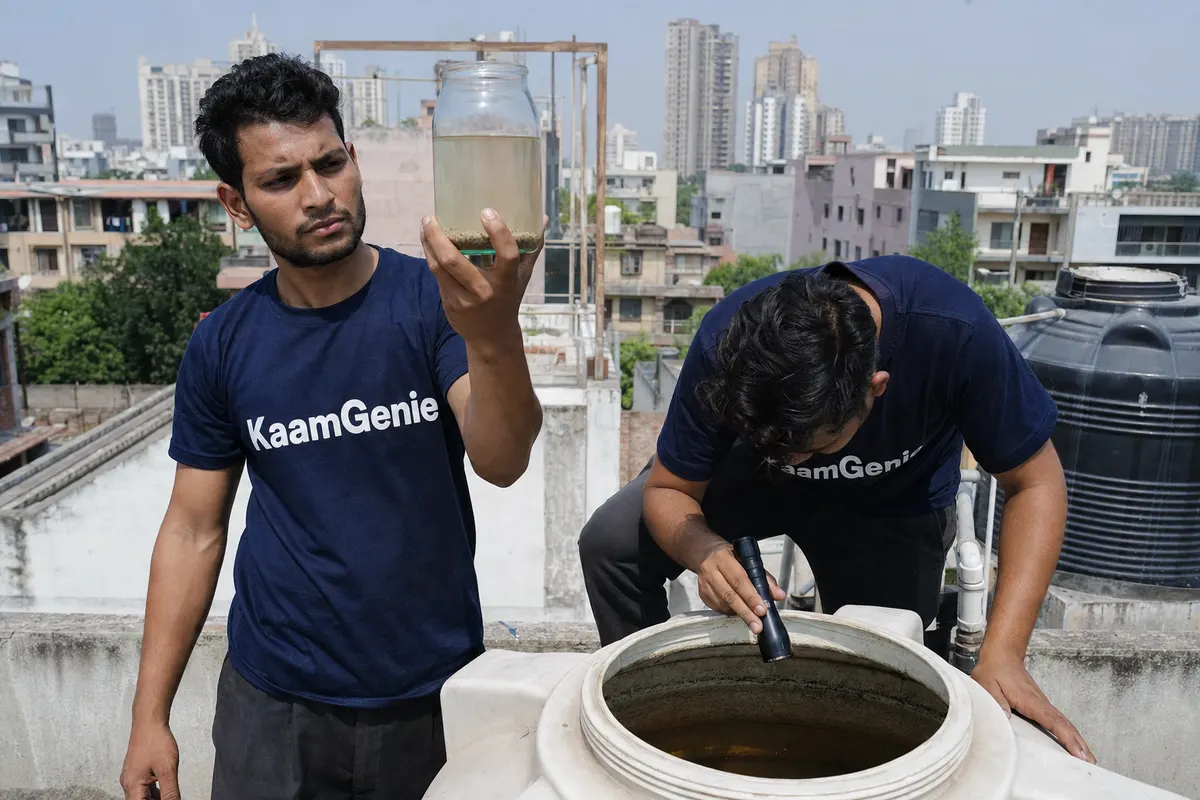
Gurgaon homes lean on their geysers from just after Diwali until the end of February, and that is when people notice the noises, the slow buckets and the odd colour. A storage geyser is filled from the same tank that feeds your cold taps, so whatever sits on the floor of that tank, and whatever is dissolved in the water, travels into the heater too. Our crews clean water tanks across Gurgaon, and we often find the same fine grit on a tank floor that the family has been rinsing out of the shower head. This post explains how it gets there and where our job ends and the geyser technician’s begins.
How tank silt and hard water get inside a geyser
A typical storage geyser has a cold inlet low down, a heating element near the bottom and a hot outlet near the top. Hot water rises and is drawn off from above; anything heavier than water sinks and stays below. Two very different kinds of deposit end up in that bottom zone.
- Silt that arrives from outside. Fine sand, clay and rust flakes lie on the floor of a tank that has not been cleaned for a while. The outlet pipe usually sits a little above the floor, but once the sludge layer thickens, or the tank runs nearly empty, the outlet starts pulling it into the house lines. The geyser is the first place where that water sits still for hours, so it settles there.
- Scale that forms inside the heater. Hard water carries dissolved calcium and magnesium. Heat drives some of it out of the water as a hard white crust, the same crust you see in an old kettle. It forms on the element and the inner walls, flakes off and piles up with the silt.
Gurgaon supplies plenty of both. Groundwater across much of the district is hard, and many homes still top up from borewells; our guide to hard water and your Gurgaon tank explains why the scale keeps returning. Tanker deliveries bring clay with every load, as we set out in tanker water and your tank. When city supply comes back after a shutdown, the first rush can fill a tank with loosened pipeline sediment; the first-day routine for that is in muddy water after supply is restored. If you want a number for how mineral-heavy your water is, a TDS meter gives a rough guide, and we explain how to read it in TDS levels in Gurgaon tank water.
Seven geyser symptoms and where each one points
The single most useful question is whether a symptom shows up in the hot water alone, or in the cold water as well. Cold water never passes through the geyser, so anything you see in both comes from further upstream.
| What you notice | Hot only, or cold too? | Likely source | Who deals with it |
|---|---|---|---|
| Popping, ticking or rumbling as it heats | Hot only | Scale and silt layer on the geyser floor | Geyser technician (descale and flush); tank clean if silt is arriving |
| Takes longer to heat, element stays on longer | Hot only | Scale insulating the element, or a weakening element | Geyser technician |
| Fine sand or brown grit in buckets and shower heads | Both | Silt from the tank, sump or supply | Tank cleaning first, then a geyser flush |
| Rusty or brown hot water, cold water clear | Hot only | Worn anode rod, corroding inner tank, or old iron hot-water pipes | Geyser technician; plumber for the pipes |
| White chalky chips clogging the hot side | Hot only | Scale breaking off inside the geyser | Geyser technician |
| Rotten-egg smell from the hot tap only | Hot only | The anode reacting with bacteria in warm water | Geyser technician; see our smelly-water guide |
| No heat, MCB trips, steam, or a valve spitting water | Hot only | Element, thermostat or safety-valve fault | Switch off at the mains; geyser technician or electrician |
The smell row has its own explanation in smelly tank water in Gurgaon, so we will not repeat it here.
The aerator and white-bucket check
You can narrow the cause down in an evening without touching the geyser. You need two clean white buckets, a small towel and, ideally, a bathroom with separate hot and cold taps.
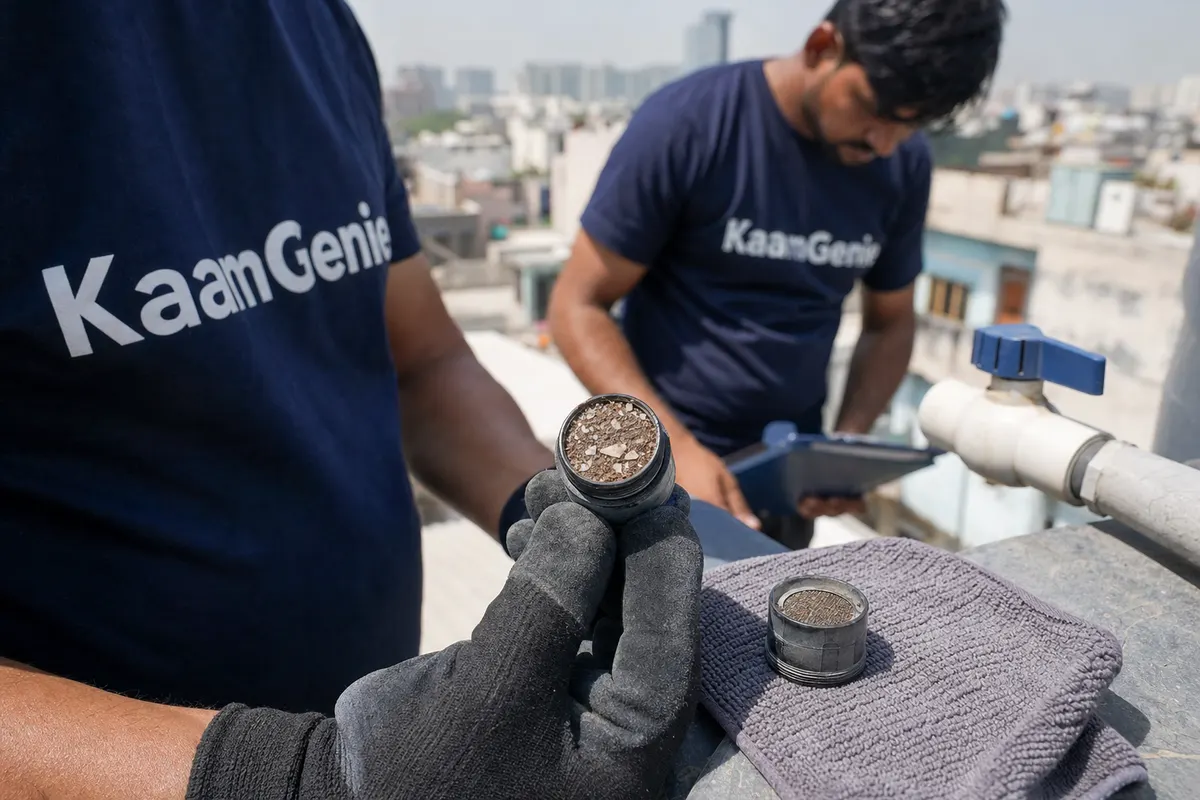
- Read the aerators. Unscrew the small mesh cap at the mouth of the hot tap and the cold tap, or the filter in the shower head, over the towel. Brown or grey sand on both meshes means it is travelling in from the tank or pipes. Hard white chips only on the hot side point to scale from the geyser. Reddish flakes only on the hot side point to rust inside the heater or along an old hot-water line.
- Fill the two buckets. Once the geyser has finished a heating cycle, fill one bucket halfway from the cold tap and the other halfway from the hot tap. Let both stand undisturbed for thirty minutes, then tilt them gently against the light and look at the bottom.
- Compare what settled. The same fine brown layer in both buckets is upstream silt. A deposit only in the hot bucket belongs to the geyser. Milky cloudiness in the hot bucket that clears within a minute or two is usually tiny air bubbles released by heating.
- Time a full heat. On a day when the geyser starts from cold, note how long the indicator light stays on before it clicks off, without changing the temperature setting. Repeat it a couple of weeks later. If the time keeps creeping up, scale is building on the element.
- Listen at the start of the cycle. Popping or a low rumble in the first few minutes of heating, which quietens as the water warms, is the classic sound of water boiling in pockets beneath a sediment layer.
A safety line before anything else: do not take the geyser cover off, unscrew the element or the anode, or try to drain the heater yourself. It combines mains electricity with water that can scald, held under pressure. Aerators and shower heads are the only parts you should handle.
Tank silt or a geyser fault: telling them apart
Silt from the tank is gritty, it settles quickly, and it appears in cold water too, especially just after a tanker fill or when supply resumes. A geyser fault behaves differently, and the main parts are worth understanding so you can describe the problem clearly to a technician.
The anode rod
Many enamel or glass-lined storage geysers have a magnesium rod inside the tank. It is designed to corrode slowly so the steel tank does not. Hard water tends to wear it down, and once it is used up, the inner tank can start to rust. The giveaway is brown or rusty water from the hot tap while the cold tap from the same tank runs clear. Checking and replacing the rod is routine servicing for a geyser technician, and your geyser manual or the brand’s service centre will tell you what it needs.
The heating element and thermostat
A scale-crusted element has to run longer to deliver the same heat, which is why a scaled geyser feels slow and why the electricity bill rises in winter. Badly scaled elements can also fail early. A dead element usually means no heat at all, while a faulty thermostat can mean water that is far too hot, or a heater that never switches off. Both need a qualified technician, and a geyser that trips the MCB should stay switched off until it has been checked.
When it is the pipes, not the heater
In older plotted houses, hot water sometimes runs through galvanised iron pipes that rust faster when warm. Then the hot side shows colour even though the geyser is fine. A plumber can confirm this by checking the water right at the geyser outlet. Our post on rust in Gurgaon tanks and fittings covers which metal parts corrode and what to replace them with.
What cleaning the tank can and cannot do for your geyser
| A tank clean can | A tank clean cannot |
|---|---|
| Remove the silt and sludge layer that feeds grit into the house lines | Remove scale or sediment already lying inside the geyser |
| Scrub off loose scale from the tank walls and floor | Make hard water soft; the minerals come in with every fill |
| Show you, in photos, what was lying in the tank | Replace an anode rod, element or thermostat |
| Slow the build-up of new deposits in the geyser | Fix rusty hot-water pipes or a leaking valve |
If hardness is the bigger issue, a softener on the inlet line is the tool that reduces it; the TDS post linked above discusses when that is worth considering. Cleaning on its own keeps the tank from adding silt on top of the scale.
Whose tank feeds your geyser
Where your geyser’s water starts depends on the building, and that decides who you call first.
- Independent builder floor: each floor usually has its own tank on the terrace, often fed from a shared sump. If only your floor has gritty hot water, your own tank is the place to start. Our builder floor tank guide explains the typical layout.
- Condominium or society flat: your geyser is fed from tower tanks that are filled from a large common reservoir. If neighbours report the same grit, ask the facility office when the reservoir and tower tanks were last cleaned.
- Plotted house or kothi: the sump and the overhead tank are both yours. Silt usually builds up in the sump first, so both need doing, sump first.
- Tanker- or borewell-heavy home: you get the most silt and the hardest water at once. Letting each tanker load settle for about an hour before running the upper taps keeps the cloudiest water out of the geyser.
We work across Gurgaon, including Sector 14, Palam Vihar, South City and New Gurgaon.
Clean the source before the geyser is serviced
Book the tank clean first, then call your geyser technician. That way the heater is not refilled from the same silty tank a week later.
The right order: tank first, geyser second
People often book the geyser technician first, get a clean heater, and then refill it from the same silty tank. Reversing the order makes the geyser service last longer.
- Get the storage tank cleaned. Include the sump if your home has one.
- Run the cold taps after the refill until the water comes through clear, so the remaining grit in the pipes is flushed out before it reaches the heater.
- Then call the geyser technician to flush and descale the heater and check the anode, element and safety valve.
- Keep the tank on a schedule. We recommend cleaning every 3 months, and our post on how often to clean a tank in Gurgaon explains what can shift that timing.
How KaamGenie deals with the tank side
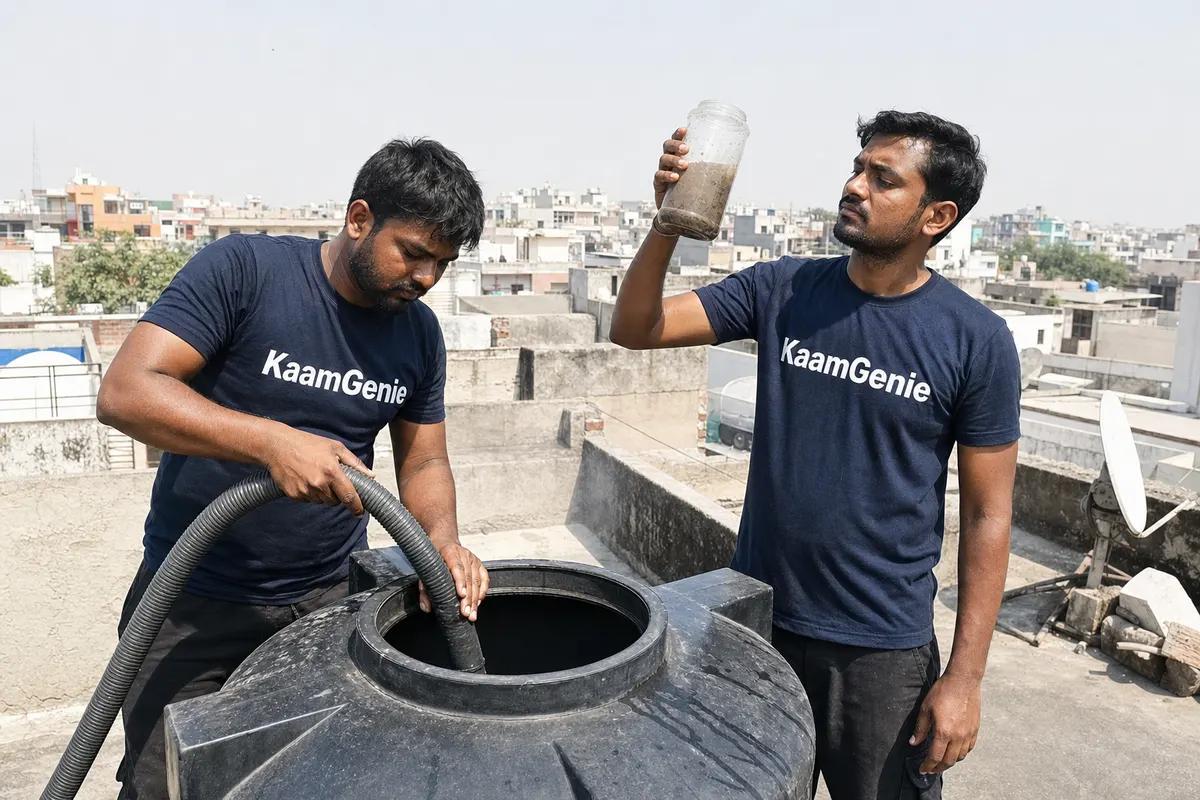
For a geyser complaint, four parts of our clean matter most. The full sequence is set out in our Gurgaon cleaning process guide.
- Inlet shut before anything else: fresh water cannot stir the bottom layer while we work, and the murky remainder is pumped away instead of being sent down the house pipes.
- De-sludging: the silt is scooped and wet-vacuumed out and carried off site, not rinsed into a drain.
- Scrubbing: walls and floor are scrubbed, which removes loose scale; heavily bonded scale may need more than one visit to shift fully.
- Photos on WhatsApp: you see the before and after state of your own tank, which is useful to show the geyser technician too.
A standard clean uses no chemicals. Disinfection is available only if you request it. A single overhead tank normally takes the crew about an hour to an hour and a half, and how soon it refills depends on your supply. You pay once the job is finished and you have looked at the before and after photos. We do not open, descale or repair geysers, and if we notice a leaking valve or pipe near the tank we will point it out for your plumber.
What not to do
- Do not open the geyser yourself. Removing the cover, the element or the anode exposes live wiring and very hot water under pressure.
- Do not pour vinegar, descaling powder or bleach into the storage tank. It does not reach the geyser in any useful strength, and it leaves a residue in your drinking water.
- Do not cap, plug or tie off a dripping safety valve. It is there to release pressure. Tell the technician instead.
- Do not turn the thermostat to maximum to make up for slow heating. Hotter water drops scale faster and raises the scalding risk.
- Do not keep resetting an MCB that trips when the geyser runs. Leave it off until an electrician or technician has looked at it.
- Do not service the geyser and skip the tank. The silt comes back with the next refill.
Book a tank clean before the cold weeks set in
If the bucket check shows grit in both hot and cold water, the tank is where to begin. We quote a fixed price before work starts: ₹699 for an overhead tank and ₹1,499 for an underground sump, with society reservoirs priced by size. Sunday and weekend slots are available. Book through our Gurgaon water tank cleaning page or call +91 95603 66362. For the wider picture of tank care in the city, read the complete Gurgaon water tank cleaning guide, and for other early warnings, see signs your Gurgaon tank needs cleaning.
Frequently asked questions
Why does my geyser make a popping or rumbling sound?
That sound usually comes from a layer of scale and silt on the floor of the heater. Small pockets of water get trapped under the layer, heat up faster than the water above, and turn to steam in little bursts. It is most noticeable at the start of a heating cycle. The noise is a sign that the geyser needs descaling and flushing by a technician, and, if grit is also showing in your cold water, that the storage tank feeding it needs cleaning.
Can a dirty water tank damage my geyser?
It can contribute to problems. Silt drawn from a neglected tank settles in the bottom of the geyser along with the scale that hard water forms, and that combined layer makes the element work harder and can shorten its life. It also blocks shower heads and aerators on the hot side. Cleaning the tank does not repair a geyser, but it stops fresh silt being added every time the heater refills.
Why is only my hot water brown or rusty?
If the cold tap from the same tank runs clear, the colour is being picked up after the water leaves the tank. The usual suspects are a worn magnesium anode, an inner tank that has started to corrode, or old galvanised iron pipes on the hot side that rust faster when warm. A geyser technician can check the anode and inner tank, and a plumber can test the water at the geyser outlet to rule the pipes in or out.
Will getting my water tank cleaned fix the geyser?
Only partly. A tank clean removes the silt and sludge that would otherwise keep flowing into the heater, and it scrubs loose scale out of the tank. It does not remove the deposit already sitting inside the geyser, and it cannot replace a failing element or thermostat. The sensible order is to have the tank cleaned first, run the cold taps until clear, and then have a geyser technician flush and descale the heater.
Does KaamGenie descale or service geysers?
No. We clean overhead tanks, underground sumps and society reservoirs, and our crews do not open, drain, descale or repair water heaters. For that, use the service centre of your geyser brand, a geyser technician or a qualified plumber. What we can give you is a set of before and after photos of your storage tank, so the technician knows whether silt from the tank has been part of the problem.
Is it safe to drain or flush a geyser myself?
We advise against it. A storage geyser holds very hot water under pressure and is connected to mains electricity, and some models need specific steps to drain without damaging the element or the valves. If someone qualified is doing it, the geyser must be switched off at the mains well beforehand. Your safe jobs at home are unscrewing and rinsing aerators and shower-head filters, and noting the symptoms for the technician.
How does hard water affect geyser heating time and the bill?
Hard water leaves a mineral crust on the heating element. That crust acts like insulation, so the element has to stay on longer to warm the same quantity of water, and the extra running time shows up on the electricity bill through the winter months. A geyser that takes noticeably longer to heat than it used to, with the same setting, is a good reason to call a technician for descaling, and to check what is lying in your tank.
What does a tank clean cost, and when do I pay?
An overhead tank is ₹699 and an underground sump is ₹1,499, with larger society reservoirs quoted by size. The price is fixed before the crew starts work. You pay after the cleaning is done, once you have seen the before and after photos of your tank on WhatsApp. A standard clean uses no chemicals; disinfection is added only when you ask for it.
Sources & references
- Bureau of Indian Standards (BIS): IS 10500:2012 sets acceptable and permissible limits for total hardness and other drinking-water parameters.
- Central Ground Water Board (CGWB): groundwater quality information for Haryana, including Gurugram district.
- WHO Guidelines for Drinking-water Quality, 4th edition: background on hardness, scaling and the acceptability of stored water.
- Gurugram Metropolitan Development Authority (GMDA): the agency responsible for bulk water supply in Gurugram.
Last verified: 23 November 2026. If you find any of these links broken, please let us know.