
Quick answer
- Find out which tank is yours. In a builder floor or kothi it is your own rooftop tank. In a society or condominium the common tanks are the RWA’s job; only a flat-level loft tank, if any, is yours.
- Arrange one person for access: a caretaker, neighbour, property manager, the RWA office or the tenant. They only need to open up and show the crew the tank.
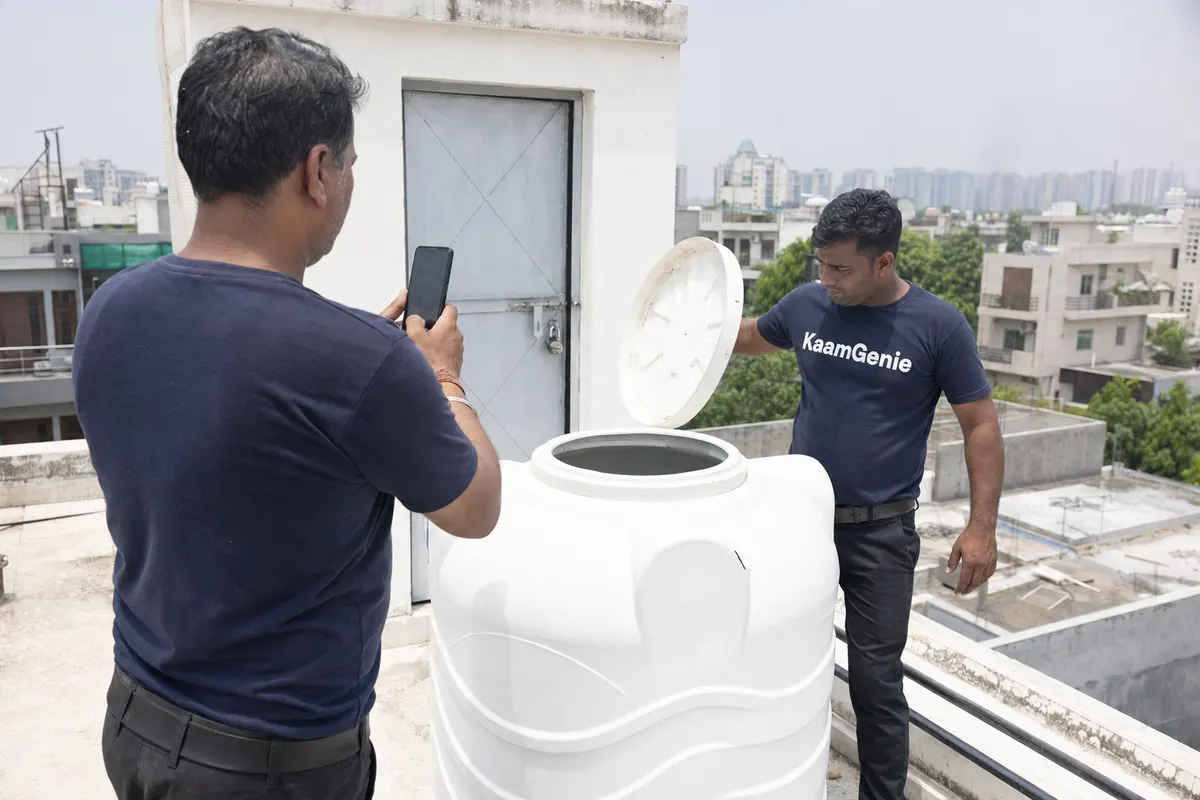
- Insist on proof: before and after photos of your own tank on WhatsApp, sent to you directly, not just to the person on site.
- Agree the price first: a fixed price is confirmed before work starts, and you pay only after the clean is finished and you have seen the before and after photos of your tank on WhatsApp. A family member or your property manager can also settle it locally.
- Time it around changes: before a new tenant moves in, after the flat has stood locked for a long time, and a few days before you or your family arrive.
For an owner abroad, the rooftop tank starts at ₹699 and an underground sump at ₹1,499, with the figure fixed on WhatsApp before your contact unlocks the door.
Living abroad? We can do the whole job remotely
Price agreed on WhatsApp, access through your caretaker, RWA or tenant, photos sent straight to you, and payment only once you have seen them. No chemicals unless you ask.
Gurgaon has a large number of flats owned by people who do not live in them: families settled abroad, owners working in other Indian cities, and parents who bought for a child who has not moved back yet. Some of these homes are let out, some are kept locked for visits, and some sit between the two. In all of them, the water tank is the part of the property nobody checks. This guide is a practical playbook for getting it cleaned from a distance. For the service itself, our crews handle water tank cleaning across Gurgaon.
Why an empty or rented flat’s tank gets worse, not better
Locked flats: water that never moves
When nobody uses the taps, the water in a rooftop tank stands still for weeks or months. In Gurgaon’s summer that tank sits in strong sun on the roof and the water warms up. Still, warm water with a little dust and organic matter is where bio-film and slime grow on the walls. If the lid is loose or the overflow pipe is open, dust storms, leaves, insects and the occasional bird get in too. The first time anyone opens a tap, all of that comes through. Many owners also keep the supply valve open while away, so the tank keeps topping up on top of the old water and the sediment layer quietly thickens.
Rented flats: nobody owns the job
Tenants reasonably assume the tank is the owner’s responsibility. Owners abroad assume the tenant would say if something was wrong. Tenants often do not notice gradual changes, and many use bottled or RO water for drinking, so the tank can go years without anyone opening it. Every tenant changeover is a chance to fix that, and it is usually missed. Our tenant guide covers the question from the renter’s side.
Two related situations with their own guides
This page is about the logistics of arranging a clean from a distance. If the flat is home to your elderly parents, plan the day around them: tell us if a carer will be present, and keep them off the roof while the crew works; use this page for the booking side. If you let the flat on short stays, fitting the clean into a guest turnover and protecting your reviews is covered in our service apartment and Airbnb host guide.
First, which tank is actually yours?
This decides who you need to talk to, and it changes from one kind of building to another.
| Your situation | Whose tank | Who can give access | What to book |
|---|---|---|---|
| Builder floor, flat kept locked | Your floor’s own rooftop tank | Caretaker, neighbour or relative with roof access | Your tank only; check whether the ground-floor sump is shared |
| Builder floor, let to a tenant | Your floor’s own rooftop tank | The tenant, or the person who manages the letting | Your tank, timed with the tenant’s convenience or the changeover |
| Independent house or kothi | Underground sump and overhead tank, both yours | Caretaker or property manager | Sump and overhead tank together |
| Society or condominium flat | Common tanks belong to the society | RWA or facility office for the common tanks | Ask the RWA for the last-clean date; book only any flat-level tank yourself |
| Flat between tenants | Depends on the building, as above | Your property manager or broker holding the keys | A clean in the vacant gap, before the new tenant’s first day |
If you are not sure, ask the person on site to send you a photo of the roof. A tank with your flat number or floor painted on it, or the only tank on a builder floor’s terrace section, is usually yours. In condominiums, a look at our condominium tank guide explains how the common reservoir and tower tanks are run.
The remote playbook, step by step
- Choose the access person. A caretaker, a trusted neighbour, your property manager, the RWA office or the tenant. They need to be able to open the roof door and the tank, and to stay for the visit: your contact should keep 60 to 90 minutes free for the cleaning of one overhead tank, plus whatever time the building’s supply needs to fill it again.
- Send us the basics on WhatsApp: the address, the type of building, whether there is an underground sump, and a photo of the tank if the access person can take one. We confirm a fixed price before anyone visits.
- Agree the slot with the access person directly, and add them to the conversation so nothing is lost in forwarding.
- Ask for photos sent to you. We send before and after photos of your own tank to the number you give us, so you see the result yourself, not a summary from someone else.
- Pay after you have seen the result. Nothing is due upfront. Once the clean is done and the photos have reached your phone, you settle the agreed amount yourself, or a family member or your property manager pays locally. Decide which before the visit, so nobody on site is surprised.
- Keep the record. Save the photos with the date in a folder for the property. It is the simplest way to answer “when was the tank last cleaned?” for the next tenant, a buyer or yourself.
For timing between cleans in a lived-in flat, see how often to clean a tank in Gurgaon. For a locked flat, the trigger is usually an event, such as a new tenant or a family visit, rather than the calendar.
What good photo proof looks like
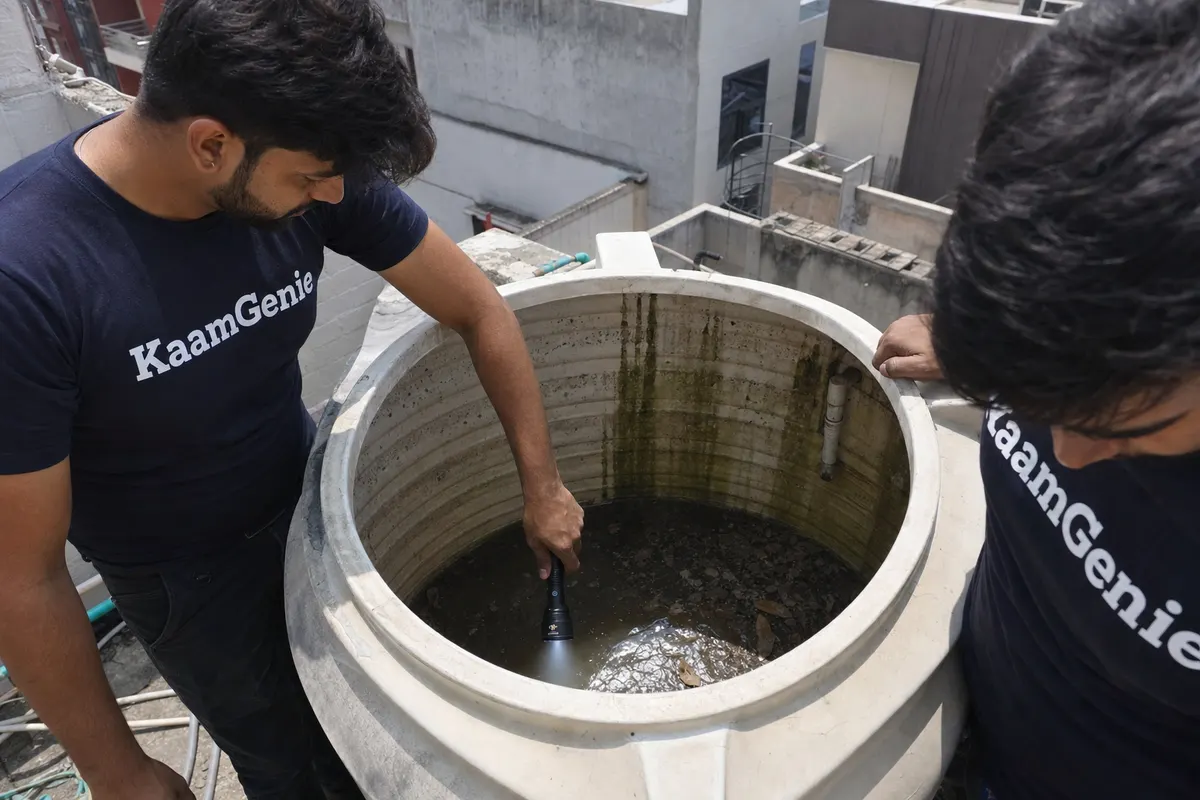
Not all photos prove much. Because you pay only after seeing them, they need to show the real job, so ask for these and expect them as standard:
- A wide shot that shows the location: the tank on your roof, with something recognisable of the building in the frame, so you know it is your tank.
- The inside before cleaning: the floor and walls with the lid off, showing whatever has collected.
- The inside after cleaning: the same view, drained, scrubbed and rinsed, before refilling.
- The lid and fittings: any broken lid, open overflow pipe or leaking valve, so you can ask the caretaker or a plumber to fix it.
Before and after photos are part of every job we do, not an extra. What a standard visit includes is set out in what is included in a tank cleaning service.
New tenant moving in soon?
Book the clean for the gap between tenants. Send us the address and the name of whoever holds the keys, and we will confirm a fixed price and a slot.
What to ask before a new tenant moves in, or before you visit
Use this as a checklist with your property manager, broker or caretaker. It takes one message and saves an awkward first week.
- When was the tank last cleaned, and is there a photo? If nobody knows, assume it is overdue.
- Has the flat been empty, and for how long? A long empty spell is the strongest reason to clean before anyone uses the water.
- Is the lid in place and secure? Ask for a photo.
- Is the supply valve open or closed while the flat is empty? Note it, so the clean is booked before it is opened again.
- For a society flat: what does the RWA say? Ask for the last cleaning date of the common reservoir and your tower’s tanks.
- Who will be at the flat on the day? Confirm their name and number with us in advance.
If you are visiting yourself, book the clean a few days before your flight rather than for the day you land, so the tank is refilled and the water has run through before your family uses it. Our move-in tank guide covers the same logic for anyone moving into a flat.
Remote owners call us from flats in DLF Phase 4, Sushant Lok, Sector 56 and along Golf Course Road. In the older plotted parts of Sushant Lok, our crews often open a locked flat’s tank to find a rust-brown layer on the floor, because ageing GI supply pipes shed scale into water that then sits unused for months. Builder-floor owners may find our builder floor tank guide helpful too.
Tenant changeovers: the handover note
The gap between two tenants is the moment remote owners most often miss, because the broker’s focus is on paint, keys and the agreement. Add three lines to whatever you send the broker or property manager when a tenant gives notice:
- “Book the tank clean for the vacant days, not after the new tenant arrives.” A clean with someone living in the flat means a few hours without water for them and an awkward first impression.
- “Send me the before and after photos, and share the after photo with the new tenant.” It answers the “when was the tank last cleaned?” question before it is asked, and sets the expectation that the tenant reports problems.
- “Check the lid and the overflow pipe while the roof is open.” A lid should be clamped, strapped or locked, never held down with a brick; a photo tells you whether it needs replacing.
For a society flat, the same note asks the RWA or facility office for the last cleaning date of the common tanks. For the general picture of how each kind of Gurgaon building is cleaned, see the complete guide to water tank cleaning in Gurgaon.
How KaamGenie cleans the tank while you are away
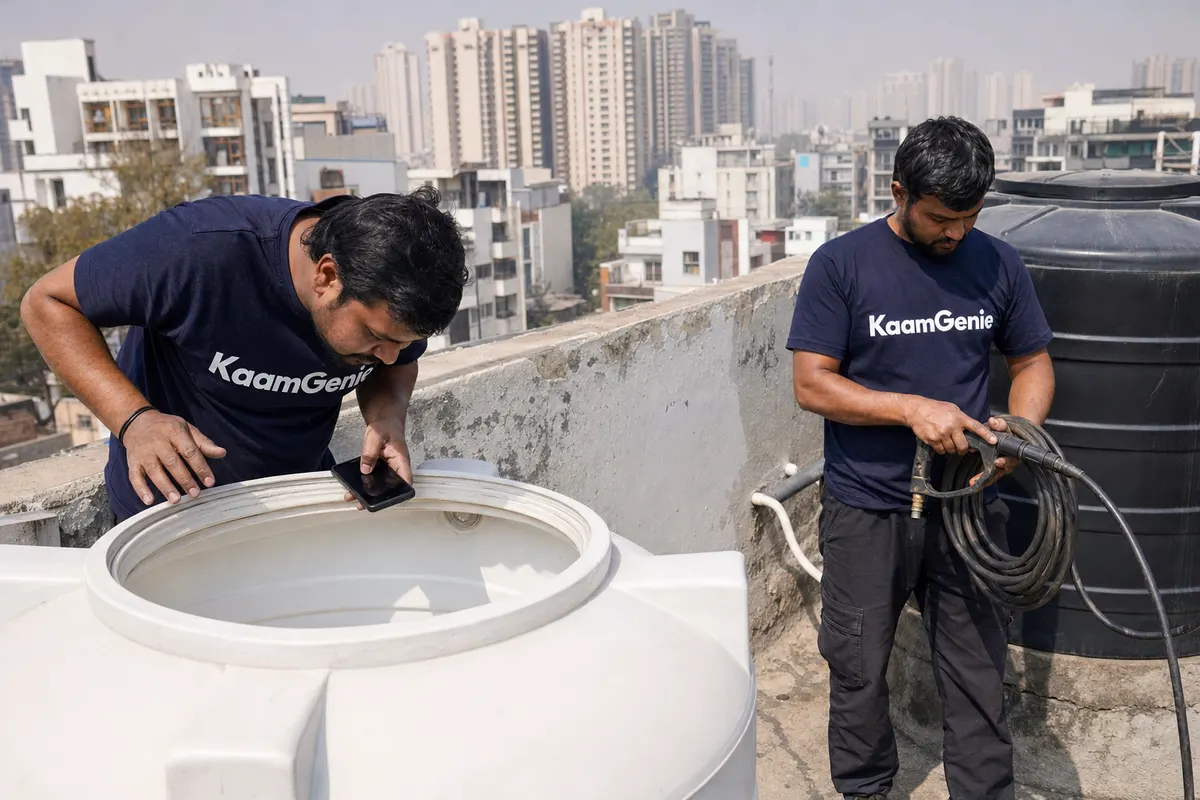
The clean itself is our standard one, the same whether you are standing next to the tank or eight time zones away, and it is explained in full in the Gurgaon cleaning process guide. Three details matter more when you are not there:
- The after photo is taken before refilling. A full tank hides the floor. Photos of the drained, scrubbed and rinsed tank, and of the location on your roof, go to the number you give us as well as to the person on site.
- The dirty bottom layer never goes down the flat’s pipes. In a locked flat nobody runs the taps afterwards to flush it out, so the settled dust, leaves and sediment are scooped and vacuumed out at the tank itself.
- Someone runs the taps after the refill. Ask your access person or tenant to open each tap for a minute. On a builder floor with several floors on one system, open taps from the top floor down to clear any airlock.
Your tank is cleaned without chemicals unless you tell us otherwise. Owners whose flat has stood locked for a long spell sometimes add disinfection when they book from abroad, and we do it only when you ask. Our disinfection guide explains when it is worth asking for.
What not to do
- Do not ask the caretaker to “just put some bleach in”. Dosing is guesswork, the sediment stays, and the next person to use the flat gets the smell.
- Do not book without naming the access person. A crew that reaches a locked roof door is a wasted visit for everyone; confirm the name and number with us in advance.
- Do not hand over a flat to a new tenant without opening the tank. It is the cheapest moment to fix it and the hardest to explain later.
- Do not rely on a verbal “it’s been done”. Without a dated photo of your own tank, you have no record.
- Do not assume the society’s clean covers your flat. The RWA cleans the common reservoir and tower tanks; a loft or bathroom tank inside your flat is yours to book.
Starting from abroad: one message is enough
You do not need to call during Indian office hours. Send us on WhatsApp the address, the kind of building and the name and number of whoever can open up, whenever suits your time zone. For a flat you own from abroad, the reply carries a fixed figure (from ₹699 for the overhead tank, from ₹1,499 if there is an underground sump), and we fix the visit with your contact. The photos land on your phone first, and only then do you pay, or ask someone in Gurgaon to pay for you. Check whether your sector is listed on the Gurgaon tank cleaning page, or ring +91 95603 66362 when it suits your time zone.
Frequently asked questions
Can I get my Gurgaon flat's tank cleaned without being in India?
Yes. You only need someone who can open the flat or roof on the day, such as a caretaker, neighbour, property manager, the RWA office or your tenant. We agree a fixed price with you on WhatsApp beforehand, coordinate the slot with your contact, and send before and after photos of your own tank directly to your number. You pay only after the job is done and you have seen those photos; a family member or your property manager can also settle it locally.
How do I know the crew actually cleaned my tank?
Ask for photos that prove location and work: a wide shot showing the tank on your building’s roof, the inside before cleaning, and the inside after cleaning but before refilling, plus any broken lid or fitting. We send these as standard to the owner’s number, not only to the person on site. Save them with the date for your records.
Is the water safe after a flat has been locked for months?
Do not assume it is. Water that stands still for months in a rooftop tank, particularly through a Gurgaon summer, can develop slime and collect dust and debris, and the first water drawn will carry it. Have the tank cleaned before anyone uses the flat, run every tap afterwards, and use separately stored water for drinking until then.
Who should pay for tank cleaning in a rented flat?
A tank that serves only your flat is part of the property, so most owners treat cleaning as their cost, especially between tenants. Some agree a different split in the rental agreement. Common tanks in a society are the RWA’s responsibility and paid through maintenance. This is general practice, not legal or tax advice; your rental agreement sets the terms between you and your tenant, and a lawyer or tax adviser can confirm anything specific.
My flat is in a society. Do I need to book anything?
Usually not for the common reservoir and tower tanks, which the RWA or facility team should clean. What you can do from abroad is ask them, by email, when those tanks were last cleaned and whether photos are available. If your flat has its own loft or bathroom tank, that one is yours to book. Ask to be added to the RWA’s notices so you hear about future cleans.
When is the best time to book while the flat is empty?
The best moments are the gap between two tenants, after the flat has been locked for a long stretch, and a few days before you or your family arrive. Avoid booking for the day you land; the tank needs time to refill and the water should be run through the taps first. If the supply valve was closed while you were away, book the clean before it is opened again.
How is payment handled if I am abroad?
Nothing is paid in advance. The crew finishes the clean, the before and after photos of your own tank reach your WhatsApp, and only then is the agreed amount due. You can settle it yourself, or a family member or your property manager in Gurgaon can pay locally. The figure is the one fixed before the visit, from ₹699 for an overhead tank and ₹1,499 for a sump, and nothing is added for the cleaning on the day. If the lid or a valve needs replacing, that part is priced for you separately.
Sources & references
- WHO Guidelines for Drinking-water Quality, 4th edition: guidance on water quality in storage and distribution, including stagnant water.
- Bureau of Indian Standards (BIS): IS 10500:2012, the Indian Standard for drinking water.
- CPHEEO Manual on Water Supply and Treatment: Government of India guidance on storage tanks and their maintenance.
Last verified: 22 November 2026. If you find any of these links broken, please let us know.