
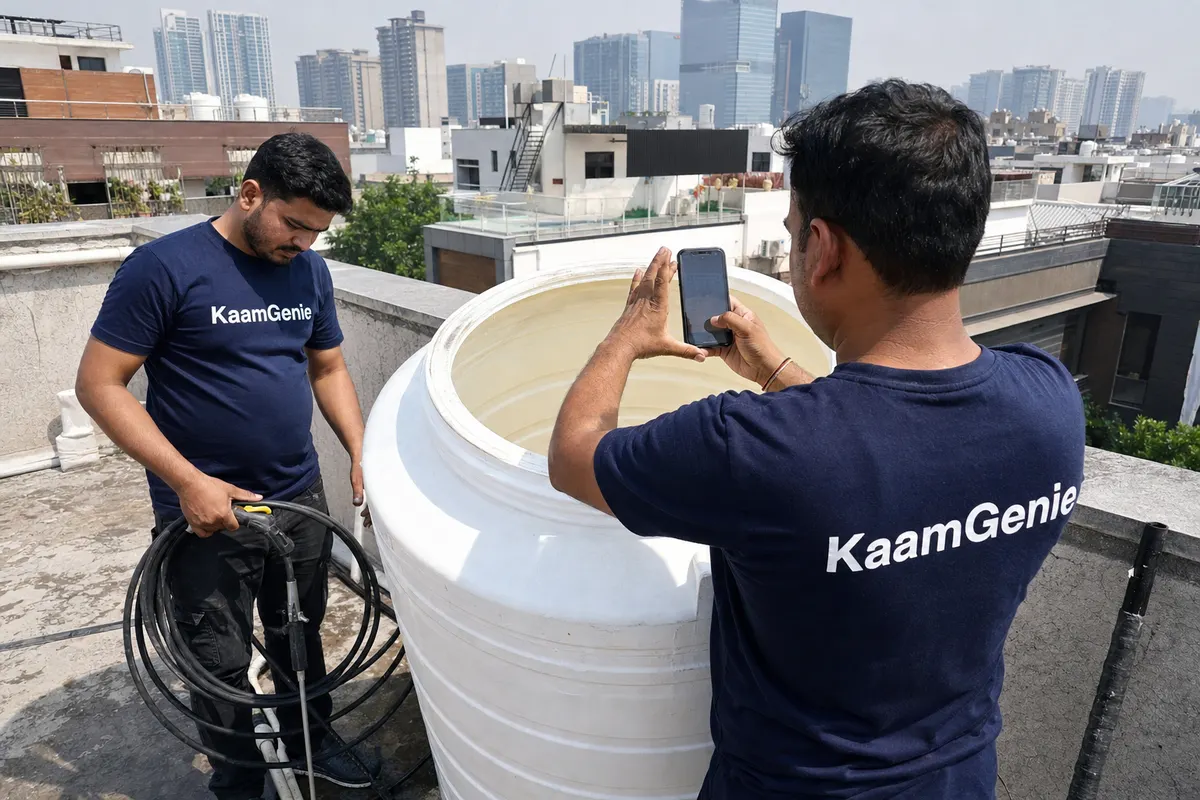
Quick answer for hosts
- Guests judge the water through the shower, the kettle and the first glass. Smell, cloudiness, grit and weak pressure are what end up in reviews, and all four can start in the tank.
- Book the clean into a turnover gap, not a booked night. Between two stays, one overhead tank needs 60 to 90 minutes of crew time plus the refill, so a morning check-out and afternoon check-in can work if the slot is available.
- Know whose tank it is. In a condominium the building usually controls the storage; in a builder floor or a converted kothi, you do.
- Keep the before and after photos. Save the WhatsApp photos of every clean in one folder: it is your hygiene record if a guest ever raises the water.
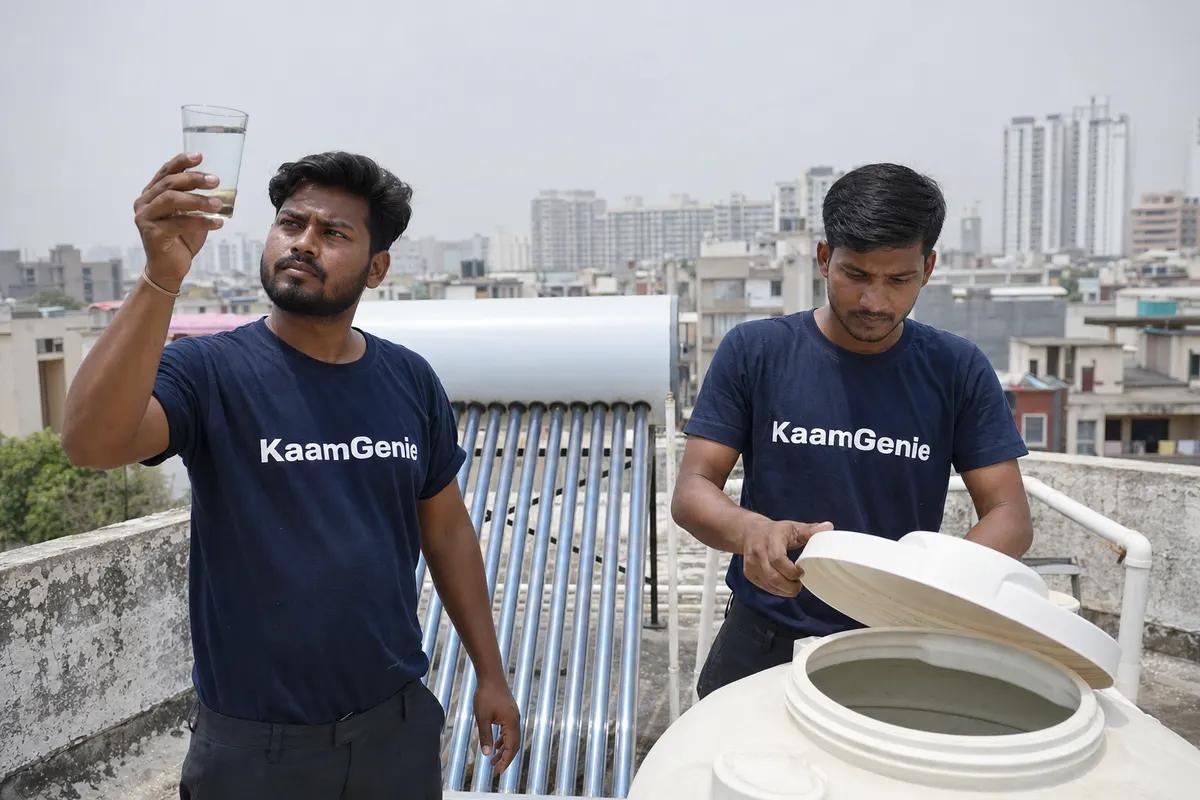
- Run a short water check at every changeover and a fuller pre-season check before the busy months.
For a hosted unit, the overhead tank starts at ₹699 and a sump at ₹1,499, and you know the exact cost before the turnover slot is booked.
Fit a tank clean into your next turnover
Tell us your check-out and check-in times. A rental unit’s overhead tank is from ₹699, the photos come on WhatsApp, and no chemicals go in unless you ask for them.
Gurgaon has a steady stream of short-stay guests: consultants on month-long projects near Cyber City, families visiting relatives, people between flats, medical travellers and wedding guests. Many of them stay in service apartments on Golf Course Road, in builder-floor units in the DLF phases, or in converted kothis in the older sectors. Hosts put real effort into linen, lighting and fast Wi-Fi. The water tank, sitting on a roof the host may not have climbed in a year, is usually the forgotten part of the listing. This guide is about the tank as a hosting problem. If you want the general picture of how tanks are cleaned across the city first, our complete guide to water tank cleaning in Gurgaon covers it.
Why water is a hosting problem, not just a maintenance one
A long-term tenant who notices slightly musty water will usually call the landlord. A guest on a three-night stay will not. They will use the water, feel uneasy, buy bottled water and mention it in the review. Water problems are also unusually personal: a guest can overlook a scuffed wall, but not water that smells odd on their skin or leaves their hair feeling rough after a wash.
Short-stay units are also harder on tanks than an ordinary home in two ways:
- Usage swings. A unit can sit empty for a week and then host four people who all shower twice a day. Water that stands still in a warm tank during the empty days is the water the next guest gets first.
- Nobody lives there. In a normal home someone notices the first change in taste or smell. In a hosted unit, the first person to notice is often a paying guest.
Gurgaon adds hard groundwater, tanker silt in the newer sectors and summer dust on rooftop lids. None of it is visible from the bedroom, which is why hosts get caught out.
What the guest notices, and what it usually means
Use this table when a guest message or review mentions the water, or when your housekeeper reports something during a changeover. It tells you whether the tank is the likely cause and what to do before the next check-in.
| What the guest notices | Likely cause | Before the next check-in |
|---|---|---|
| A stale or musty smell from the hot shower | Stagnant water and bio-film in a tank that sat unused between bookings | Run all taps for a few minutes; if the smell stays, book a tank clean in the gap |
| Cloudy water in a glass or the bathtub | Fine silt on the tank floor, often after a tanker fill | Do not offer tap water for drinking; clean the tank |
| Grit in the bucket or brown first flush | Settled sediment or rust from old fittings | Check with our yellow water guide, then clean the tank |
| Weak or spluttering shower | Sediment choking the outlet or the shower head | Clean the shower head, and have the tank outlet checked |
| White crust on the kettle, glass screen or taps | Hard water scale, which also coats the inside of the tank | Descale fittings; plan a tank clean (the scrub removes loose scale) |
| Insects or tiny worms in a basin | A loose or missing tank lid, or an open overflow pipe | Block the unit, clean the tank and fix the lid before anyone checks in |
Scale is a common long-running issue; see hard water and your Gurgaon tank.
Scheduling a clean between bookings
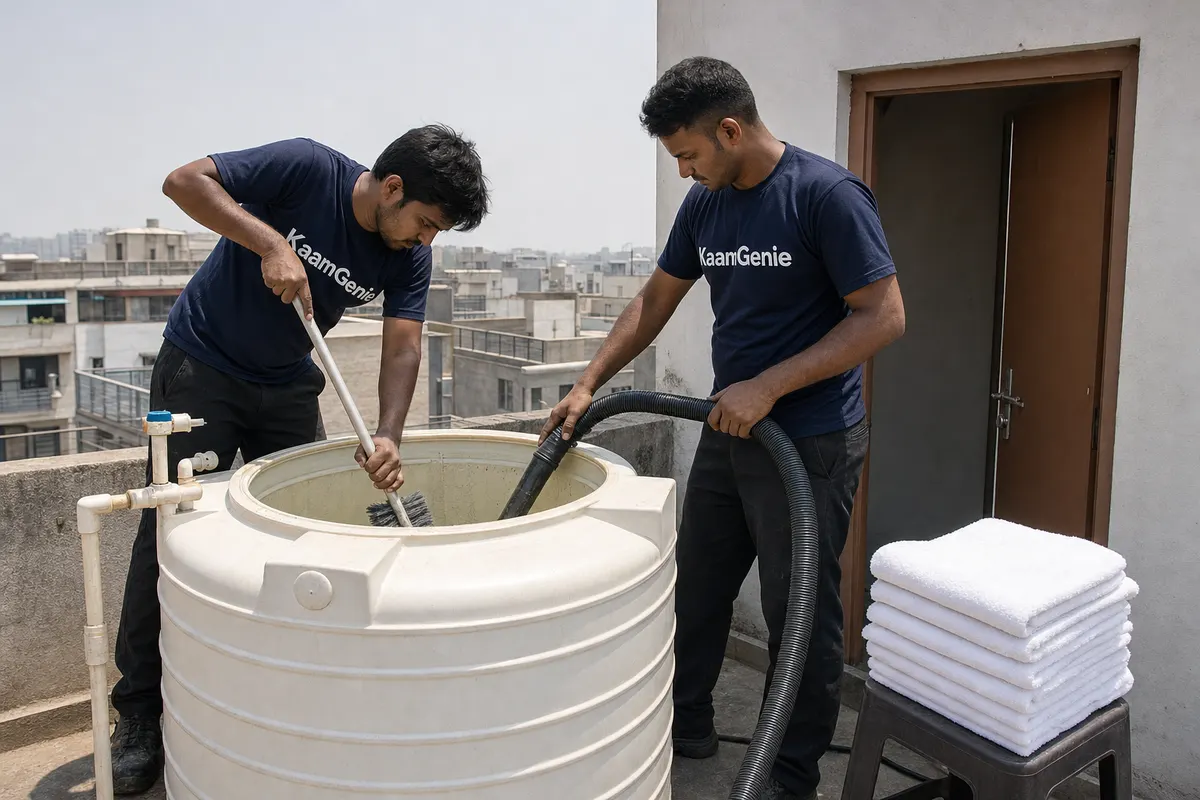
The good news for hosts is that a tank clean does not need a blocked night in most cases. According to our guide to how long a tank cleaning takes, a host should plan on 60 to 90 minutes of cleaning for one overhead tank, followed by the time the building’s supply takes to fill it. A sump plus an overhead tank together takes a few hours. The water is off for most of that time, and the tank then needs to refill before the guest arrives.
How to plan the turnover window
- Pick a gap with at least half a day between check-out and check-in. A same-day turnover with an 11 am check-out and a 2 pm check-in can work for a single overhead tank, if a slot straight after check-out is available; confirm it when you book.
- Tell housekeeping to fill two buckets before the water goes off. They will need water for mopping and the bathroom while the tank is empty.
- Do the tank first, the cleaning of the flat second. The tank crew works on the roof, but after the refill your housekeeper will need to run the taps, and the first water can splash grit into a freshly polished basin.
- Leave time to refill. How fast the tank refills depends on the GMDA supply timing, the borewell pump or a tanker. If the refill comes from a tanker, give the water about an hour to settle before the first guest shower.
- Run every tap for a minute after refill. This clears the pipes of any water that stood in them while the tank was being cleaned.
When a booking gap is very short and something has gone wrong, such as a guest reporting worms or a strong smell, our same-day tank cleaning in Gurgaon page explains when a same-day visit is possible. For timing across the year, rather than within a single turnover, see how often to clean a water tank in Gurgaon.
Can you book the clean yourself? It depends on the unit
For a host, the type of building decides one thing above all: whether you can fit a clean into your own turnover calendar, or whether you depend on someone else’s schedule. Three kinds of unit cover most Gurgaon listings.
| Unit | Can you book it into a turnover? | What to do instead or as well |
|---|---|---|
| Condominium or society flat | Not the common reservoir and tower tanks; only a loft or utility tank inside the flat, if there is one | Ask the facility office for the last reservoir cleaning date and photos, and keep the reply with your listing records. Our condominium tank guide explains how they are run |
| Builder-floor unit | Yes, your floor’s own rooftop tank | Agree the sump with the other floors, since it may be shared; our builder floor guide explains the plumbing |
| Kothi or house split into several units | Yes, and usually several tanks plus a sump | Map which tank feeds which unit, so one forgotten spare tank does not serve a guest stale water, and clean them together on a day with the most vacancies |
Whatever the building, a unit that runs mostly on tanker or borewell water needs the most attention before peak season, and is the one where tap water should never be offered for drinking.
Your photos are your hygiene record
Every KaamGenie clean ends with before and after photos of your own tank on WhatsApp. For a homeowner those photos are reassurance. For a host they are something more useful: a dated record that the water storage was looked after.
A simple way to keep it:
- One folder per unit. Save the before, after and any fittings photos with the date in the file name or the folder name.
- Note the tank’s details once: which tank feeds which bathroom, and where the lid and inlet valve are.
- Record the lid and overflow condition. If the crew flags a cracked lid or an open overflow pipe, photograph the repair too.
- Keep the facility team’s replies if you are in a condominium or society and do not control the tank yourself.
If a guest ever raises the water, you can reply calmly with facts: when the tank was last cleaned, what it looked like afterwards, and what you have done since. Hosts with several units often find a yearly plan simpler than booking each clean separately; our page on tank cleaning AMC in Gurgaon explains how that works.
The 5-minute changeover water check
Add these steps to your housekeeping checklist. They take five minutes and catch most problems before a guest does. None of them involve climbing to the roof.
- Open the hot and cold shower for one minute each. Sniff the water. A stale, musty or rotten-egg smell is a common early warning.
- Fill a clear glass from the kitchen tap and hold it against a white surface. It should be clear, with nothing floating or settling.
- Check the shower head and tap aerators for grit or white crust. A sudden drop in pressure is worth noting.
- Look inside the kettle. White flakes mean hard water; brown flakes mean rust or sediment.
- Note it in the turnover log. One line per changeover: “water clear, no smell”, or what was found. Patterns show up quickly.
If two changeovers in a row show the same problem, treat it as a tank issue rather than a pipe hiccup. Our list of signs your Gurgaon tank needs cleaning covers the less obvious ones.
A host’s pre-season checklist
Gurgaon’s busy hosting periods tend to follow the wedding season, the winter months and corporate travel cycles. Before a run of back-to-back bookings, when there will be no gap long enough to fix anything, work through this list:
- Clean every tank that feeds a guest unit, including spare and loft tanks, and the sump if you control it.
- Check that every lid is clamped, strapped or locked. Rooftop lids are knocked loose by wind, monkeys and painters, and a brick on top is not a fix.
- Make sure the overflow pipe has a mesh cap so insects and birds cannot get in.
- Decide what drinking water you offer. A filtered dispenser or sealed bottles, and a clear note in the house manual that tap water is for washing. Our comparison of tank cleaning and a water purifier explains why a purifier alone is not enough.
- Brief the caretaker or housekeeper on the 5-minute changeover check and who to call if it fails.
- Save the after photos into the unit’s folder before the first guest arrives.
Running several units? Book them in one visit
Send us the addresses and your booking gaps on WhatsApp. We will group nearby units, give you a price for every tank before the day, and send photos for each flat separately.
How KaamGenie cleans a host’s tank
The clean is our standard one (inlet shut, drain, de-sludge, scrub, jet wash, wet-vacuum, fresh-water rinse, before/after photos on WhatsApp), and our step-by-step process guide has the detail. What a host should care about is the part that protects the next review:
- The sludge leaves the building. The silt on the tank floor is what turns up as cloudy bath water or grit in a guest’s shower tray, so it is scooped and vacuumed out of the tank, rather than flushed through your pipes and taps.
- Lids and fittings are photographed. Along with your before and after photos, you get a photo of any loose lid or worn fitting. The cleaning charge for your unit stays as agreed; a replacement lid or mesh, if you want one, gets its own price first.
Your guests’ water is cleaned with no chemicals added as standard. A unit that sat unlet for months, or a tank that was contaminated, can get disinfection if you ask, and only then. If you host from another city or country, a caretaker or housekeeper only needs to let the crew onto the roof; our guide for owners arranging a clean remotely covers the access person, photos and payment in detail.
What not to do
- Do not pour bleach or other chemicals into the tank yourself before a guest arrives. A wrong dose leaves a smell guests will notice, and it does nothing to the sludge.
- Do not tell guests the tap water is drinkable unless you have a filter you maintain and a recent lab report that says so.
- Do not leave the clean until a guest complains. A clean booked in a hurry rarely fits your calendar, and a reply to a review is no substitute for a clean done in a quiet gap.
- Do not send the housekeeper up a ladder to the tank. Rooftop tanks in Gurgaon builder floors are often reached by narrow, unrailed steps. Leave the roof to a trained crew.
If you rent the unit from an owner and sublet it to guests, check who is responsible for the tank under your agreement. Our tenant’s guide covers how that conversation usually goes. If you run long-stay shared rooms rather than short stays, our PG and co-living guide is the better fit.
Send us your next booking gap
The quickest way to start is to share the unit address, the kind of tank and the dates of your next gap between guests. For a short-stay host, the rooftop tank starts at ₹699 and a sump at ₹1,499; we tell you the amount before the slot is locked, and you pay after the clean, once the photos are in your folder. In tree-lined DLF Phase 2, our crews often find leaves and dust on the water in units that sit empty between guests, because branches overhang the roofs and nobody checks the lid. Hosts in Sikanderpur book us too; other sectors are on our Gurgaon tank cleaning page, or ring +91 95603 66362 between turnovers.
Frequently asked questions
Can a water tank be cleaned on the same day as a guest check-in?
Often, yes, for a single overhead tank. The crew spends roughly 60 to 90 minutes on one overhead tank, and refilling then runs at the pace of your mains, borewell or tanker. Ask for a slot straight after check-out, if one is available, ask housekeeping to keep a couple of buckets filled, and leave at least a couple of hours before check-in. If the unit also has an underground sump to clean, a longer gap or a free day is safer.
My flat is in a condominium. Can I clean the tank myself?
In most Gurgaon condominiums the water comes from a common underground reservoir and tower tanks that the facility team controls, so you cannot book them on your own. What you can do is ask the facility office when the reservoir and your tower tank were last cleaned and request photos. Some flats also have a small loft or utility tank of their own, and that one you can have cleaned between bookings.
Is the tap water in a short-stay flat safe for guests to drink?
Tap water from a rooftop or loft tank should not be offered as drinking water unless it passes through a filter you maintain and you have a recent lab test that shows it meets IS 10500. Most hosts simply provide sealed bottles or a filtered dispenser and say clearly in the house manual that tap water is for bathing and washing. A clean tank still matters, because guests shower, brush their teeth and make tea with it.
What should I tell a guest who complains about the water?
Thank them, ask exactly what they noticed and when, and offer bottled water straight away. Then check the shower and a clear glass yourself or through your caretaker. If the tank is the likely cause, arrange a clean in the next gap and tell the guest what you have done. Being able to share the date and photos of the last clean helps the conversation stay factual and calm.
Do I need to be present for the cleaning?
No. Many hosts manage units from another city or simply cannot leave work. A caretaker, housekeeper or neighbour only needs to give the crew access to the roof and the tank, and to the inlet valve if it is inside the flat. The before and after photos are sent to your WhatsApp directly, along with any photos of a loose lid or worn fitting. Our guide for remote owners covers the access arrangements in more detail.
How do I clean tanks for several units without blocking nights?
Map which tank feeds which unit first, then look for gaps in each unit’s calendar. Units that share a building can often be done in one visit on a day when one or two are vacant, with the occupied ones scheduled around check-out. Send us the addresses and booking gaps on WhatsApp and we will suggest a sequence, price each tank in advance and photograph each unit on its own.
Does the tank need cleaning if the unit was empty for weeks?
An empty unit does not mean an empty tank. The water sat still in a warm tank, under a lid that may not seal well, and the first guest to arrive gets it. At the very least, run every tap for several minutes and do the changeover check. If the water smells stale or looks cloudy, have the tank cleaned before the guest arrives. Disinfection after a long vacancy is available if you ask for it.
How much does tank cleaning cost for a service apartment?
For a service apartment, the overhead tank is from ₹699 and an underground sump from ₹1,499. The amount is agreed before the crew starts, even if the tank turns out to hold more sludge than expected, and it covers the before and after photos on WhatsApp. Nothing is added to the cleaning bill on the day; a new lid or mesh would be a separate, priced part. Disinfection is optional, added only on request.
Sources & references
- Bureau of Indian Standards (BIS): IS 10500:2012, the Indian Standard for drinking water quality.
- WHO Guidelines for Drinking-water Quality, 4th edition: guidance on safe storage of water in buildings and stagnation.
- Gurugram Metropolitan Development Authority (GMDA): the agency responsible for bulk water supply in Gurugram.
- CPHEEO Manual on Water Supply and Treatment: the Government of India's engineering manual covering storage tanks and their upkeep.
Last verified: 22 November 2026. If you find any of these links broken, please let us know.