
Quick answer
- Heat: a rooftop tank in full sun warms the water through the day, and warm, still water is where bacteria, algae and slime grow fastest.
- Tankers: when GMDA supply falls short, tanker deliveries drop fine silt into the sump and tank with every fill.
- Low levels: a sump or tank drawn close to its floor starts feeding sludge into the pipes, which is why taps run murky in late May and June.
- What to do: fix the lid, shade the tank, cover the overflow, mark a minimum level on the sump, and get the tank cleaned before the April rush, not in the middle of it.
If the tap water turns warm, cloudy or smelly in summer, do not drink it until the tank has been checked.
Get your tank summer-ready before the rush
A pre-summer clean is a fixed ₹699 for an overhead tank and ₹1,499 for a sump. Sludge out, no chemicals unless you ask, and you pay once the before and after photos land on WhatsApp.
Every Gurgaon summer follows a familiar pattern. The roof gets hotter, people bathe and wash more, coolers need topping up, and the city’s supply struggles to keep pace in the newer sectors. Each of these things affects the water stored in your tank, and together they explain most of the water complaints that come up between April and June. If you only want to know the best month to book, our guide on the best time to clean a water tank in Gurgaon covers the calendar. This article is about what actually happens inside the tank during the hot months, and how to stay ahead of it. Summer slots for Gurgaon water tank cleaning run right through the hot months.
Three summer pressures on a Gurgaon tank
1. The roof turns into an oven
Most Gurgaon homes keep their overhead tank on an open terrace with no shade at all. From April onwards the sun is on it for most of the day, and in May and June the roof itself radiates heat well into the evening. How much heat reaches the water depends on the tank. A thin, single-layer, translucent tank lets in both heat and light. A multi-layer tank with an opaque, light-blocking inner layer and a lighter outer layer reflects much of the heat and keeps light out, which is why it is the better choice when you replace a tank. A concrete tank warms more slowly but holds the heat for longer once it does.
Warm water matters for hygiene, not just comfort. Bacteria and algae multiply faster in warm water than in cold, and the thin slimy layer called biofilm that coats tank walls grows quickly when temperatures rise. A tank that held up fine through winter can develop a smell, a green tinge near the lid, or a slippery feel on the walls within a few weeks of hot weather. If the tank already has sediment on the floor, that layer gives microbes even more to feed on. The WHO guidance on drinking-water quality lists warm storage temperatures among the conditions that help microbial growth in stored water.
2. Demand rises, supply does not
Summer is when Gurgaon households use the most water: more baths, more laundry, coolers, gardens and terrace plants. At the same time, supply in many areas becomes irregular. Large parts of the city rely on bulk supply from GMDA, and in newer sectors along Dwarka Expressway, the Southern Peripheral Road and New Gurgaon, that supply is often supplemented with tankers and borewells. When the gap widens in summer, tankers stop being occasional and become routine.
Tanker water is not dirty by definition, but it rarely arrives as clean as piped supply. It is pumped through hoses, carried in a tanker body that may not have been washed recently, and delivered with enough force to churn up whatever already lies on your tank floor. Each fill leaves behind a little fine silt. Over a summer of regular deliveries, that adds up to a soft, grey-brown layer at the bottom of the sump and the overhead tank. We look at this in depth in our guide to tanker water and your Gurgaon tank.
3. Low levels pull up the sludge
This is the summer problem most people never connect to their tank. When supply is short, sumps and tanks are drawn down much lower than usual. The outlet pipe of a tank, and the suction pipe of a sump pump, normally take water from well above the sediment layer. When the water level drops close to the floor, the flow starts pulling that sediment along with it. The result is murky or gritty water at the taps, clogged purifier filters, and sometimes a sudden brown flush that seems to come from nowhere.
Summer symptoms and what they usually mean
Most summer tank problems give themselves away through a change you can see, smell or feel. Use this table to match what you notice with the likely cause.
| What you notice | Likely summer cause | What to do |
|---|---|---|
| Water warm or hot at the tap in the afternoon | Unshaded rooftop tank absorbing heat | Shade the tank, insulate exposed pipes, check for slime |
| Musty or rotten smell that is new this season | Biofilm and microbes growing in warm, still water | Get the tank cleaned; do not drink until it is checked |
| Green film near the lid or on the walls | Algae fed by heat and light leaking in through gaps | Clean, then fix the lid and any light gaps |
| Gritty or cloudy water after a tanker fill | Fresh silt plus floor sediment churned up by the inflow | Let it settle before use; clean if it keeps happening |
| Brown flush on a day the sump was very low | Pump drawing from just above the sludge layer | Sump cleaning, and a minimum-level rule for the pump |
| RO pre-filter choking much faster than usual | Silt load from tankers and low-level draw-off | Clean the source tank, not just the filter |
If the problem is a colour rather than a smell or grit, our guide to yellow or brown water from your tank in Gurgaon walks through how to tell pipes, tank and supply apart.
The pre-summer checklist: what to do in March
The best time to deal with summer problems is before the first hot week. Walk up to the roof and down to the sump with this list.
- Check the lid and the openings. In summer a gap matters for light as much as dust: a lid that rocks or has a cracked rim lets in the light that feeds algae in warm water. The lid should be clamped, strapped or locked, never held down with a brick or weight, and the overflow and vent need a fine mesh. Our dust-storm guide explains how to secure each opening properly before the pre-monsoon dust storms arrive.
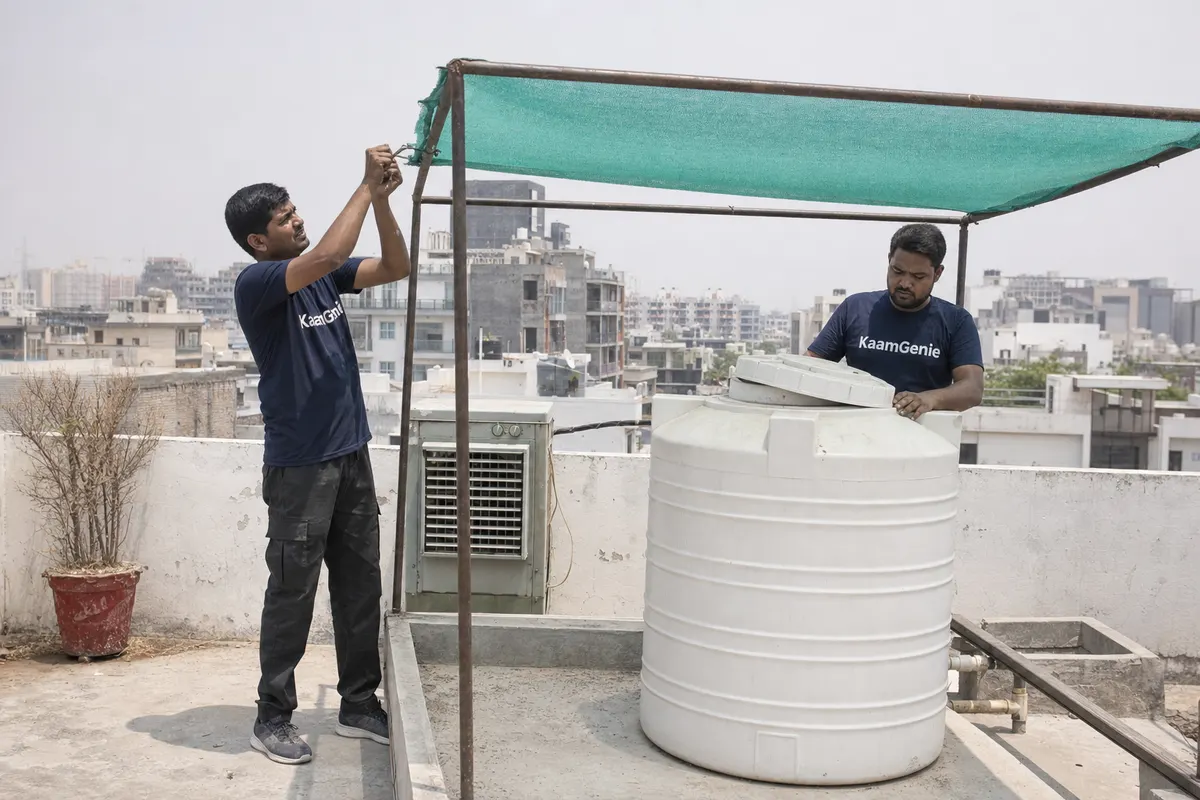
- Give the tank some shade. A simple frame with green shade net, a light-coloured tarpaulin tied clear of the tank, or a small roof over the tank stand all cut the direct sun. Keep the cover loose enough for air to flow around the tank, and never wrap the tank tightly in plastic.
- Insulate the exposed pipes. The short run of pipe from tank to the first tap often sits in full sun on the parapet. Foam pipe insulation or a covered channel stops that water from being heated twice.
- Mark a minimum level on the sump. Open the sump and note where the pump’s suction pipe ends. Ask your plumber to fit a dry-run or low-level cut-off so the pump stops before the water drops to the sludge layer. If that is not possible, agree a rule at home or in the building: no pumping once the level falls below the mark.
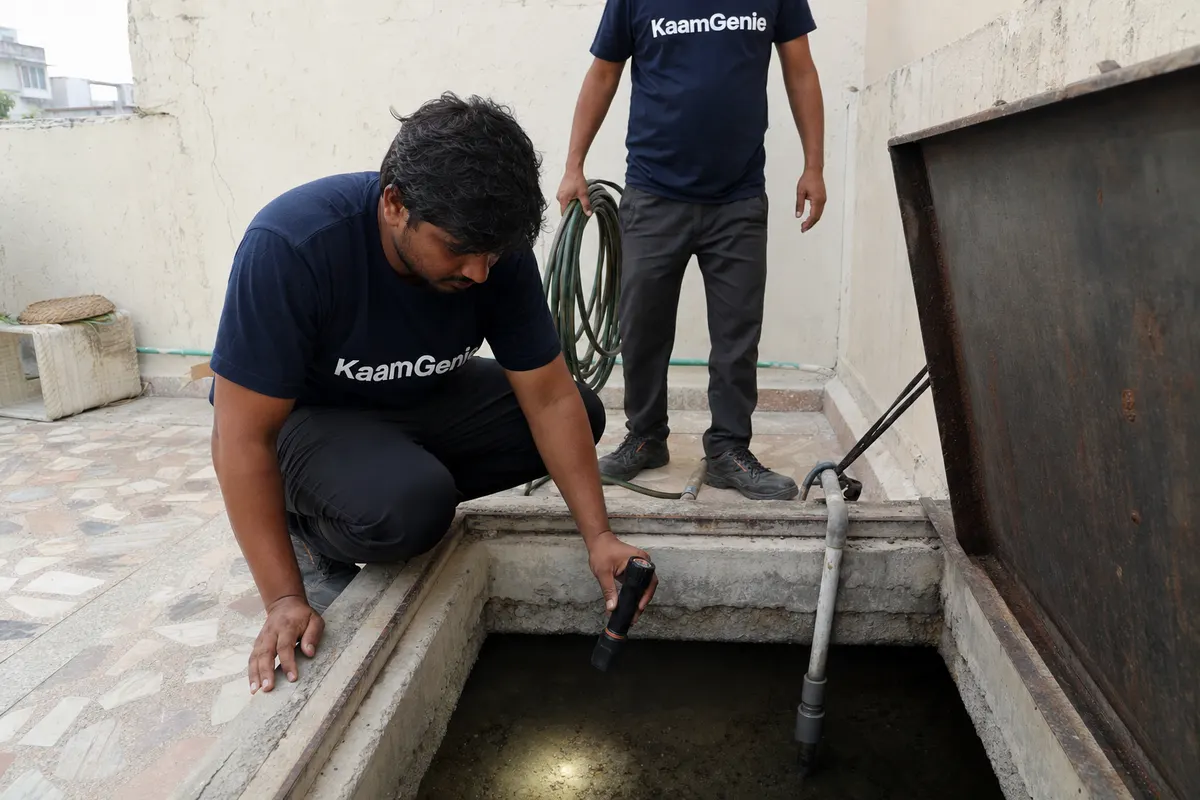
- Look at the floor. Shine a torch into the tank. If you can see a layer of silt, slime on the walls, or the floor is not visible at all, book the cleaning now, while slots are easy to get.
A two-minute afternoon check during the season
Once summer is under way, do this once a week on a hot afternoon. Open a tank-fed tap and fill a steel tumbler. Smell it straight away: summer problems usually announce themselves through smell before colour. Then feel the temperature. Warm water on its own is not a problem, but warm water with a new smell, or a slippery feel on the tap aerator, means the tank is growing biofilm and should be cleaned soon.
Living with tankers in a shortage
For many homes in the newer sectors, tankers are simply part of summer. You cannot always control where the water comes from, but you can reduce what it leaves behind.
- Fill the sump, not the overhead tank, where you can. The sump gives silt somewhere to settle before water is pumped up to the roof.
- Wait before pumping up. After a delivery, give the sump an hour or so to settle before you run the pump, so the fine silt sinks rather than travels.
- Watch the hose. Ask the driver not to rest the hose end on the ground or in the drain while connecting. It sounds minor, but that end goes straight into your water.
- Look at the sump again after the heaviest tanker weeks. If you are tanker-dependent from April to June, a second look at the sump once supply normalises is sensible. For timing in your situation, see how often to clean a water tank in Gurgaon.
A note for buildings with a shared reservoir
In a condominium or society, the summer problem usually starts one level down. The common underground reservoir is drawn hardest in May and June and topped up by tankers, so when its level falls, every tower can get cloudy water on the same afternoon. Flat owners cannot fix that from their own tap; the facility team or RWA has to clean the reservoir before peak season and check that the pump has a low-level cut-off. Committees will find the scheduling side in our society water tank cleaning guide, and the wider picture for each kind of building is in the complete guide to water tank cleaning in Gurgaon.
What a summer clean has to deal with
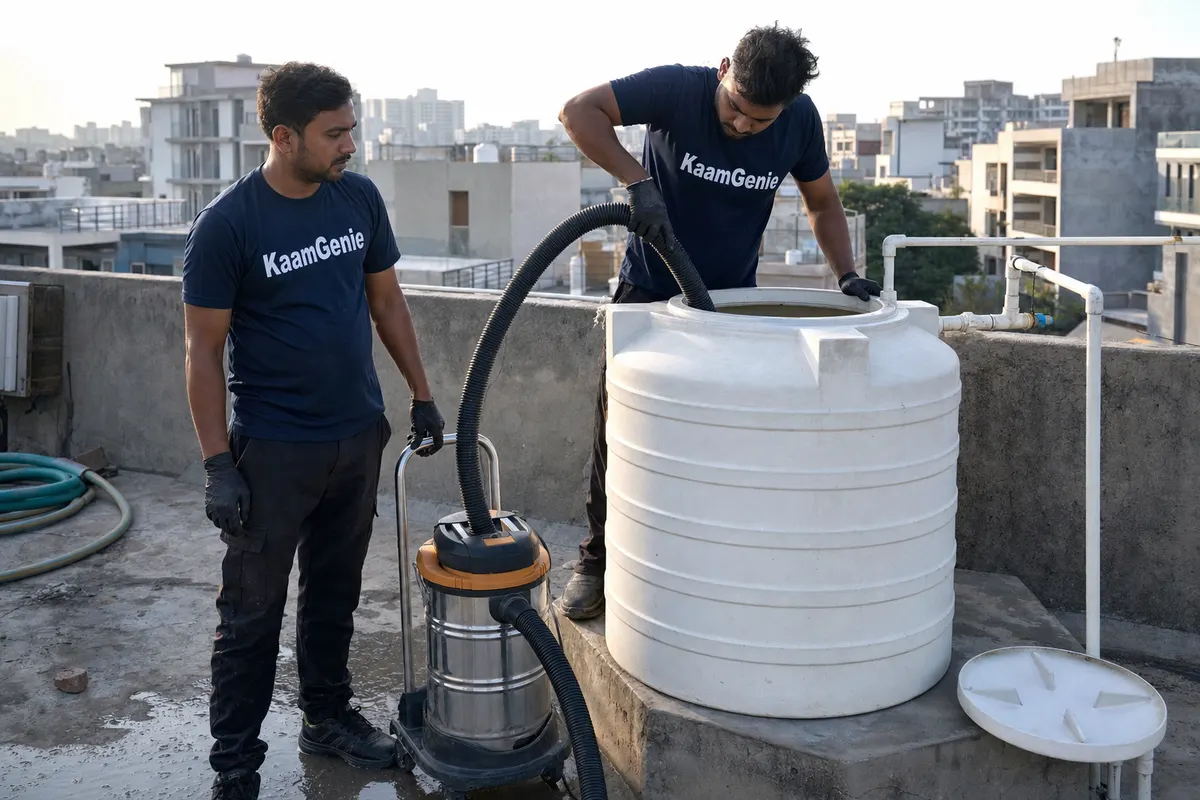
Every clean follows the same standard sequence, set out in the Gurgaon cleaning process guide. In the hot months, the work concentrates on three things the season leaves behind:
- The sump first, then the roof. Tanker silt settles mainly in the underground sump. If only the rooftop tank is cleaned, the next pump run sends sump silt straight back up. With both on the same visit, the sump is drained, de-sludged and rinsed before the overhead tank is refilled from it, and the sludge is vacuumed out down to the bare floor.
- Biofilm on the walls, not just silt on the floor. Warm water grows the slippery layer on the walls and the green band under the lid. Those surfaces are scrubbed by hand, then jet washed, wet-vacuumed and rinsed with fresh water, because a rinse alone slides over biofilm.
- The weak points the heat will find. The crew looks at the lid, overflow, vent and float valve and photographs anything that needs fixing before May, so you can get it sorted while the tank is still clean.
You get before and after photos of your own tank on WhatsApp. A summer clean relies on scrubbing, not chemicals; if the heat has left the water smelling strongly, or you want extra reassurance, disinfection can be added on request. Our note on tank disinfection in Gurgaon explains when it is worth asking for. In newer areas such as New Gurgaon and Sector 82, where tankers top up supply in the hot months and open plots and construction raise dust, our crews often find a fresh silt bed building on tank floors as summer goes on.
Tanker-fed this summer? Clean the sump and tank together
We drain, de-sludge and rinse the underground sump and the rooftop tank in one visit. Tell us your tanker or supply timings when you book and we will try to plan around them.
Why booking before the rush matters
Demand for tank cleaning in Gurgaon climbs steeply once the first hot spell arrives, and again just before the monsoon. Booking in March or early April gives you a wider choice of days, the crew is not racing between back-to-back jobs, and your tank starts the hot months clean instead of halfway through them.
If you miss the window and the water has already turned, do not wait for a quieter week. A tank that smells or runs cloudy in May will only get worse in June. We offer same-day cleaning in Gurgaon where crews are available. Once the summer is over, the next pressure point is the rain; our monsoon guide for Gurgaon tanks covers that season.
What not to do
- Do not throw bleach or potassium permanganate into a smelly tank yourself. It masks the smell for a day while the biofilm and sediment that cause it stay put, and an overdose in a hot tank makes the water unpleasant and unsafe.
- Do not wrap the tank in black plastic for shade. Black sheeting traps heat. Use a light-coloured or green shade net held clear of the tank.
- Do not run the pump until the sump is empty. The last of the water is the dirtiest, and a dry-running pump can burn out.
- Do not leave the lid off to “let the water breathe” or cool down. An open tank in summer collects dust, insects and birds far faster than it cools.
- Do not top up the cooler straight from a murky tank tap. Cooler pads trap silt and grow slime fast in the heat, and the fan then blows that smell through the room. Fix the tank first, then refill the cooler.
Start the hot months with a clean floor
The simplest summer plan is a clean tank and sump in March, a shaded tank with a secured lid, and a minimum-level rule for the pump. If you are already into May and the water smells or runs cloudy, book now rather than after the heat breaks. Summer cleaning of an overhead tank starts at ₹699 and of an underground sump at ₹1,499, fixed before work begins, and you pay after the clean, once the photos show the floor clear. Not sure the tank is the problem? Run through the signs your Gurgaon tank needs cleaning, then call +91 95603 66362 or message us on WhatsApp. If a dust storm hits in the meantime, our after-the-storm checklist tells you whether to clean again.
Frequently asked questions
Does hot weather really make tank water unsafe?
Heat on its own does not poison water, but it speeds up the things that do. Bacteria, algae and the slimy biofilm on tank walls all grow faster in warm, still water, and a rooftop tank in a Gurgaon May can stay warm through the night. If your tank already has sediment on the floor, that gives microbes even more to live on. A clean tank with a tight lid copes far better with the heat than a dirty one.
How do I keep my rooftop tank cooler in summer?
Shade is the most effective step. A frame with green shade net, a light-coloured tarpaulin tied clear of the tank, or a small sheet roof over the tank stand all block direct sun while letting air move around it. Insulate the exposed pipe that runs along the parapet, and keep the lid closed. Painting a concrete tank white on the outside also helps. Avoid wrapping the tank tightly in dark plastic, which traps heat.
Why does my water turn murky in June even though the tank looks fine?
Very often it is the level, not the tank walls. When supply is short and the sump or tank is drawn close to its floor, the outlet or pump suction starts pulling in the sediment that normally sits undisturbed below it. The tank can look acceptable from the top and still have a silt bed at the bottom. A minimum-level rule for the pump, plus a proper de-sludge, solves it.
Is tanker water safe to store in my tank?
It can be, but treat it with more care than piped supply. Use a regular supplier who can tell you the source, refuse any load with a smell or colour, and let the water settle in the sump before pumping it up. Do not drink tanker water straight from the tap without boiling or purifying it. Because every delivery leaves some silt behind, tanker-fed tanks also need their floors cleaned more often than piped ones.
When should I book a summer tank cleaning in Gurgaon?
Ideally in March or early April, before the first hot spell and before tanker season begins in earnest. That gives you a clean tank going into the hottest months and an easier choice of slots. If the water has already turned smelly or cloudy in May or June, book straight away rather than waiting; summer problems get worse as the heat continues. Our timing guide explains how your own frequency depends on supply and water type.
How do you clean a tank in summer without wasting water?
Where your schedule allows, we try to plan the visit for when the tank is already low, so very little stored water is lost. Tell us your supply or tanker timings when you book. The inlet is shut first, the remaining water is pumped out, and the sludge is scooped and wet-vacuumed rather than flushed out with large volumes of water. A fresh-water rinse follows, and then the tank is refilled from your normal supply.
Can I ask for chlorine to be added to the tank in summer?
Not as standard. Our normal clean removes the sludge, biofilm and algae physically, with scrubbing, jet washing, wet-vacuuming and a fresh-water rinse, and uses no chemicals. If your water has had a strong smell, or you simply want extra reassurance during the hot months, disinfection is available on request and we will explain what it involves before we start.
What does a summer tank cleaning cost in Gurgaon?
A hot-season clean costs from ₹699 for an overhead tank and from ₹1,499 for an underground sump. A heavy silt bed left by summer tanker deliveries takes longer, yet the figure is agreed before the crew starts, and you pay only after the job, once your before and after photos reach WhatsApp. Summer visits carry no surprise extras for the cleaning itself; mesh or a new lid is quoted separately.
Sources & references
- India Meteorological Department (IMD): heatwave warnings and seasonal forecasts for Haryana and the Delhi NCR region.
- Gurugram Metropolitan Development Authority (GMDA): the agency responsible for bulk water supply in Gurugram.
- WHO Guidelines for Drinking-water Quality, 4th edition: guidance on microbial growth, temperature and the safe storage of drinking water.
- Bureau of Indian Standards (BIS): IS 10500:2012, the Indian Standard for drinking water quality.
Last verified: 22 November 2026. If you find any of these links broken, please let us know.