
Quick answer
- Lid on, water clear, no smell: the tank is very likely fine. Wipe the lid, clear the overflow and carry on.
- Lid on, but a dust film or a few leaves on the surface: skim, settle and watch, using other water for drinking meanwhile; book a clean if the water stays cloudy.
- Lid shifted or blown off, debris or mud inside, cloudy or smelly water: stop drinking from it and get the tank cleaned.
- Before the next storm: clamp, strap or lock the lid (never rely on a brick), mesh the overflow and vent, and clear loose items off the roof when a warning is issued.
Wait until the wind has fully dropped and it is daylight before going up to the roof.
Lid blew off in the storm? Get the tank cleaned
Dust, leaves and debris removed, tank scrubbed and rinsed, photos sent. A storm-hit overhead tank starts at ₹699, priced before work; no chemicals unless you ask.
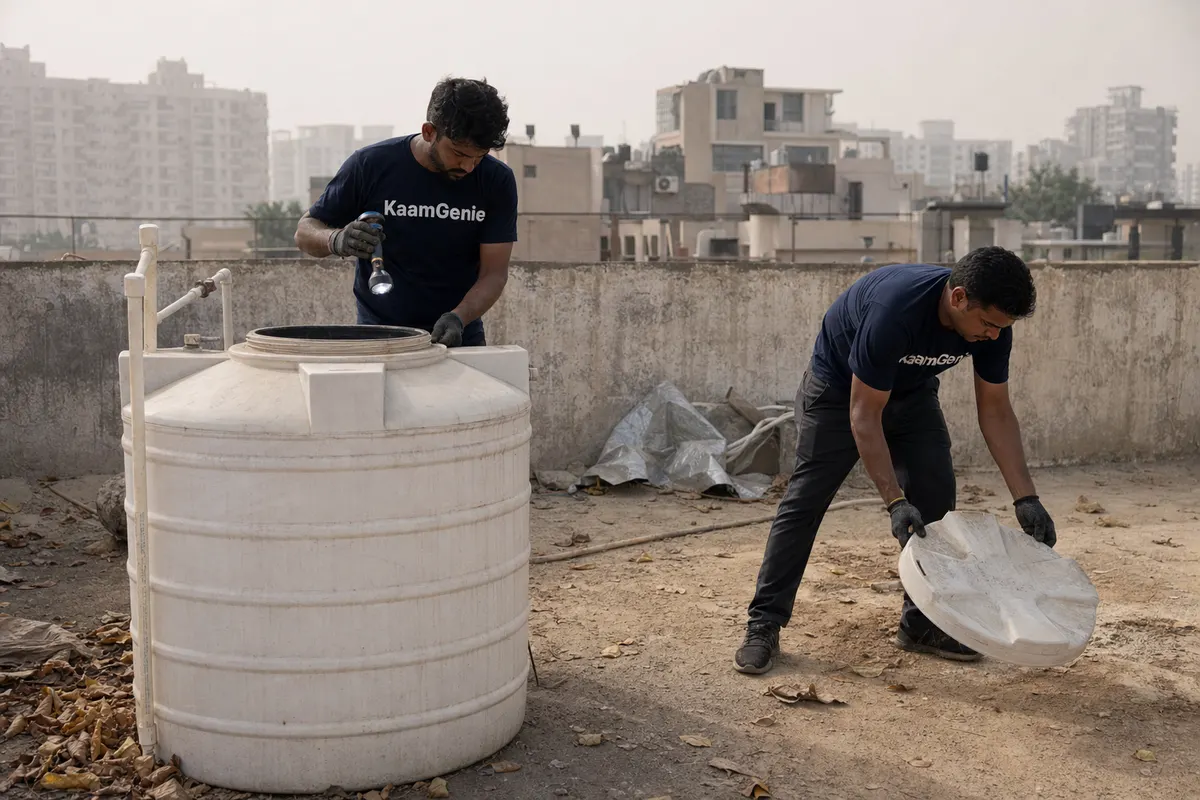
Dust storms are a familiar part of the hot months in Gurgaon. They are most common in the pre-monsoon weeks, when hot, dry ground and gusty winds lift dust from open land, construction sites and roadsides across the region, and they often arrive with a short burst of thunder and rain. The India Meteorological Department issues warnings and short-range nowcasts when one is likely. For a rooftop tank, the problem is not the storm itself but the half-hour of wind that turns your terrace, and everyone else’s, into a source of flying debris. If you would rather have someone check it, our crews handle water tank cleaning across Gurgaon, including post-storm visits.
What a dust storm does to a rooftop tank
Every storm is different, but after an andhi a tank can show any combination of these:
- Fine dust and sand. The finest particles get through the smallest gaps: around the lid rim, through the vent and up the overflow pipe. They form a brown film on the surface and settle as a soft layer on the floor.
- Leaves, twigs and flowers. Gurgaon’s neem, peepal and gulmohar trees shed heavily in strong wind, and anything that lands in the water starts to rot within days.
- Plastic and litter. Polythene bags, kite string, food wrappers and pieces of packaging from neighbouring roofs and empty plots.
- Shifted or missing lids. Light plastic lids that only rest on the tank can be lifted, turned or carried off entirely. Lids weighted with a brick often end up with the brick inside the tank.
- Displaced fittings. Overflow pipes knocked loose, vent caps blown away, and on some roofs the tank itself nudged on its stand.
- Roof runoff. If rain follows the dust, it washes the dirt on the terrace towards any open opening. What the rains do over a whole season is covered in our monsoon guide for Gurgaon tanks.
Homes near open land, new construction or unpaved roads usually get the worst of it, simply because there is more loose dust upwind.
The next-morning checklist
Do this in daylight, once the wind has fully dropped. Take a torch, a clear glass, and a pair of gloves.
- Safety first. Do not go up during the storm or in the dark. Look out for fallen cables, loose dish antennas, broken glass and wet, slippery patches. If a wire is down or a pump connection looks damaged, keep away and call an electrician.
- Find the lid. Is it still on, sitting flat and locked? If it has shifted, been turned, or is lying on the roof, treat the tank as open to the storm.
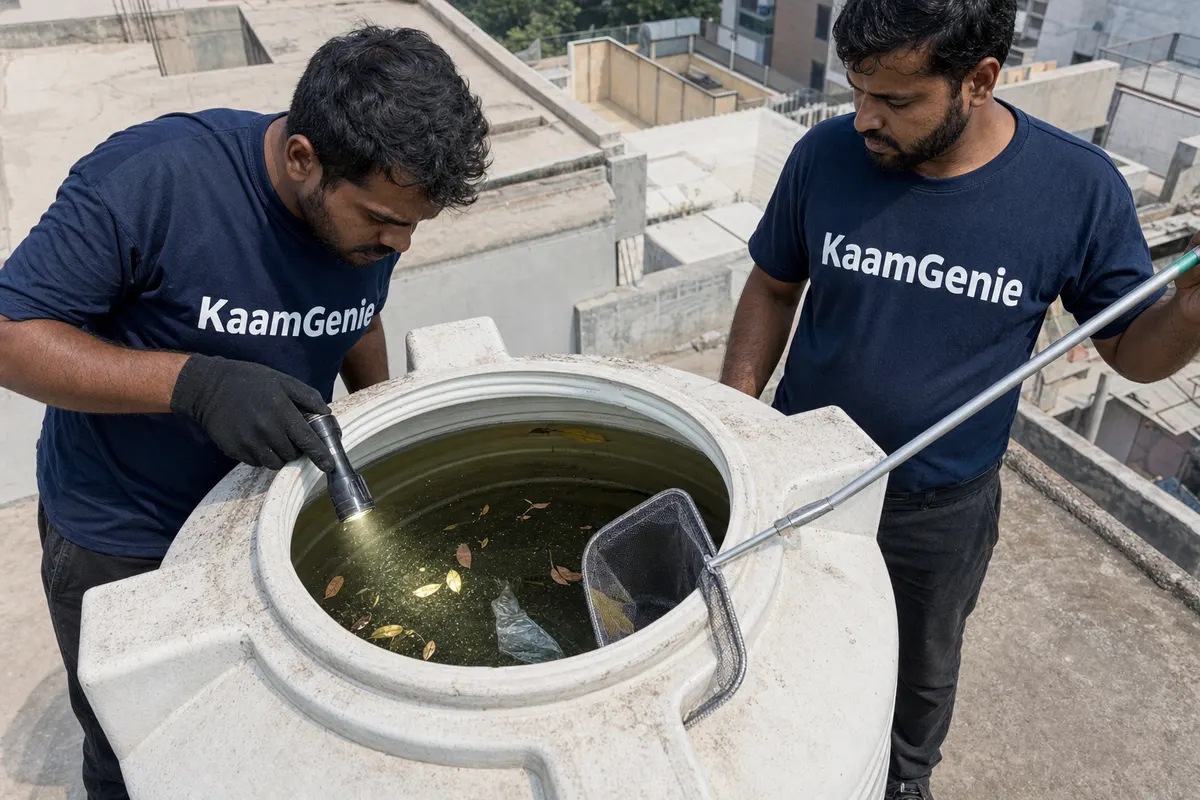
- Look inside. Lift the lid and shine the torch across the water. Note any floating leaves, plastic, a brown film, or objects lying on the floor.
- Smell it. Fresh dust has little smell. A sour or rotten smell a day or two later means organic debris is breaking down in the water.
- Do a settle test. Fill a clear glass from a tank-fed tap and leave it on a white surface for half an hour. If a layer of fine brown grit settles at the bottom, storm dust has reached your pipes. If the water stays clear, it has not. For colour problems that persist, our yellow-water guide and its 3-glass test help you find the source.
- Check the overflow and vent. Is the mesh still in place? Is either pipe blocked with leaves or plastic? If the overflow is blocked, water backs up and spills over the lid rim the next time the tank fills, washing roof dust in.
- Check the inlet and float valve. Make sure the float arm has not been bent and the inlet pipe has not been knocked out of position.
- Look at the sump lid too. Ground-level sump manholes collect wind-blown dust and leaves around the rim. Make sure the cover is still in place and nothing has washed in.
Top-up is fine, or the tank needs cleaning?
Not every storm means a full clean. Most of the time, a tank with a well-fitted lid comes through with nothing more than dust on the outside. Use what you found in the checklist to decide.
| What you find | Verdict | What to do |
|---|---|---|
| Lid secure, water clear, settle test clean | Fine | Wipe the lid and clear the overflow; normal top-ups are fine |
| Lid secure, light dust film on the surface only | Watch | Use other water for drinking while you watch; check the glass again next day, and clean if cloudiness stays |
| A few leaves or one plastic bag on the surface, water clear | Watch closely | Lift them out with a clean net the same day; clean if the water starts to smell |
| Lid shifted or blown off for the storm | Clean | Assume dust and debris are on the floor; book a clean before drinking from it |
| Mud, sand or grit visible on the tank floor | Clean | Drain and de-sludge; topping up only stirs it through the pipes |
| Sour or rotten smell a day or two later | Clean soon | Rotting organic debris; stop drinking and cooking with it |
| Bird, rodent or a dead animal inside | Clean urgently | Do not use the water at all; see our dead bird or rat guide, and ask for disinfection on request after the clean |
“Watch” does not mean ignore it, and it does not mean drink it: use bottled, boiled or purified water while you wait. If the glass is still cloudy after a day, or any smell develops, move to a clean. Visibly cloudy water is usually well above the 1 NTU acceptable turbidity limit in IS 10500:2012 (5 NTU is permissible only where nothing better is available); a lab test confirms it. The dust that causes it can carry bacteria with it. Our list of signs your Gurgaon tank needs cleaning covers the other warning signals.
Until the tank is cleaned
- Use bottled, boiled or purified water for drinking, cooking and brushing teeth.
- Close the tank inlet so no more fresh water mixes with the dirty water and gets wasted.
- Keep the tank-fed water for flushing and floor washing only.
- Expect your purifier pre-filter to clog faster, and check it after the clean.
Securing the lid and openings: the full guide
Dust storms are hard to predict far in advance, but the IMD and its regional centre issue warnings and nowcasts when thunderstorms and strong winds are expected over the NCR, and weather apps generally pass these on. The steps below are worth doing once, properly, before the pre-monsoon weeks, rather than in a rush when the warning arrives. They also keep out smog dust in winter and debris on Diwali night.
The lid
- Clamp, strap or lock it. Many plastic tanks have a threaded or locking lid; make sure it is turned fully home. For lids that only rest in place, fit a simple lid clamp, or tie the lid handle to the tank body with a nylon strap or rope, pulled snug so the lid cannot lift at one edge.
- Never rely on a brick or a weight. A brick can slide off, fall into the tank or crack the lid, and on a windy roof it becomes a hazard itself. A lid held down only by weight still lifts at the edge in a gust.
- Check the seat. Run a finger round the rim: if the lid rocks, has warped in the summer sun or has a cracked edge, replace it rather than tying it down every time.
The vent, overflow and inlet
- Mesh, do not seal. The vent and overflow must stay open so air can move as the tank fills and empties; a sealed vent can upset the flow or even distort a plastic tank. Tie a fine stainless steel or nylon mesh over each opening with a clip or cable tie, so it cannot slip off.
- Point the overflow down. An overflow mouth that faces sideways catches wind-blown dust. A short elbow turning it downwards, with mesh over the end, keeps most of it out.
- Close the gap round the inlet pipe. Where the inlet enters through a hole in the lid or wall, a loose gap lets fine dust in. Your plumber can fit a grommet or a collar.
- Clean the mesh. Mesh clogs with dust and leaves, especially after a storm or through the smog weeks. A clogged overflow mesh is how water ends up spilling over the lid rim.
The roof and the sump
- Keep the tank reasonably full when a storm is forecast. A nearly empty plastic tank is light and can be shifted on its stand by strong wind. Strap tall, exposed tanks to the stand or the parapet.
- Clear loose items. Plastic chairs, buckets, shade nets, tarpaulins and drying clothes all become flying debris. Fold or tie them down.
- Seat the sump cover. Check the ground-level manhole lid is fully in place, and that rainwater cannot run towards it.
If your tank sits on an open farmhouse terrace or near fields, the exposure is greater; our farmhouse tank guide covers properties with several tanks. For the heat and algae side of the same season, see summer tank care in Gurgaon; for smog dust, see our winter tank guide; and for Diwali-night debris, the pre-Diwali guide.
Which tanks take the most storm dust
What decides the damage is not the address but how exposed the tank is and who is responsible for checking it. See the complete guide to water tank cleaning in Gurgaon for the wider picture.
| Tank situation | Why it is exposed | Check first |
|---|---|---|
| A tank on a high terrace facing open land or a building site | Nothing upwind to break the wind; loose dust and construction debris | Lid seat and the overflow mesh |
| Several tanks side by side on a shared terrace | One loose lid can be blown onto another tank | Every lid, and tell neighbours if theirs looks open |
| A ground-level sump manhole | Wind-blown dust and leaves gather round the rim; rain washes them in | The cover and the ground around it |
| Dozens of tower tanks run by a facility team | A lost vent cap on one tower can go unnoticed for days | A roof walk of every tower, with photos of each lid |
For towers in the new belt, our guide to water tank cleaning on Dwarka Expressway explains how facility teams manage tower tanks. In newer sectors with open plots and building sites close by, such as Sector 102, our crews often find a thicker bed of fine brown silt after a storm, because loose soil from the empty land blows straight onto the roofs. Storm calls also come to us from Badshahpur and Manesar.
What a post-storm clean has to remove
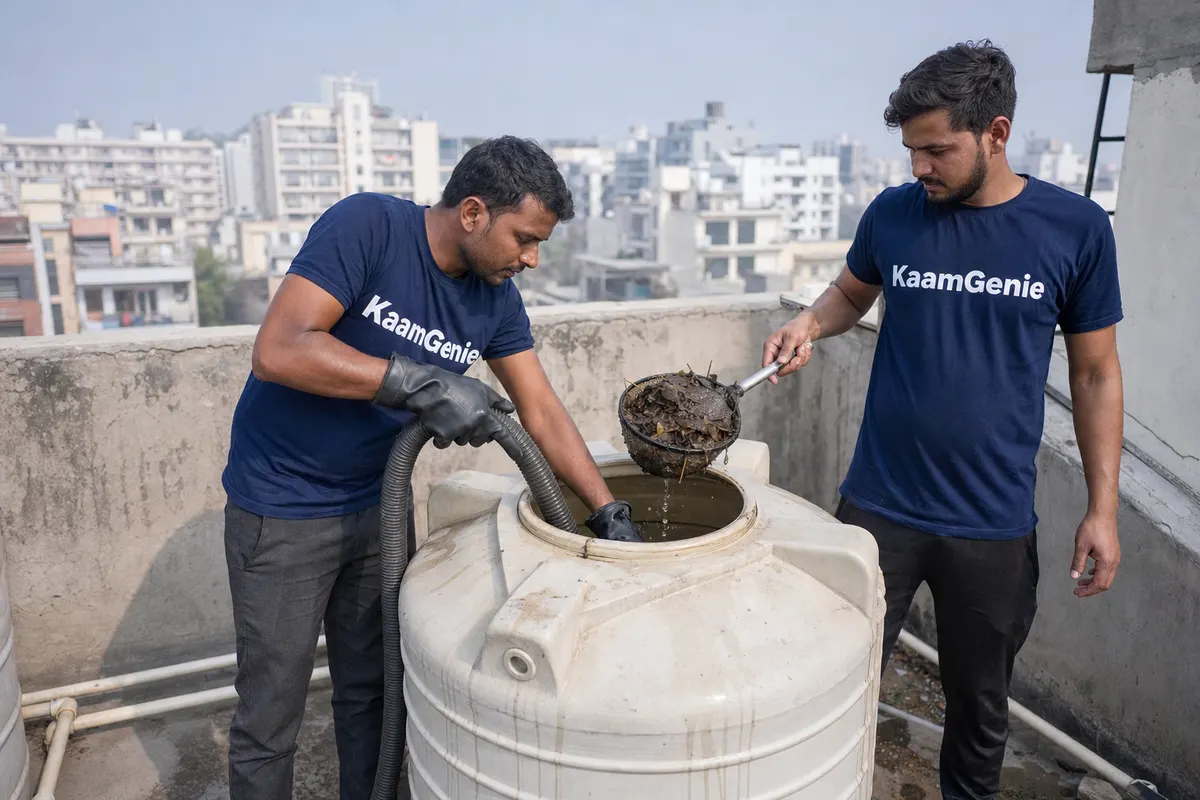
The full standard sequence is in the Gurgaon cleaning process guide. After a storm, the parts that matter are these:
- Debris out by hand before the water goes. Once the inlet is shut, floating leaves, plastic and anything larger are lifted out first, so they do not end up wrapped round the outlet or dragged across the floor as the tank drains.
- The fine layer on the floor. Storm dust settles as a soft brown silt under the water, often more than the surface suggests. It is scooped and wet-vacuumed out down to the bare floor, then the walls, floor and lid are scrubbed, jet washed and rinsed with fresh water.
- A record of what the storm broke. The lid, lock, overflow, vent and float valve are photographed with the before and after shots on WhatsApp. If the storm cracked a lid or tore a mesh, the replacement part is priced on its own, so you can decide what to replace.
Storm dust comes out by hand and machine, and disinfection is optional, on request: when a bird or animal fell in, or the water turned foul-smelling, you can ask us to add it once the physical clean is done. Our guide to tank disinfection in Gurgaon explains when it is worth asking for.
Send us a photo of the tank after the storm
Share a picture of the open tank or the water on WhatsApp. We will tell you honestly whether a top-up is enough or it needs a proper clean.
What not to do
- Do not climb onto the roof while the wind is still blowing. Gusts, flying debris and wet surfaces cause far more harm than a dirty tank.
- Do not just top up and hope it dilutes. Fresh water mixed with storm dust stirs the sediment into the pipes rather than removing it.
- Do not pour bleach into the tank yourself. It does not remove leaves, plastic or silt, and an uncontrolled dose makes the water harder to use safely.
- Do not put the lid back on without looking inside. A lid that blew off for even a few minutes may have let in more than you think.
- Do not refill from a tanker before the tank is checked. A fresh delivery churns storm dust off the floor and sends it up to every tap.
If the storm got in
A lid that lifted for ten minutes is reason enough to look inside, and a floor you cannot see is reason enough to clean. Send us a photo of the open tank on WhatsApp or call +91 95603 66362; if the water is unusable, ask about same-day cleaning, which we offer where possible. After a storm, a rooftop tank still costs from ₹699 and a sump from ₹1,499, however much the wind dumped in, and you hear the figure before we start. See where our crews offer tank cleaning in Gurgaon. For when to clean outside of storms, see how often to clean a water tank in Gurgaon.
Frequently asked questions
Is it safe to use tank water after a dust storm?
If the lid stayed on and locked, the water is clear and the settle test shows no grit, it is very likely fine for normal use. If the lid moved or blew off, or you can see leaves, plastic, a dust film or mud inside, stop using the water for drinking and cooking until the tank is cleaned. Use it only for flushing. Dust that sinks out of sight can still cloud the water and carry bacteria.
My tank lid blew off in the storm. Does the whole tank need cleaning?
In most cases, yes. Even a few minutes of exposure in a strong dust storm lets in fine dust, sand and often leaves or litter. Some of it floats, but much of it sinks to the floor where you cannot see it, and topping up only stirs it into the pipes. A proper clean drains the tank, removes the debris and sediment, and scrubs and rinses the walls, after which you can refit or replace the lid.
Can I just skim out the leaves myself?
If the lid stayed on and only a few leaves or a single bag blew in through a gap, lifting them out the same day with a clean net is reasonable. Then watch the water for a day. If it turns cloudy or develops a smell, the tank needs a full clean. Do not lean into the tank or climb inside it yourself; tanks are confined spaces, and a slip on a wet roof is a real risk.
How do I stop the lid blowing off next time?
Use a tank with a locking or threaded lid and make sure it is fully closed. For lids that only rest on the rim, fit a lid clamp or tie the lid handle to the tank body with nylon rope or a strap. Avoid putting a brick on top, because it slides off or falls in. Replace warped or cracked lids rather than tying them down after every storm, and fit fine mesh over the vent and overflow.
When are dust storms most likely in Gurgaon?
They are most common in the hot pre-monsoon weeks, when the ground is dry and gusty winds and thunderstorms build up over north-west India, though a storm can arrive at other times too. The India Meteorological Department issues warnings and short-range nowcasts for the NCR when strong winds or thunderstorms are expected, and most weather apps carry these alerts. That is the moment to secure the lid and clear the roof.
Should I ask for disinfection after a dust storm?
Not usually. Dust, sand, leaves and plastic are removed physically by draining, de-sludging, scrubbing, jet washing and rinsing with fresh water, which is what our standard chemical-free clean does. Where a bird or animal got in, or a strong rotten smell developed, you may ask for disinfection on top, after the physical clean. Do not add bleach yourself while the debris is still in the tank.
How much does a post-storm tank cleaning cost in Gurgaon?
No storm premium applies. A storm-hit overhead tank is from ₹699 and an underground sump from ₹1,499. A tank with heavy debris may take longer, but the amount is agreed before the crew starts, and you pay after the before and after photos of your own tank arrive on WhatsApp. If several tanks on a society roof were exposed, ask for a combined quote covering only the tanks that need it.
Sources & references
- India Meteorological Department (IMD): thunderstorm, dust storm and strong-wind warnings and nowcasts for the Delhi NCR region.
- Bureau of Indian Standards (BIS): IS 10500:2012, the Indian Standard for drinking water, including turbidity limits.
- WHO Guidelines for Drinking-water Quality, 4th edition: guidance on protecting stored water from contamination.
- Central Pollution Control Board (CPCB): air quality data, including dust events over the NCR.
Last verified: 22 November 2026. If you find any of these links broken, please let us know.