
Quick answer for gym, salon and spa owners
- Your clients feel the water directly. Showers, hair washes, facials, steam and laundered towels all carry whatever is in the tank, so problems show up as complaints, not just as plumbing faults.
- High daily use stirs sediment constantly. A busy gym or salon drains and refills its tank many times a day, and each refill lifts silt off the floor.
- Clean outside opening hours. Salons and spas usually want a slot before they open; gyms usually prefer the afternoon lull or after closing. Ask for the slot you need when you book.
- Count every tank. Changing rooms, laundry, the steam generator and the shop above may each be fed from a different tank.
- Keep a simple log with photos. It answers client questions and helps you spot problems early.
For a gym, salon or spa, each rooftop tank starts at ₹699 and an underground sump at ₹1,499, priced tank by tank before the crew begins.
Clean the tank before your doors open
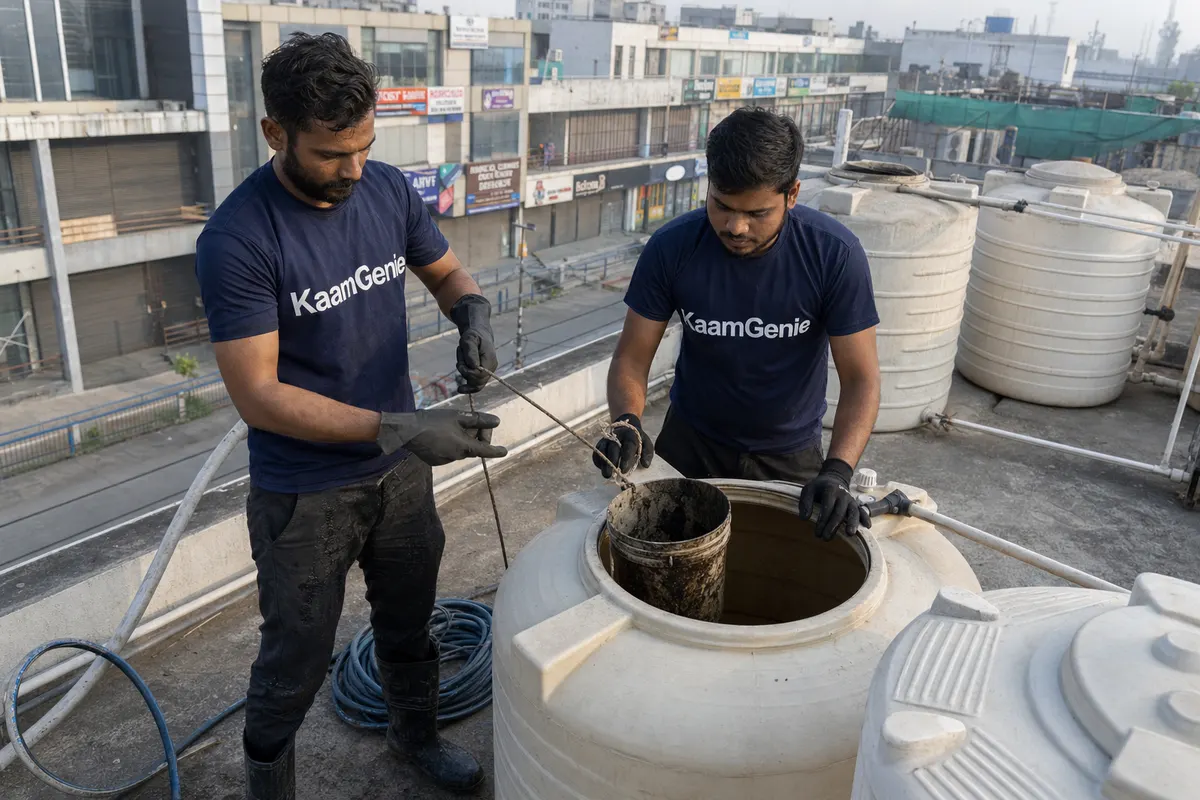
Tell us your opening hours and we try to fit the clean before you open or after you close, with each tank from ₹699, the total fixed before we start, and photos for your water log. No chemicals unless you ask.
Gurgaon has gyms in the basements of sector markets, salons above chemist shops in two-storey market blocks, spas inside converted kothis and fitness studios in the retail podiums of new towers. They have one thing in common: they use far more water per square foot than a shop, and the water touches the customer. This post is for owners and managers of those businesses. If you manage a whole office building or a corporate campus, our guides to commercial tank cleaning and office tank cleaning are written for you instead.
Why water quality is visible to your clients
In most businesses a dirty tank is a hidden risk. In yours it is part of what the client experiences, often within minutes of walking in:
- Gyms: members shower after every session. A musty smell in the changing room, grit in the shower tray or a weak, spluttering shower head is noticed by dozens of people a day, and it is the kind of thing members mention when they decide whether to renew.
- Salons: hair is washed at the basin, rinsed after colour and washed again after treatment. Very hard water can leave hair feeling rough and can affect how colour and treatments behave, which stylists notice before clients do. Our guide to tank water, hair fall and skin problems separates what a tank can and cannot contribute.
- Spas: steam rooms, showers, foot baths and facial steamers all draw on stored water. Clients are relaxed, skin is warm and pores are open. That is exactly when a smell or a cloudy foot bath is most off-putting.
- Laundry: towels and robes washed in sediment-heavy or iron-tinted water slowly turn grey or yellowish, however much detergent you use.
None of this means your water is dangerous, only that your clients will notice first when it is not right. If a client reports skin irritation or a rash they link to the water, take it seriously, suggest they see a dermatologist, and check your tank rather than guessing.
Why these tanks get dirty faster
A home tank may be refilled once or twice a day. A busy gym, salon or spa can empty and refill its tank many times between opening and closing. Every refill pushes water in at speed and lifts the fine silt lying on the tank floor, so the water stays slightly cloudy for longer. Gurgaon then adds three things on top:
- Hard groundwater. Borewell water in much of the city is high in dissolved minerals. It leaves white scale inside the tank, on shower heads and inside steam generators and geysers. We explain why it keeps coming back in hard water and your Gurgaon tank.
- Tanker top-ups. Market buildings in the newer sectors often top up with tankers when supply runs short, and each delivery brings silt. Our guide to tanker water and your tank covers why.
- Warm water in the system. Steam rooms, geysers and hot showers keep parts of your plumbing warm for hours. Warm, slow-moving water and sediment are the conditions in which certain bacteria, including Legionella, can grow, which is why the WHO’s guidance gives building hot water systems specific attention. Tank cleaning is not Legionella control: it removes sediment that can feed the problem, but control happens in the hot-water system, through storage temperature, regular flushing of rarely used outlets and, for steam rooms and spas, a specialist risk assessment.
Where your water problem shows up, and what it points to
Use this table when a client or staff member mentions the water. It separates tank problems from fixture problems so you call the right person.
| What you or clients notice | Where it starts | Next step |
|---|---|---|
| Musty or rotten-egg smell in changing-room showers | Bio-film and sludge in the tank, or a rarely used shower line | Run unused showers daily; if the smell stays, clean the tank. Our smelly tank water guide helps tell the smells apart |
| Grit in shower trays or the hair-wash basin | Sediment lifted off the tank floor by frequent refills | Tank cleaning with full de-sludging |
| White crust on shower heads, steamer nozzles and glass | Hard water scale, also building up inside the tank | Clean the tank first, then descale fittings and the steam generator |
| Towels and robes turning grey or yellowish | Silt or iron in the laundry tank feed | Clean the laundry tank; if the tint persists, test for iron |
| Cloudy foot baths or pedicure tubs | Turbid water from a silted tank | Clean the tank before the next busy day |
| Weak pressure on upper-floor basins only | Sediment at the tank outlet, or a pump problem | Have the outlet checked during a clean; call a plumber for the pump |
If the water is coloured rather than cloudy, our yellow water guide has a quick test to tell rusty pipes from a dirty tank.
Where you trade changes who owns the tank
Before booking anything, find out which tanks are yours. In Gurgaon it depends heavily on the building.
Sector markets and local shopping centres
The older sector markets and the busy two- and three-storey market blocks in the DLF phases usually have a row of tanks on the roof, one or more per shop. Your tank may be shared with the shop below, and the tanks are often unlabelled. Before booking, ask your own plumber to trace the lines and mark which tank feeds your premises, ideally with the building owner present. On older shared market roofs, our crews often find cracked or missing lids and dust and leaves inside, because nobody owns the roof. Salon and gym owners book us in markets such as Sector 29, South City and Sushant Lok.
Commercial complexes and malls
In larger commercial complexes, such as those along MG Road, water usually comes from a central underground reservoir and tanks managed by the building’s maintenance team. You may not be allowed to book a clean yourself. Ask the maintenance office for the date of the last clean and photos, and keep their reply in your records. If your unit has its own booster or storage tank inside the premises, that one is usually your responsibility.
Converted houses and standalone premises
Spas and salons in converted kothis, and gyms in standalone buildings, usually control everything: an underground sump and several rooftop tanks, sometimes with old GI pipes in an older house. That gives you full control, and full responsibility: all tanks and the sump belong in one visit, sump first.
Clubhouses and home studios
A clubhouse gym or spa in a condominium is fed from the common reservoir, often through dedicated clubhouse tanks, so the facility team or its contracted operator arranges cleaning; ask that the steam-room feed is included when the reservoir is done. A home salon or studio in a society flat shares the society’s storage, and only a loft tank, if there is one, is yours to book. For anything that runs mainly on tanker or borewell water, plan the clean before your busy season and test for hardness and iron. For the general picture of how each kind of building is cleaned, see the complete guide to water tank cleaning in Gurgaon.
Scheduling around your opening hours
The worst time to discover the water is off is with a client in the chair. Plan the clean like any other closure:
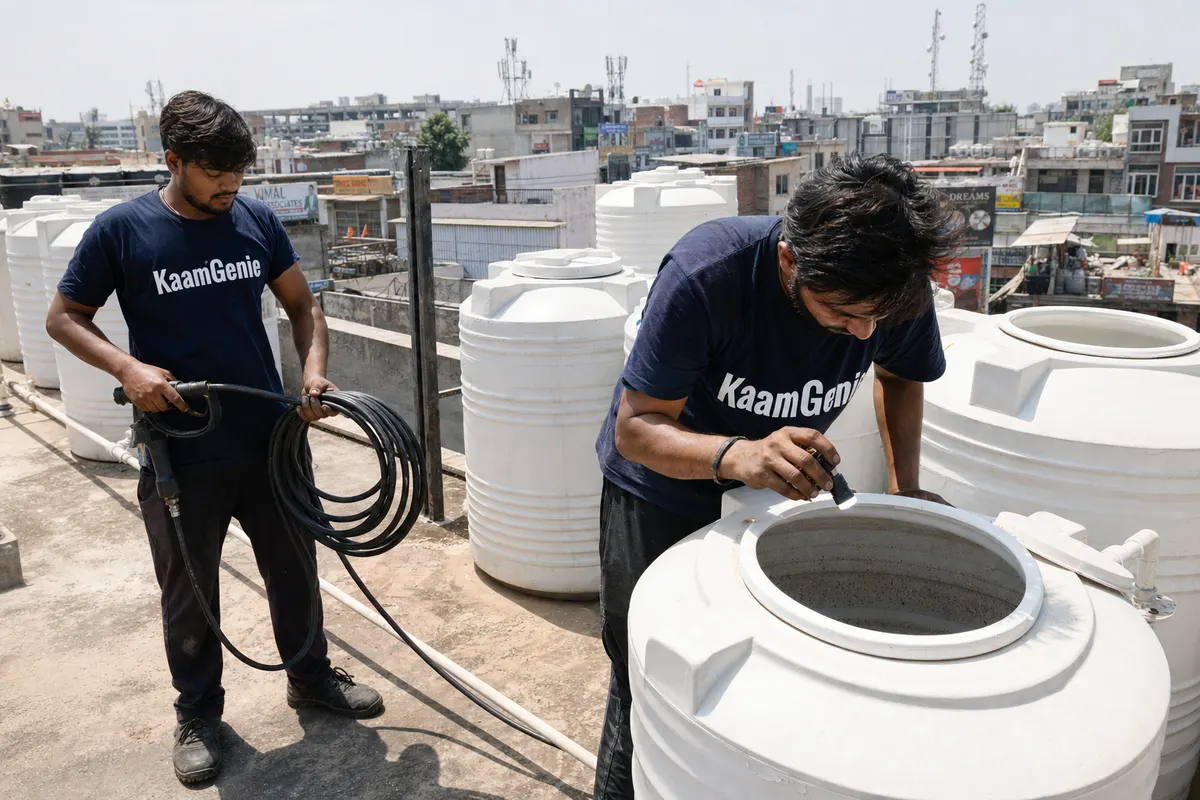
- Salons and spas: most open mid-morning, so a slot before opening, if one is available, lets the crew finish and the tank refill before the first appointment. Budget 60 to 90 minutes of work for one overhead tank before your first client, and add the time your mains, borewell or tanker takes to top it up.
- Gyms: many open very early and are busiest at dawn and in the evening. The early afternoon lull or the hours after closing are usually best.
- One tank at a time: if you have several tanks, we can clean them in sequence so at least part of the premises keeps water, for example the ladies’ changing room stays on while the men’s tank is done.
- Sump first, then overhead tanks: if you control a sump, it is cleaned before the tanks it feeds so clean tanks are not refilled from a dirty sump. Our page on overhead versus underground tanks explains the difference.
- Book the refill: if you depend on tankers, arrange a delivery for after the clean, not before, and give the water about an hour to settle before the first client shower.
For timing across the year, see how often to clean a water tank in Gurgaon.
A 10-minute monthly water walk for managers
Hand this to the manager or the senior staff member who opens up. It needs no tools and no climbing.
- Run every shower and basin for one minute, including the ones that are rarely used. Note any smell.
- Fill a clear glass from the hair-wash basin and a changing-room shower. Compare them against a white towel. Both should be clear.
- Check three shower heads and the steamer nozzle for white crust or grit.
- Look at the newest and the oldest towels side by side. A grey or yellow drift in the newer ones is a laundry water sign.
- Ask the staff one question: “Has any client mentioned the water this month?” Write the answer down.
- Record it in the water log, with the date and initials.
Records worth keeping
A simple water log protects you in two ways: it shows clients and building managers that you look after the water, and it lets you see a problem building before it becomes a complaint. Keep, in one folder or binder at reception:
- A sketch or photo of the roof with each tank marked, by your plumber, with what it feeds.
- The date of every clean and the before and after photos we send on WhatsApp.
- Your monthly water-walk entries.
- Any lab test results, compared against IS 10500:2012. For reference, the acceptable limits are 1 NTU for turbidity, 200 mg/l for total hardness, 0.3 mg/l for iron, and coliform must not be detectable in 100 ml.
- Replies from the building’s maintenance office if they control your tanks.
If you also serve food or drinks, such as a juice bar or a spa café, the kitchen side has its own expectations, covered in our FSSAI guide. Businesses with several branches often move to a yearly plan; see tank cleaning AMC in Gurgaon.
Several tanks, one visit
Send us a photo of your rooftop and your opening hours on WhatsApp. We will count the tanks with you, quote a fixed price for each and plan the order so you are never without water.
How KaamGenie cleans a gym, salon or spa tank
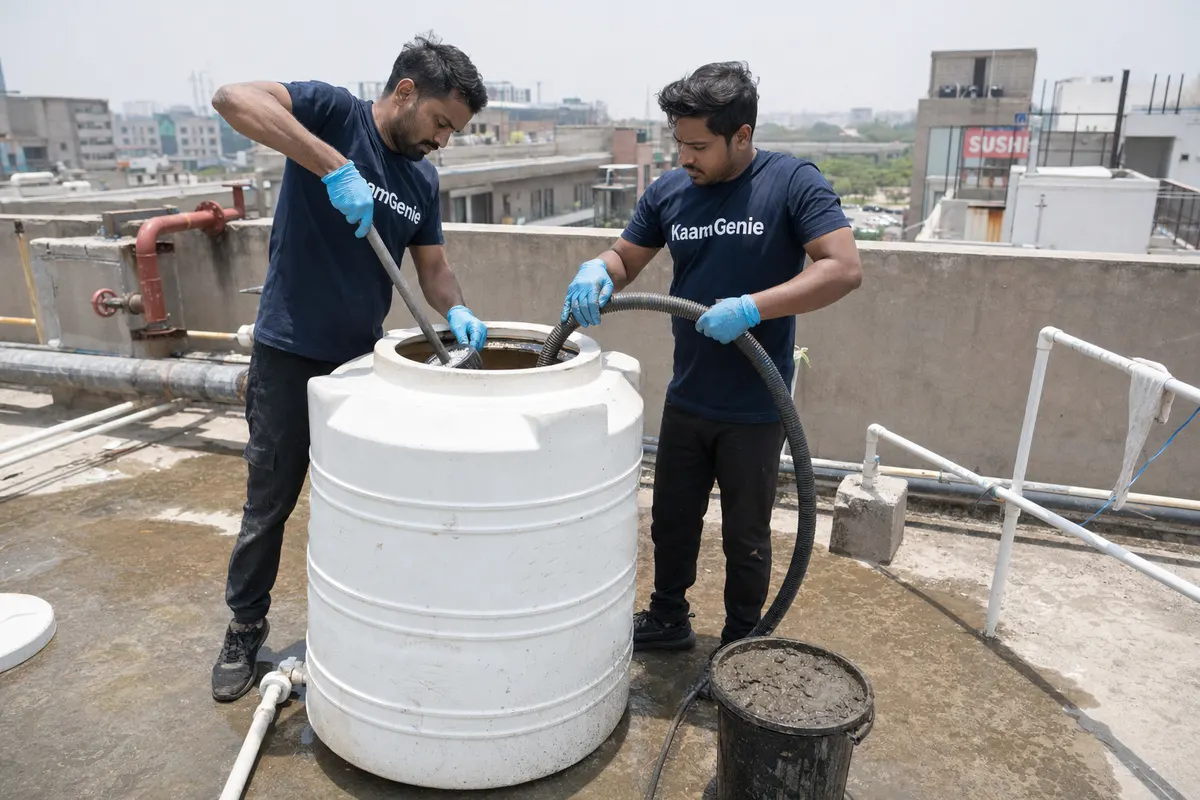
It is our standard clean (inlet shut, drain, de-sludge, scrub, jet wash, wet-vacuum, fresh-water rinse, before/after photos on WhatsApp), and the full sequence is in our cleaning process guide. For a gym, salon or spa, three parts matter most:
- Cleaning every tank you point out. Have your plumber work out beforehand which tank serves the steam room, the laundry and each changing room. Our crew then cleans each of those tanks and photographs it separately for your log.
- Getting the scale and silt out, not just off the walls. Frequent refills keep lifting fine silt, and hard water leaves loose scale. The scrub removes loose scale, and the silt and scale are scooped and vacuumed out of the tank, rather than flushed through your pipes and showers.
- Photographing the weak points. Any cracked lid, open overflow or corroded fitting is photographed with the tank. Your bill for the cleaning stays at the agreed figure; if your premises needs a new lid or mesh, we price that part for you on its own first.
Your clients’ showers stay chemical-free in a standard clean. A gym or spa that has been shut for weeks, or has had a contamination scare, can ask us to add disinfection, and we only do it when you request it. Our disinfection guide explains when it is worth asking for.
What not to do
- Do not let staff pour bleach or other chemicals into the tank. An overdose leaves a smell clients notice on their skin, and it does nothing to the sludge or the scale.
- Do not only descale the shower heads. If the tank is full of scale and silt, the heads clog again within days.
- Do not send a staff member up to the roof to look inside the tank. Market roofs often have no railing, and tank lids are heavy.
- Do not clean during opening hours to save a slot. A dry basin mid-appointment costs more than an early start.
- Do not treat a tank clean as your steam-room safety plan. It keeps sediment out of the system, but hot-water temperatures, outlet flushing and a specialist risk assessment are separate jobs.
Before you call: three things to have ready
A quote goes fastest when you can tell us your opening hours, roughly how many tanks you think you have (a photo of the roof helps), and whether there is an underground sump. For a business premises, every rooftop tank starts at ₹699 and a sump at ₹1,499; you get the per-tank figure before anyone climbs, and pay once the tanks are done and the photos are in your log. Studios and spas along Golf Course Extension are on our routes too; the full list of sectors sits on our Gurgaon tank cleaning page, or ring +91 95603 66362 outside your peak hours.
Frequently asked questions
Can you clean our gym tank without closing the gym?
Usually, yes. Most gyms have a quiet window in the early afternoon or after closing, and one overhead tank needs roughly 60 to 90 minutes of crew time, after which it refills at whatever pace your supply allows. If you have separate tanks for different changing rooms, we can clean them one after another so part of the gym keeps water. The only time a short closure makes sense is when the premises runs from a single tank and you have no quiet window at all, in which case an early start on your quietest day is the easiest answer.
Our salon is in a market and the tanks are not labelled. What do we do?
This is common in Gurgaon sector markets. Ask your plumber to follow the pipes from the roof and open taps in your salon until it is clear which tank is yours, ideally with the building owner or a neighbouring shopkeeper present, and to mark that tank. Note it in your water log with a photo so it is not in doubt next time, and tell us which tank it is when you book. If your tank turns out to be shared with another shop, it is usually simplest to split the cost and clean it together.
Can hard water affect clients’ hair and skin?
Very hard water can leave hair feeling rough and dull and can make some colour and treatments less predictable, which is why stylists often notice it first. Some people also find hard water drying on skin. A tank clean removes the scale and silt that build up in storage, but it does not change the hardness of the water arriving from the borewell or tanker. If a client has a persistent skin or scalp problem, they should see a dermatologist.
Does a steam room need its own tank cleaning?
The steam generator itself is serviced by its supplier or technician, but it draws water from your tank. If that tank holds scale and silt, the generator scales up faster and the steam can carry a stale smell. Cleaning the feeding tank before a generator service gives the technician a clean starting point. Tell us which tank feeds the steam room so we can photograph it separately for your records.
We are in a mall. Can we book the clean ourselves?
Usually not for the main storage. Malls and large commercial complexes run central reservoirs and tanks through their maintenance team, and tenants are rarely allowed onto the roof. Ask the maintenance office for the date of the last clean and photos, and keep the reply in your water log. If your unit has its own booster or storage tank inside the premises, that one you can normally have cleaned yourself.
What records should a salon or spa keep about its water?
Keep a roof sketch with each tank marked, the date of each clean with its before and after photos, monthly notes from a quick water walk, and any lab test results. That small folder lets you answer a client’s question with facts, helps you notice a problem early, and gives a new manager everything they need to keep it going.
Is disinfection part of the clean, or only on request?
Only on request. A standard clean is chemical-free: the tank is drained, de-sludged, scrubbed, jet washed, wet-vacuumed and rinsed with fresh water. If your spa is reopening after a long closure or has had a contamination scare, you can ask for disinfection on top of the clean. We explain the options before doing anything, and never add it without asking you first.
How much does it cost to clean tanks for a gym or salon?
For a gym or salon, each overhead tank is from ₹699 and a sump from ₹1,499. With several tanks, you see the price for each one and the total before the crew climbs the roof, and that total does not change on the day. Every tank gets its own before and after photos on WhatsApp, and payment is due only after you have seen them.
Sources & references
- Bureau of Indian Standards (BIS): IS 10500:2012, the Indian Standard for drinking water, including hardness, turbidity and iron limits.
- WHO Guidelines for Drinking-water Quality, 4th edition: includes guidance on water in buildings and hot water systems.
- Central Ground Water Board (CGWB): groundwater quality reports for Haryana, including hardness in Gurugram district.
- Gurugram Metropolitan Development Authority (GMDA): the agency responsible for bulk water supply in Gurugram.
Last verified: 22 November 2026. If you find any of these links broken, please let us know.