
Quick answer: the water check before you take possession
- Find out which tank serves the flat. Ask the seller to show you; you or your plumber confirm it. Note any shared sump.
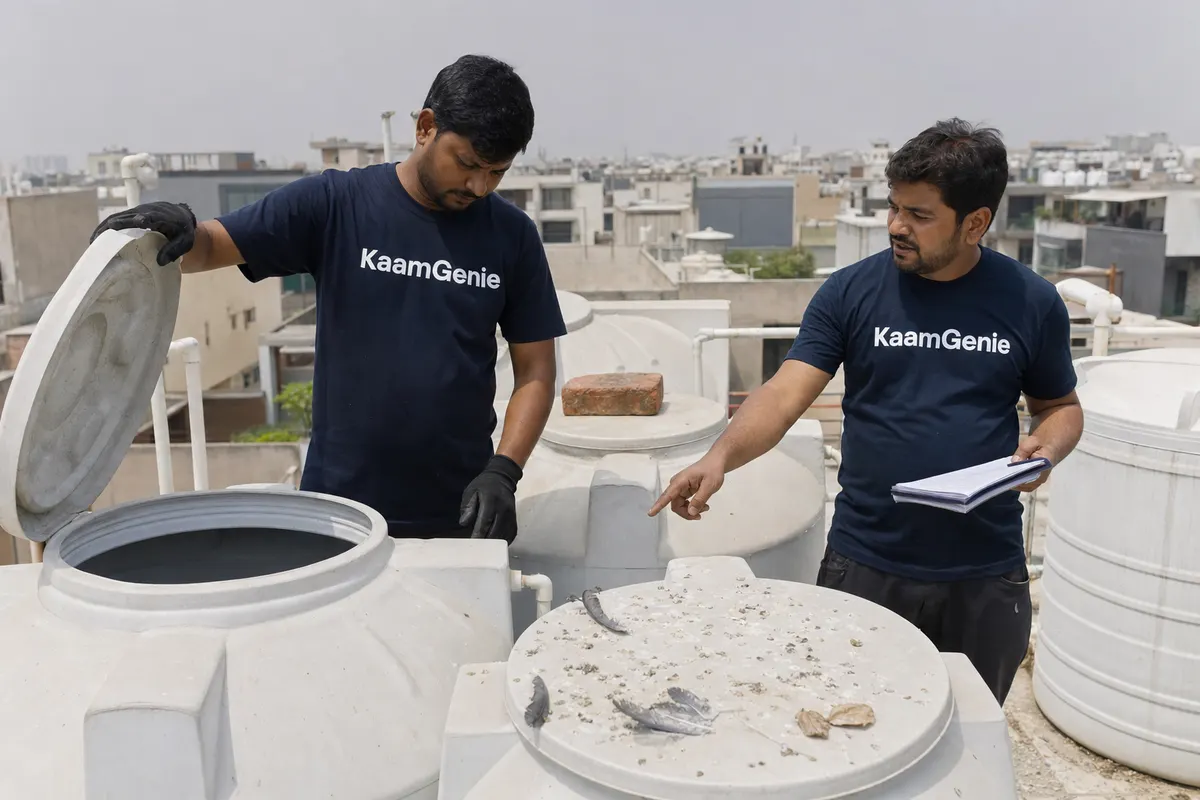
- Look at the lid. It should fit and be clamped, strapped or locked, not held down with a brick.
- Check the tank top and terrace for bird droppings, feathers, leaves and loose debris.
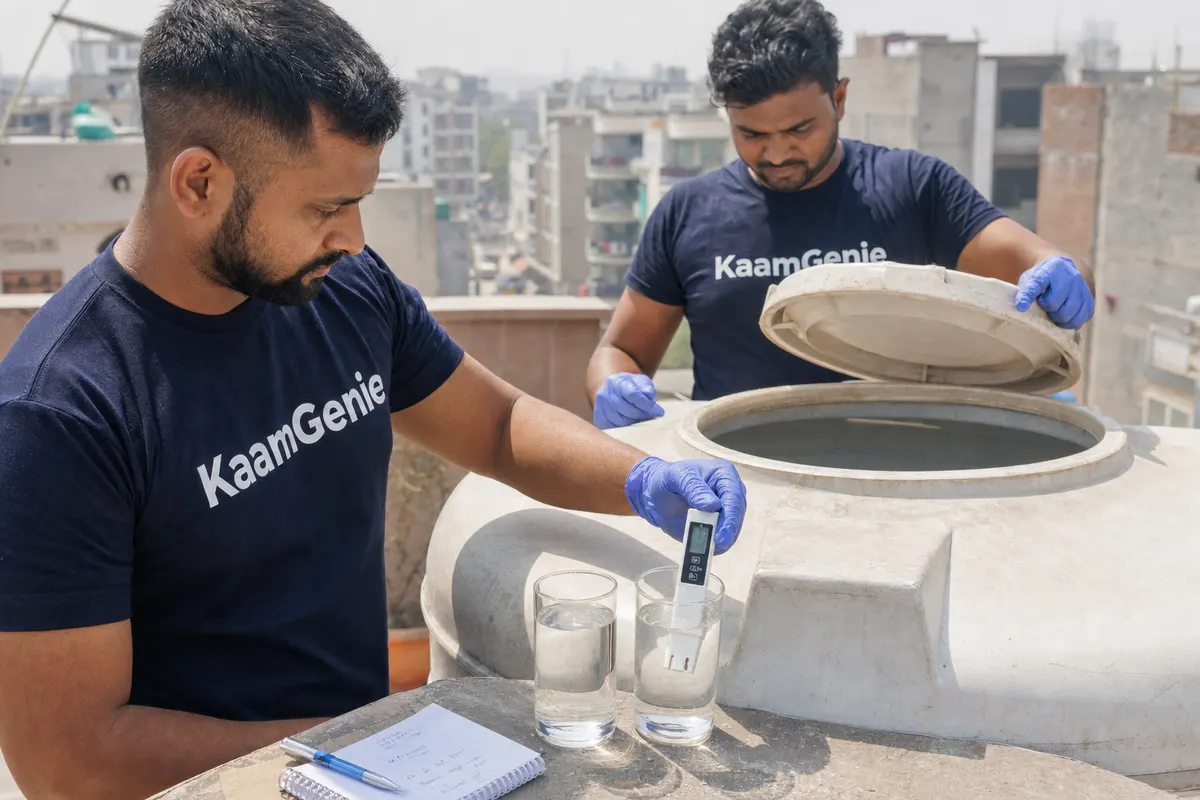
- Run the taps in the kitchen and a bathroom and look at, and smell, a glass of each.
- Take two TDS readings: one at a tank-fed tap and one from the direct supply line, if the flat has one.
- Ask the seller, and the RWA or facility office, when the sump and tanks were last cleaned, and for any photos or invoice.
- Get a clean done before you move in, once the keys are yours, or ask for it as part of the handover.
Builder floor: the tanks serving your floor are usually your responsibility from day one. Condominium: the common tanks belong to the society, so your job is to ask the right questions.
Just signed for a resale flat? Book the first clean
Overhead tank ₹699, underground sump ₹1,499, price fixed before we start. You see your own tank in before and after photos and pay once the job is done.
A new flat and a resale flat raise different water questions. In a brand-new tower the tanks hold construction dust and have never been used; our first clean after possession guide covers that case. A general move-in, including rentals, is covered in water tank cleaning before moving in. A resale is its own situation: the tank has been in daily use for years, maintained to someone else’s standard, and the flat may have stood empty while it was on the market. The time to ask about it is before the final payment, not after. Once you have the keys, our crews handle water tank cleaning across Gurgaon.
When to do the check
Three moments in a resale deal give you a natural chance to look at the water.
- The first serious visit. Run the taps, smell the water and ask the seller where the tanks are. Nobody minds a buyer asking.
- A second visit before you commit. Take your own plumber if you can, and a borrowed TDS meter. This is when you go up to the terrace or the sump.
- Handover day. Confirm that anything agreed, such as a clean or a new lid, has actually happened, and note the tank’s condition before your things go in.
Nothing in this post is legal advice. If you want a water-related point written into your agreement, ask your property lawyer how to word it.
The pre-possession water checklist, step by step
1. Which tank serves this flat
This sounds obvious and often is not. A builder floor terrace can carry four tanks of the same size, with old floor numbers painted over or missing. A society flat may draw from a tower tank shared by dozens of homes. Ask the seller to point out the tank and the sump that serve the flat, then have it confirmed. Your plumber can do this by closing the outlet valve of one tank and checking which flat’s taps go dry. KaamGenie does not trace or label tanks, so settle this question before you book any cleaning.
While you are up there, note whether your tank fills from a sump shared with other floors, and whether the building also uses tanker or borewell water. Both affect how quickly silt builds up.
2. The lid
The lid is the tank’s only defence against dust, birds, lizards and rainwater runoff. It should sit flush, have no cracks, and be clamped, strapped or locked. A loose lid with a brick on top, a lid that has blown off and been propped back, or a sheet of plywood in place of a lid all mean the water has been exposed. A replacement lid is a small cost, and it is reasonable to ask the seller to fit one.
3. Droppings, feathers and debris
Pigeons roost on many Gurgaon terraces, and the tank top is a favourite perch. Look for droppings and feathers on and around the lid, dry leaves, plastic bags, and a layer of dust that has turned to mud near the overflow pipe. Check that the overflow and vent openings have a mesh. Our crews often find debris inside tanks whose lids looked fine from a distance, because a small gap at the rim is enough. If you see wriggling larvae when the lid is opened, read our post on worms and larvae in Gurgaon tanks.
4. The water at the tap
Fill a clear glass from the kitchen tap and one from a bathroom tap, and look at them against a white wall. Note the colour, any floating specks, and the smell when you swirl the glass. A tint of yellow or brown has a set of possible causes that we unpick in yellow or brown water from your tank. A musty or rotten-egg smell is covered in why tank water smells. If the flat has been locked for weeks, let the taps run for a few minutes first; the first water out of stagnant pipes is not a fair sample, but it is worth noting how bad it is.
5. Two TDS readings
A pocket TDS meter costs little and gives you a quick comparison. Take one reading at a tank-fed tap and another from a tap on the direct supply line, if the flat has one (in many builder floors it is the kitchen tap on the ground floor or an outside tap). A large gap between the two is a prompt to look harder at the tank and the source. What the numbers mean against the drinking-water standard is explained in TDS levels in Gurgaon tank water, so we will not repeat it here. A TDS meter does not detect bacteria; for that you need a lab test from an NABL-accredited laboratory.
6. When were the sump and tanks last cleaned?
Ask the seller directly, and ask for anything that backs up the answer: a dated invoice, WhatsApp photos from a cleaning company, or a maintenance-office record. In a society, ask the facility office for the cleaning schedule of the underground reservoir and the tower tanks. “Recently” with no date, or “the society does it” with no record, should be treated as unknown.
7. Fittings you can see
Look at the inlet pipe, the float valve and the outlet. Orange crust or flaking on metal parts suggests rust is getting into the water; our rust in tank water post explains which parts to worry about. Any drip, crack or damp patch around the tank or sump is a job for a plumber or mason, so flag it to the seller before you agree on a price.
8. Plan the clean
Even if everything looks acceptable, a tank with an unknown history is worth cleaning before your family drinks from it, either by you after possession or by the seller before handover.
What you find, and what to ask the seller for
| What you find | What it suggests | Reasonable request |
|---|---|---|
| Nobody is sure which tank is the flat’s | Tanks have changed hands or been swapped over the years | Seller and your plumber confirm it on site before handover |
| Missing, cracked or brick-weighted lid | Dust, birds and insects have had access | A proper lid fitted, and the tank cleaned |
| Droppings or feathers on the tank top | Birds roost there; contamination risk if the lid is not tight | Lid and mesh checked; clean before you move in |
| Coloured, cloudy or smelly tap water | Sludge in the tank, rusty fittings or a source problem | Clean before handover, or a price that reflects the work |
| Tank-tap TDS well above the direct supply | Scale and sediment in the tank, or a borewell or tanker mix | Ask about the water sources the building uses |
| No record of the last clean | History unknown | Treat as overdue; plan a clean before moving in |
| Leak or damp around the tank or sump | A structural or plumbing issue, not a cleaning one | A plumber’s or mason’s inspection before you commit |
Builder floor or condominium: two very different handovers
The building type changes who owns the tank, who can get it cleaned, and what you can realistically check.
| Point | Independent builder floor | Condominium or society |
|---|---|---|
| Who owns the tank | Usually the floor owner, for the tank on the terrace marked for that floor | The society or AOA, for the reservoir and tower tanks |
| Access | Terrace access may sit with the top-floor owner; agree how you will reach your tank | Through the facility office only; residents rarely go up |
| Shared parts | Often a sump shared by all floors | Everything upstream of your flat’s pipes |
| Who books the clean | You, from the day you take possession | The facility team, on the society’s schedule |
| Records to ask for | The seller’s invoice or photos, if any | The maintenance office’s cleaning schedule and last dates |
| What you can do before move-in | Get your own tank cleaned, and raise the shared sump with the other owners | Ask when the next society clean is due, and clean any tank that serves only your flat |
On a builder floor, the seller hands you a tank that is now yours to look after. Roof rights are often held by the top-floor owner, so if your tank is on that roof, it helps to know in advance how you will reach it for cleaning. Our builder floor tank cleaning guide explains the usual tank and sump layout.
In a condominium, you inherit the society’s maintenance standard, not the seller’s. You cannot book a clean of the common reservoir yourself, but you can ask the facility office for dates, and look at whether residents complain about water in the society group. Our condominium tank cleaning guide describes how large complexes usually handle it.
A plotted house or kothi is simpler: the sump and every overhead tank come to you with the property, so check them all and plan to clean them together.
Questions to put to the seller and the RWA
- Which tank and which sump serve this flat, and are any of them shared?
- When were they last cleaned, and by whom? Is there an invoice or photos?
- Does the building use only GMDA supply, or also a borewell or tankers?
- How long has the flat been empty, and has anyone run the taps in that time?
- Have there been water complaints from other floors or flats?
- Are there any known leaks, damp patches or repairs pending near the tank?
- In a society: when is the next scheduled clean of the reservoir and tower tanks?
What a move-in clean can and cannot do
A proper clean takes out the sludge on the floor, the bio-film on the walls and whatever has blown or fallen in, and the photos show you exactly what was there. It does not change the source water, so a high TDS from the borewell stays high. It does not fix corroded pipes inside the walls, a leaking float valve or a cracked sump; those go to your plumber or mason. And for a society flat, cleaning a tank that serves only you will not help if the common reservoir upstream is the problem.
Move in to a tank you have actually seen
Book the clean for the days between possession and moving day. The photos give you a clear record of the tank you inherited.
How KaamGenie handles a resale-flat clean
The best window is the gap between possession and moving day, when the flat is empty and nobody needs water for a few hours. For an inherited tank, three parts of our work matter most; the full sequence is in our cleaning process guide.
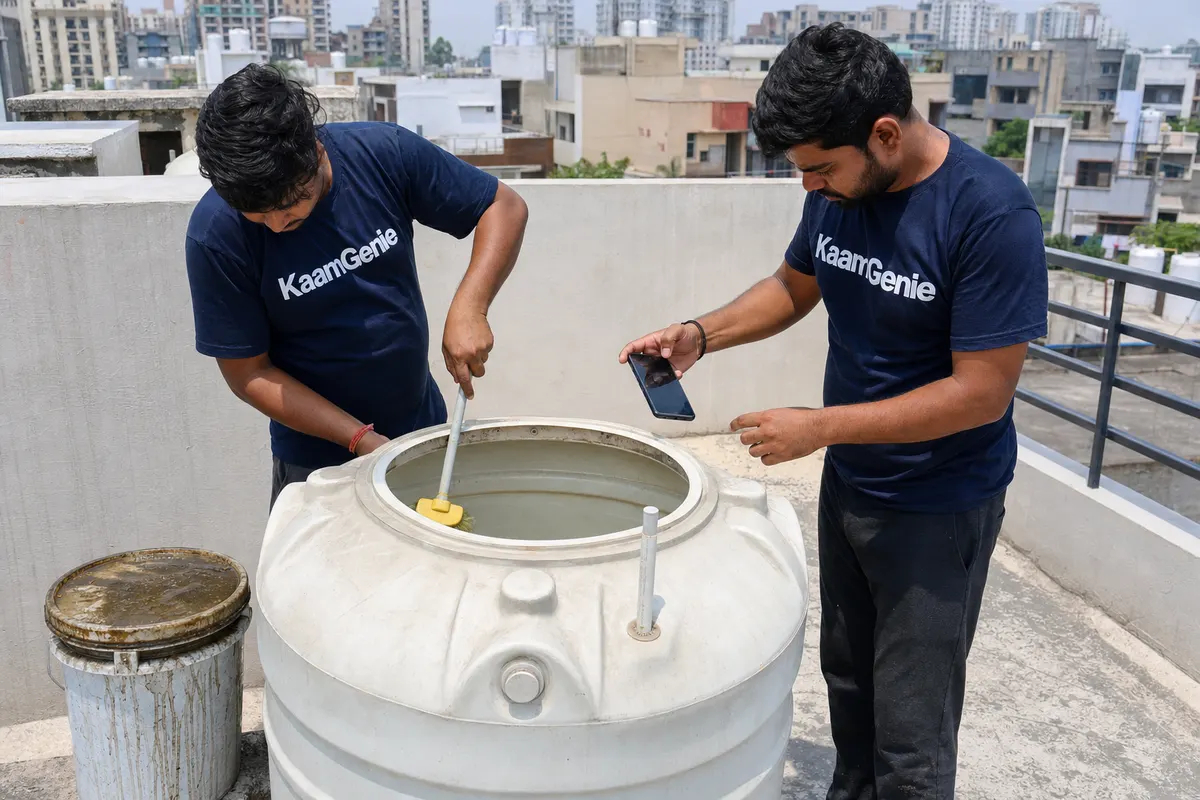
- A full drain-down. With the inlet shut, the tank is emptied so you can see the floor for the first time. Water that has stood in a vacant flat’s tank for months is pumped away, not run through your new home’s pipes.
- De-sludging and scrubbing. Years of settled silt are scooped and vacuumed out, and the walls are scrubbed to take off bio-film and loose scale.
- Photos as a record. Before and after photos come to you on WhatsApp, which gives you a dated record of the tank’s condition at the start of your ownership. A cleaning certificate is also available on request.
A standard clean uses no chemicals. If the tank has stood unused for a long time, or you saw droppings inside, you can ask for disinfection as an extra. One overhead tank usually takes the crew about 60 to 90 minutes of work, and refilling depends on your supply. Sunday and weekend slots are available, which suits buyers who finalise on weekdays and shift at the weekend. You pay after the job, once you have seen the before and after photos.
What not to do
- Do not assume the tank was cleaned because the flat was freshly painted. Renovation and tank care are separate jobs, and paint dust often ends up in the tank.
- Do not book a clean before you know which tank is yours. Confirm it with the seller and your plumber first.
- Do not pour bleach or other chemicals into an unknown tank yourself. It hides smells without removing sludge, and the dose is easy to get wrong.
- Do not lean into a sump or climb into a tank to look. Inspect from above at arm’s length with a torch.
- Do not rely on the water purifier the seller left behind. Its filters have an unknown age, and silt from a dirty tank clogs them quickly; see tank cleaning vs a purifier.
- Do not treat a low TDS reading as a clean bill of health. It says nothing about bacteria.
Book the clean for the week before you shift
Once the flat is yours, a clean before the furniture arrives is the simplest way to start on known water. The price is fixed up front: ₹699 for an overhead tank and ₹1,499 for an underground sump, while society reservoirs are quoted by size. We work across Gurgaon, including Sushant Lok, DLF Phase 2, Sector 56 and Sohna Road. After that first clean, we recommend repeating it every 3 months; how often to clean your tank in Gurgaon explains why. Book on our Gurgaon tank cleaning page or call +91 95603 66362. The complete Gurgaon tank cleaning guide covers everything else.
Frequently asked questions
Should the seller get the tanks cleaned before handover?
It is a fair request, especially if there is no record of a recent clean, the lid is damaged or the tap water looks or smells off. Some sellers agree, others prefer to adjust the price and leave it to you. Many buyers simply book the clean themselves in the days after possession, because then they choose the company, see the photos and know exactly what was done. Whatever you agree, write it down.
How do I find out which tank serves the flat I am buying?
Ask the seller to show you the tank and any sump that feed the flat, then confirm it with your own plumber. A common method is to close the outlet valve of one tank and check which taps stop running. On builder floor terraces the old floor markings are often faded or missing, so do not rely on paint. KaamGenie does not trace or label tanks, so have this settled before you book a cleaning.
Is a TDS meter reading enough to judge the water?
No. A TDS meter tells you roughly how much dissolved mineral matter is in the water, which is useful for comparing a tank-fed tap with the direct supply. It cannot detect bacteria, silt that has settled at the bottom of the tank, or most contaminants. Use it as a quick comparison on your visit, and if you want to know whether the water is safe to drink, get a sample tested at an NABL-accredited laboratory.
The flat has been empty for months. Is the tank water safe?
Treat it as unsafe to drink until the tank has been cleaned. Water that stands still for months in a tank loses freshness, and anything that got in through a gap in the lid has had time to break down. Run the taps to waste for a few minutes before using any water for washing, and plan a full drain and clean before you move in. Disinfection can be added on request for a tank in this state.
In a condominium, can I get the common tanks cleaned myself?
Usually not. The underground reservoir and tower tanks belong to the society, and the facility team or AOA arranges their cleaning. What you can do is ask the maintenance office for the dates of the last clean and the next one due, and raise it through the residents’ channels if the water is poor. If your flat has a tank that serves only you, that one you can book yourself.
What does a move-in clean cost, and when do I pay?
An overhead tank is ₹699 and an underground sump ₹1,499, fixed before the crew starts; large society reservoirs are quoted by size. There are no surprise extras for the cleaning itself, though parts such as a new lid or mesh are quoted separately. Payment comes after the cleaning is finished, once you have seen the before and after photos of your tank.
Can I get a record of the cleaning for my property file?
Yes. You receive before and after photos of your own tank on WhatsApp, which many new owners keep with their purchase papers as a record of the tank’s condition when they took over. If you need something more formal, a cleaning certificate is available on request. Keeping these records also makes life easier when you sell or rent the flat later, because the next buyer or tenant will ask the same questions you did.
Sources & references
- Bureau of Indian Standards (BIS): IS 10500:2012, the Indian Standard for drinking water, including limits for TDS and coliform bacteria.
- Gurugram Metropolitan Development Authority (GMDA): the agency responsible for bulk water supply in Gurugram.
- National Accreditation Board for Testing and Calibration Laboratories (NABL): where to find accredited laboratories for drinking-water testing.
- WHO Guidelines for Drinking-water Quality, 4th edition: guidance on safe storage of drinking water and contamination risks.
Last verified: 23 November 2026. If you find any of these links broken, please let us know.